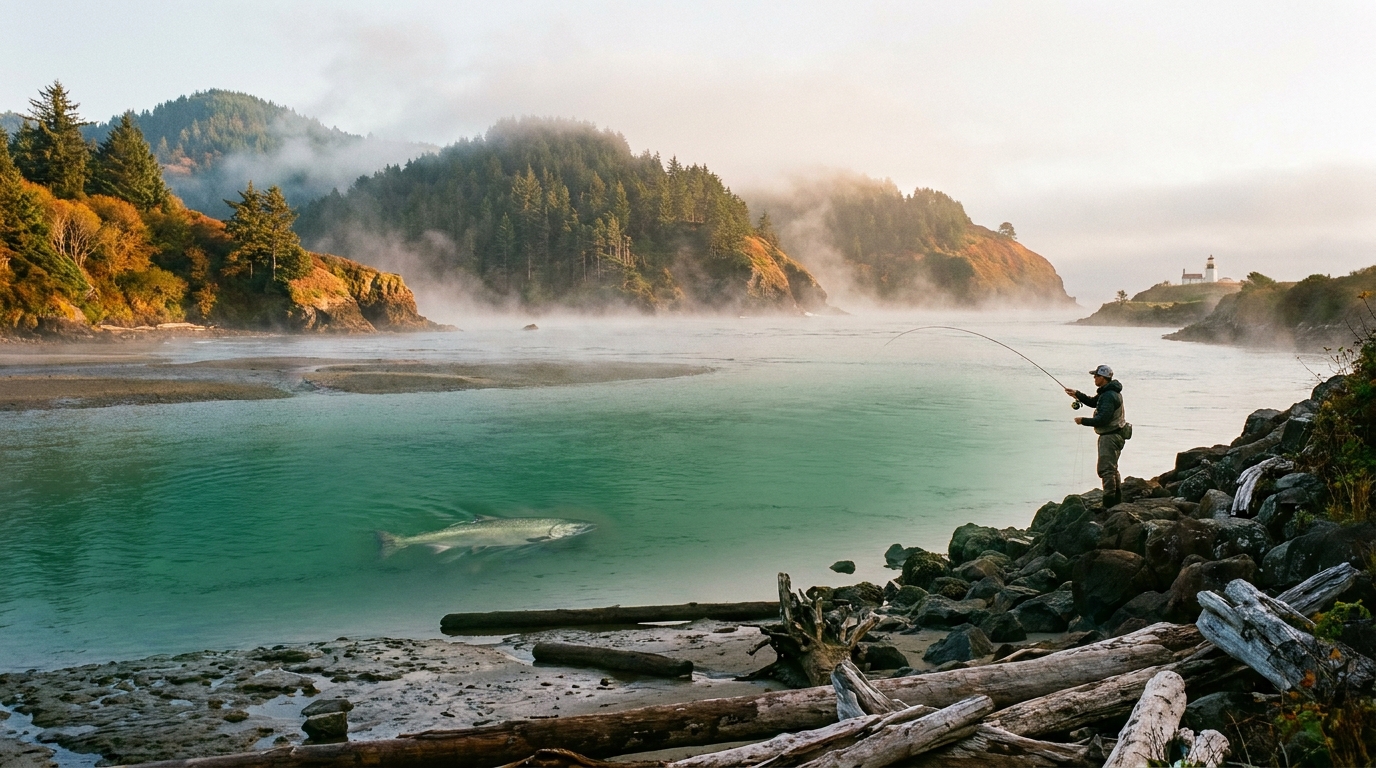
When the calendar flips to late August and the first coastal rains start creeping south, salmon fishermen across the Pacific Northwest know what it means: Coos Bay fall chinook are staging. Oregon's largest coastal bay offers a unique blend of estuary bank access and impressive salmon returns that most outside anglers still haven't discovered — and that's just fine with the locals.
Understanding Coos Bay's Fall Salmon Runs
Coos Bay receives two distinct fall salmon runs. The chinook — locally called kings — typically begin entering the bay in late August, peaking through mid-September. These fish are fresh, bright, and aggressive, often running 20 to 40 pounds. The coho run follows close behind, arriving in earnest from late September through October. Both species can be targeted simultaneously from the bank during peak overlap weeks.
The South Fork Coos River, Millicoma River, and the main Coos River tributaries all see significant returns. The Oregon Department of Fish and Wildlife (ODFW) monitors these runs closely and posts real-time updates at their Coos Bay field office — check their site weekly as the season approaches, since in-season adjustments to retention rules happen fast.
Best Bank Access Points
- Catching Slough Road: One of the most productive reaches for bank fishing. The slough's channel concentrates staging chinook at incoming tides. Fish the inside edge of the channel during the first two hours of incoming tide.
- Allegany Bridge on the South Fork Coos: A favorite local spot, especially as October coho push upriver. The gravel bars here allow good casts into the main seam.
- Glasgow Bridge to Catching Slough confluence: This stretch of the main Coos River is walkable at low water and holds fish through mid-October. The deep outside bends hold resting chinook.
- North Bend boat ramp area: Don't discount the upper bay near the docks. During high tide, salmon stack up waiting to push with the next flood, and bank casters with the right presentation can intercept them.
Tides Are Everything
In an estuary fishery, tide timing is more important than any lure or bait. Salmon move on incoming tides — period. The two hours either side of high tide are your prime windows. Study the Newport tide tables (they apply well to Coos Bay with minor corrections) and build your fishing schedule around them. Early morning high tides in September and October are gold. A high tide at 7 AM with low light and cool water? That's an alarm-clock day.
Proven Bank Techniques
Back-Bouncing Bait
The most effective bank technique for Coos Bay chinook is back-bouncing cured eggs or sand shrimp along the river bottom. Use a 3/4- to 1.5-ounce pencil lead sinker on a slider above an 18-inch leader to a size 4 or 2 hook. Cast upstream at roughly a 45-degree angle and let the current bounce your bait downstream ahead of you. Keep line contact but let it move naturally — you're trying to simulate drifting prey.
Spinners and Spoons
For coho especially, aggressive presentation pays off. Blue Fox #5 and #6 spinners in chartreuse/silver or orange/gold have a long track record on Coos Bay coho. Fish them on a downstream swing across the current seam. Coho will slam a spinner broadside when they're aggressive; it's a violent strike you won't miss.
Plug-Cut Herring
When chinook are deep and reluctant, a plug-cut herring fished on a three-way swivel rig — with enough weight to hold bottom — is often the trigger. Cut the head at a 20-degree angle to create erratic spinning action. Brine your herring in rock salt and Pro-Cure Super Gel overnight for maximum scent dispersion.
Gear Setup
For bank fishing Coos Bay, a 9- to 10-foot medium-heavy rod paired with a quality level-wind baitcaster or large spinning reel is the standard. Spool with 30-pound braid mainline and a 20-pound fluorocarbon leader. The water in the Coos can be murky with tannins; go heavy enough on leader to handle snags and gill-plate cuts from big fish.
Regulations — Read Before You Go
Oregon's coastal salmon regulations can change in-season based on run strength. The Coos, Coquille, and nearby coastal rivers all operate under their own retention rules. Check the ODFW regulation updates at myodfw.com or call the Coos Bay field office before each trip. Barbless hook requirements may apply, and the coho retention window can shift. Don't get caught without checking.
What to Bring
- Valid Oregon fishing license and combined angling tag
- Tide table printed or bookmarked on your phone
- Cured eggs (home-cured in BorX O' Fire is hard to beat) and sand shrimp
- Waders — even bank anglers benefit from getting a foot into the river
- Cooler with ice — don't let a fresh bright salmon sit in the sun
- Landing net with a long handle — you'll need it on steep banks
The Bottom Line
Coos Bay's fall salmon fishery is one of those sleeper runs that delivers big numbers without the crowds of the Columbia or Willamette. Get your bait in the water during the incoming tide, work the channel edges, and be there in early September when the first fresh chinook push through. There's nothing like hauling a 30-pound bright chinook onto the bank from a public access point — and in Coos Bay, it happens more than you'd think.