Oregon's general early rifle deer season opens in late October, and for hunters in the Willamette Valley and Portland metro area, the Cascade foothills represent some of the most accessible and productive blacktail habitat in the state. From the Bull Run watershed east of Sandy to the Santiam corridor south of Salem, blacktail deer thrive in the mixed timber, clear-cut edges, and brush-choked drainages that define western Oregon hunting country.
Understanding October Blacktail Behavior
In late October, blacktail bucks are just beginning to shift out of their summer patterns. Velvet has been shed for weeks, and testosterone is building toward the November rut. Bucks that spent summer in high-elevation basins are beginning to move downslope, following does as they transition to lower-elevation winter range. This migration creates prime ambush opportunities at elevation transition zones—particularly at 2,000–4,000 feet in the western Cascades.
Unlike the whitetail rut that defines hunting in eastern Oregon, blacktail pre-rut in October is subtle. Bucks are not yet chasing does recklessly, but they are beginning to rub, scrape, and cruise their home range more frequently. Morning and evening movement windows tighten around dawn and dusk, with midday activity nearly nonexistent except during cold, rainy fronts—which October delivers in abundance.
Best Units for Western Cascade Blacktail
Alsea Unit
Stretching from the central Coast Range east toward Corvallis, the Alsea Unit holds strong blacktail populations on a mix of private and public timber land. The Siuslaw National Forest parcels around Lobster Valley and the Alsea River drainage offer walk-in access. Scout saddles and benches above 1,500 feet for fresh rubs and tracks before the opener.
Santiam Unit
The Santiam Unit covers a massive swath of western Cascade foothills from the North Santiam River south through the Calapooia drainage. Detroit Lake-area clearcuts and the Opal Creek Wilderness corridor provide excellent mixed-age forest structure. Drive the Quartzville Road corridor and glass clearcut edges at first light—mature bucks use these openings to feed in the final minutes of darkness.
Tillamook State Forest
Though technically within the Saddle Mountain Unit, Tillamook State Forest provides over 364,000 acres of walk-in hunting with an extensive road system. The forest's dense brush and second-growth timber is classic blacktail country. Target fresh clearcuts three to eight years post-harvest for maximum browse concentration and deer density. The regenerating alder and vine maple in these young cuts is prime October blacktail forage.
Rifle Selection for Blacktail Country
Blacktail hunting is close-cover work. Shots inside 150 yards are the norm, and a light, fast-handling rifle beats a dedicated long-range rig every time in the timber. Top choices for the Cascades include:
- .30-30 Winchester: The classic timber rifle. Inside 150 yards, nothing puts blacktails down faster, and lever-actions handle brush without complaint. A 170-grain flat-nose at 2,200 fps has killed more western Oregon deer than any other load.
- .308 Winchester: Versatile enough for any shot angle and light enough to pack all day. Federal Trophy Bonded or Hornady ELD-X in 165-grain covers every western Oregon blacktail scenario out to 300 yards.
- .243 Winchester: For younger hunters or those recoil-sensitive, the .243 with a 100-grain bonded bullet is plenty of cartridge for deer inside 200 yards. Low recoil means faster follow-up shots in thick cover.
- 7mm-08 Remington: The sweet spot for Pacific Northwest deer. Light recoil, flat trajectory, and enough sectional density to punch through shoulder bone. Hard to beat for all-day pack-in hunts where the rifle gets heavy by noon.
Tactics That Work in October Timber
Still-Hunting on Rain Days
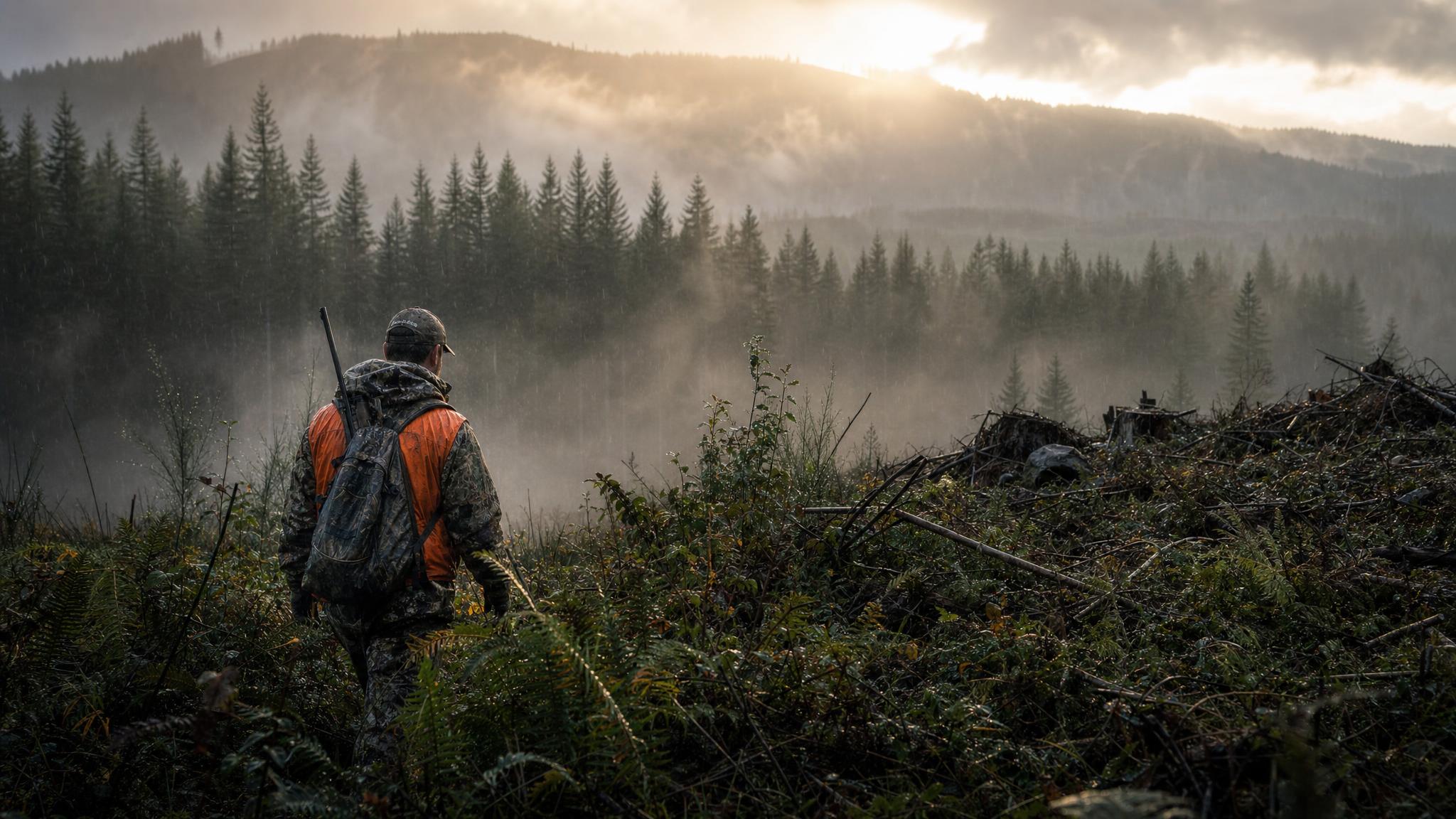
October in the western Cascades means rain—a lot of it. Rather than sitting cold and wet in a ground blind, use heavy rain to your advantage. Wet duff muffles your steps completely, and deer bedded under heavy timber canopy tend to hold tight in the downpour. Move slowly through old-growth corridors and second-growth stands, pausing every 10 steps to glass the timber ahead. More blacktails are killed still-hunting in the rain than any other method in this country.
Glassing Clearcuts at First Light
Find a high point overlooking a clearcut complex and be in position before legal shooting light. Blacktails feeding in open cuttings at dawn are vulnerable before rising thermals complicate scent control. Use a tripod-mounted binocular or spotting scope—even 8x42 glass is adequate for judging bucks at 200–400 yards across clearcut openings. Look for the dark swinging head of a feeding deer silhouetted against the lightening sky.
Logging Road Corridor Ambush
Old logging roads function as natural travel corridors for blacktails. Find a road crossing with fresh tracks and droppings, especially where a skid road descends through a saddle connecting two drainages. Set up downwind of the crossing with good sight lines in both directions along the road. Bucks cruise these corridors searching for does from first light until about 9 AM—then again in the final hour before dark.
Tag and Regulations Reminder
Oregon's general rifle deer season typically runs from the last Saturday of October through mid-November in the western Cascades, though exact dates vary by unit and are subject to annual ODFW adjustment. Check the current ODFW Big Game Regulations summary for exact season dates, legal shooting hours, and any unit-specific antler restrictions before you head out. A valid Oregon hunting license and deer tag are required. Hunters aged 17 and younger must possess a completed Oregon Hunter Education certificate.
October blacktail hunting in the Cascades is wet, demanding, and deeply satisfying. These deer are not easy—they live in thick country and have thrived for generations under sustained hunting pressure. But with the right tactics, a suitable rifle, and the willingness to get out in the Oregon rain, a fat Cascade forked-horn or heavy-horned three-point buck is absolutely within reach. Get your boots muddy and your scope caps closed.