The 6mm Creedmoor emerged from the precision rifle competition (PRS) world and earned a permanent spot in hunting rigs across the West. It pushes high-BC 6mm bullets — the 103 gr Berger Hybrid, 108 gr Berger Elite Hunter, and 105 gr Hornady A-MAX among them — at velocities that make 800-yard hits routine and 1,000-yard work achievable. For Western hunters running it on deer, pronghorn, and even elk at reasonable distances, it's one of the most capable cartridges available. Here's how to reload it properly.
Understanding the 6mm Creedmoor Case
The 6mm Creedmoor is a necked-down 6.5 Creedmoor, sharing the same Hornady-designed case geometry. It runs on a 30-degree shoulder and has generous case capacity for a 6mm cartridge. Factory brass from Hornady is excellent — consistent wall thickness and good neck tension out of the box. Lapua also makes 6mm Creedmoor brass, and it's arguably the best available for serious handloaders who want consistent primer pockets and long case life.
Because the parent case is 6.5 Creedmoor, you can also reform 6.5CM brass to 6mm Creedmoor on a sizing die — a useful trick if you have a stockpile of good 6.5 brass.
Brass Prep
After firing and before sizing, inspect your brass. Look for:
- Case head separation or bright rings near the web (signs of over-pressure or excessive headspace)
- Primer pocket uniformity — anneal after 3–4 firings to restore neck tension and extend case life
- Neck runout — use a comparator and sort by headspace to tighten groups
Trim to 1.920" (SAAMI max is 1.925"). A consistent trim length matters more for this cartridge than most — neck tension uniformity directly affects ES (extreme spread) in velocity, which is your enemy at long range.
Powder Selection
The 6mm Creedmoor runs best with medium-slow powders that fill the case well and meter consistently. Top performers:
- Hodgdon H4350: The gold standard. Temperature-stable, consistent, and it works across a wide range of 6mm bullets. For 105–108 gr bullets, expect charges in the 38–40 gr range hitting 2,900–3,000 fps from a 24" barrel.
- Shooters World Magnum Rifle (formerly N160 equivalent): Excellent alternative to H4350 with similar burn rate and strong velocity numbers. Good availability during powder shortages.
- Hodgdon Varget: Works well with lighter 87–95 gr bullets for varmint or competition loads. Slightly faster than H4350, providing a velocity boost with lighter projectiles.
- IMR 4451: An Enduron powder with extreme temperature stability — worth considering if you're hunting in climates with big temp swings (Eastern Oregon in October can go from 70°F at noon to 25°F at dawn).
Bullet Selection
For Long-Range Competition (PRS/ELR)
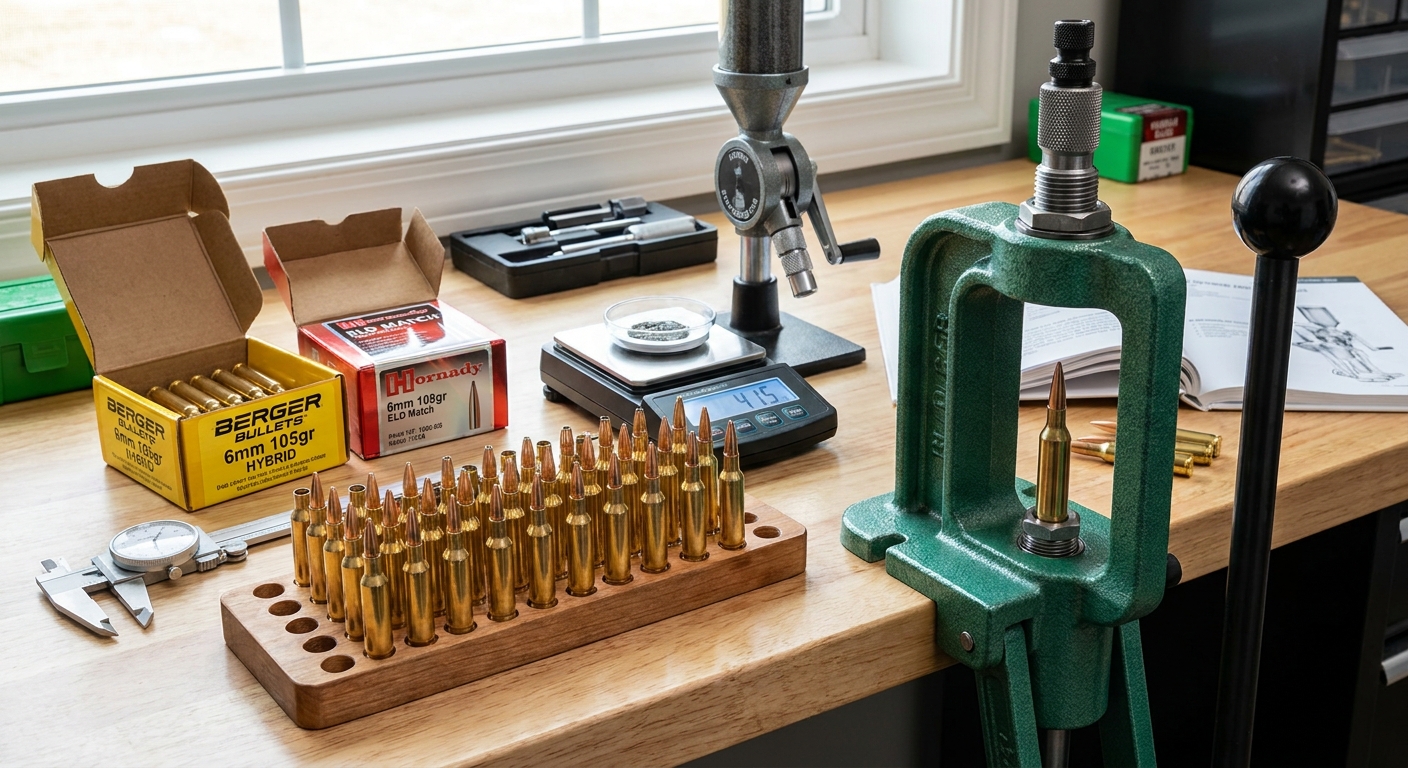
- Berger 105 gr Hybrid Target: G7 BC of approximately .275. The PRS staple. Excellent in-flight stability and consistent performance past 1,000 yards.
- Berger 103 gr Long Range Hybrid Target: Slightly higher BC, designed for barrels with 1:8" twist. Requires good barrel speed to stabilize.
- Hornady 108 gr ELD Match: Heat-shielded polymer tip with excellent BC and factory-accessible pricing. Very accurate in most 6CM chambers.
For Hunting
- Berger 109 gr Elite Hunter: Hybrid ogive, bonded-style construction. Expands at lower velocity thresholds — critical for longer shots where terminal velocity has dropped. Excellent on deer-sized game.
- Hornady 103 gr ELD-X: The hunting version of the ELD-M. Controlled expansion, high BC, and works from close-range impact velocities down to 1,600 fps. Great all-around hunting bullet.
- Nosler 90 gr AccuBond: Bonded core, good expansion, works great for pronghorn and deer at moderate velocity. A bit short for extreme long range but very accurate.
Load Development Process
Start with the published starting load in your reloading manual or powder manufacturer data. With H4350 and a 105 gr Berger Hybrid, a solid starting point is 37.5 gr, working up in 0.3 gr increments to a max of around 40.0–40.5 gr (watch for pressure signs: flattened primers, sticky bolt lift, ejector swipes).
Run an OCW (Optimal Charge Weight) or ladder test before you commit to a seating depth. Once you've identified a node — typically a 0.5–1 gr window where velocity stops jumping and groups tighten — dial in seating depth. Jump the bullet 0.020"–0.050" off the lands for most hunting bullets, or experiment with jamming 0.010" into the lands for competition bullets in tight chambers.
Sample Working Load (24" Barrel, 1:8" Twist)
- Brass: Lapua 6mm Creedmoor, 3x fired, annealed
- Primer: CCI BR-2 Large Rifle Benchrest
- Powder: H4350, 39.2 gr
- Bullet: Berger 109 gr Elite Hunter, seated to 2.825" COAL (0.030" off lands)
- Velocity: ~2,960 fps average
- ES/SD: 12 fps ES, 4 fps SD (10-shot string)
Reloading Safety Notes
Always work up from minimum loads. The 6mm Creedmoor is a relatively efficient cartridge and doesn't need to be pushed hard for impressive performance. Keep an eye on primer pocket tightness — it's your first indicator of case life. When primer pockets feel loose (primer seats with no resistance), retire that brass regardless of how many firings it has. High-BC bullets at long range are unforgiving of velocity inconsistency, so prioritize ES/SD over chasing the last 50 fps.