Most duck hunters think of Sauvie Island as a place Portlanders go to pick pumpkins. That's fine. Let them think that. Because every October, when the first cold fronts push birds south along the Pacific Flyway, the north end of Sauvie Island becomes some of the best duck hunting in Oregon—and a remarkable number of serious hunters overlook it entirely.
Sauvie Island sits at the confluence of the Willamette and Columbia rivers, about 10 miles northwest of downtown Portland. The northern half of the island is managed by ODFW as the Sauvie Island Wildlife Area—roughly 12,000 acres of wetlands, lakes, sloughs, and fields that hold migrating and wintering waterfowl in serious numbers. This is not casual hunting. Done right, limits of mallards, pintail, wigeon, and Canada geese are absolutely achievable here.
Access, Parking Permits, and Regulations
Access to the Sauvie Island Wildlife Area requires an ODFW parking permit, available annually for a nominal fee from ODFW offices, Sauvie Island Market, and online through the ODFW licensing system. Display the permit on your dashboard. Wardens check regularly, especially during opening weekend.
Large portions of the northern wildlife area are closed to access from October through mid-April to protect wintering birds—but hunting blinds and access points open for the waterfowl season on specific dates. The season typically aligns with Oregon's general waterfowl opener, usually the third Saturday in October, with teal season opening earlier in September.
Hunters must use steel or non-toxic shot only. Decoy limits apply in some areas. Read the current ODFW regulations for Sauvie Island carefully before opening day—the area has its own set of rules layered on top of statewide regulations.
Where the Birds Are
The northern lakes—Sturgeon Lake, Steelman Lake, and the interconnected slough system—are the heart of the duck hunting on Sauvie Island. These shallow, food-rich wetlands attract thousands of dabbling ducks: mallards, pintail, wigeon, gadwall, teal, and shovelers. Diving ducks work the deeper channels and sloughs.
Canada geese are present in large numbers, particularly in the agricultural fields on the eastern side of the island. Field blinds set in cut corn or cover crops can produce limits when migration is moving. Resident Canada goose numbers are high all season, with migrant birds arriving in force from November onward.
Specklebelly (white-fronted) geese pass through in October and November and can be hunted here. Snow geese occasionally work the fields during the light goose conservation order in late winter and spring.
Hunting Strategies for Sauvie Island
Blind Hunting on Sturgeon Lake
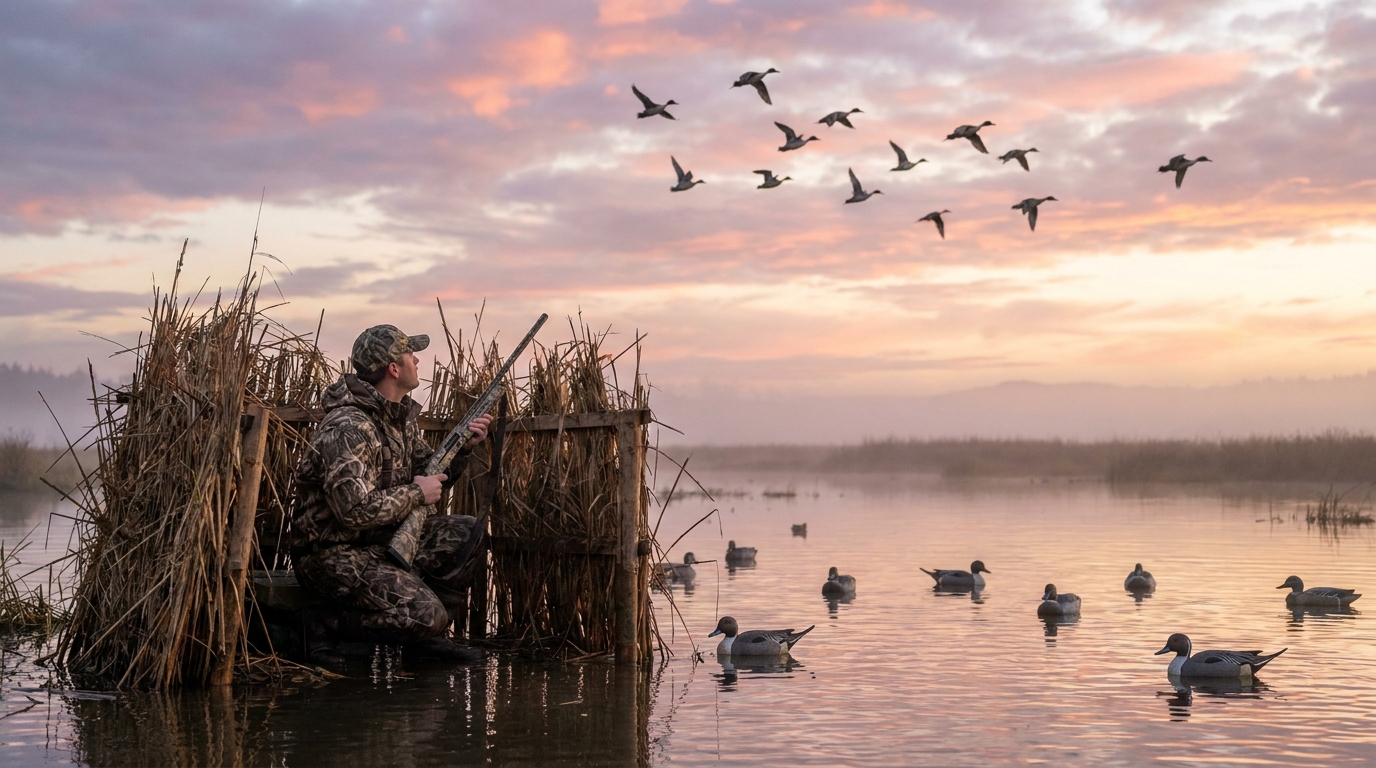
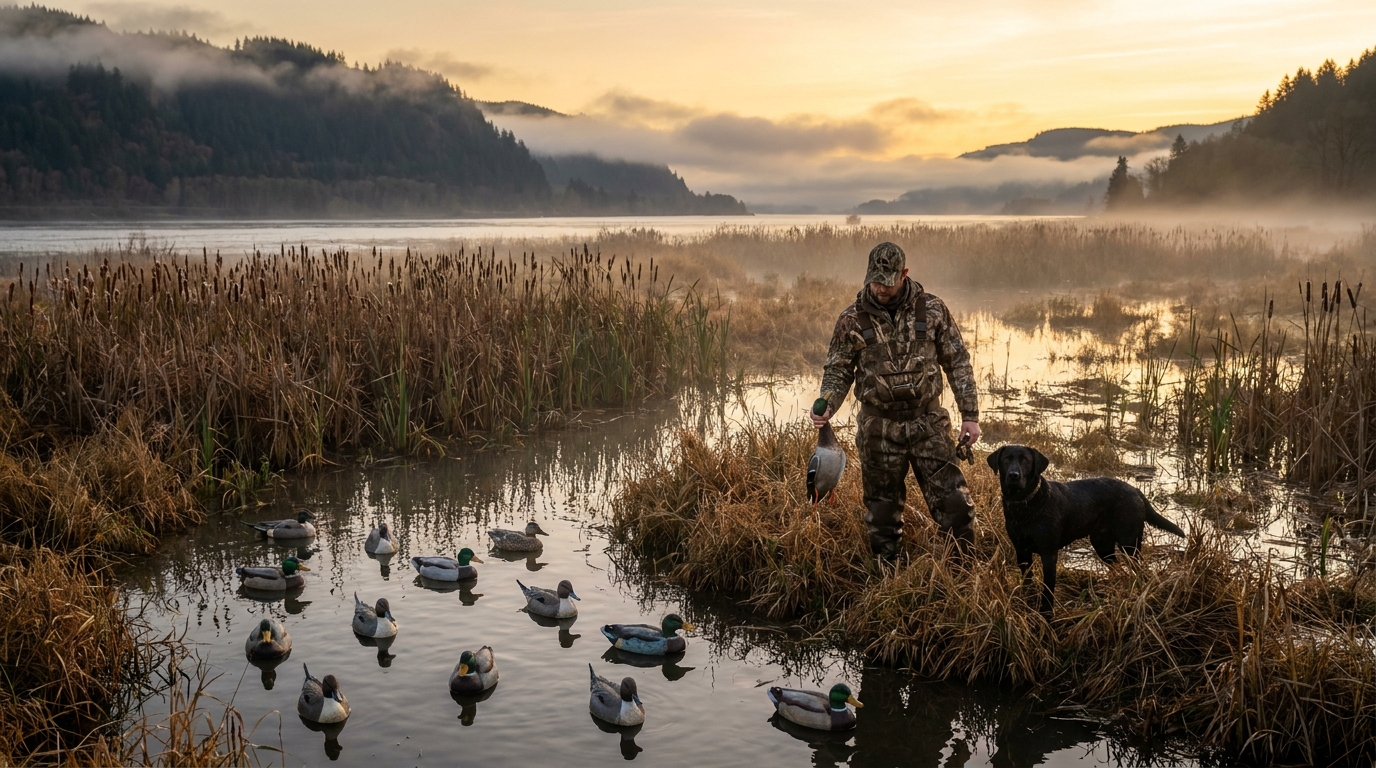
Sturgeon Lake is the classic Sauvie Island waterfowl hunt. Timber blinds and natural cover positions dot the shoreline, and hunters spread decoys in open water or along flooded vegetation edges. Calling is effective here—these birds have usually traveled and are looking to commit. Run a 4–6 dozen decoy spread with mallard floaters and a small group of pintail and wigeon to the side. Motion decoys are allowed in this area and increase early-season success significantly.
Field Hunting for Geese
Set up in cut fields on the east side of the island for Canada geese and specklebellies. Layout blinds or ground blinds placed in stubble are standard. Run a spread of full-bodies with a few silhouettes mixed in. Specklebellies respond well to realistic two-note moaning calls. Start your spread before first light and be in position 45 minutes before shooting time.
Jump Shooting the Sloughs
Slough hunting on Sauvie Island is underused. Walking the vegetated edges of the smaller sloughs—Columbia Slough feeders and the cut channels—and pushing birds out of holding cover can produce fast shooting for teal, mallards, and wood ducks early in the season. Move slowly, keep the wind in your face, and stay in the brush until you're at shooting distance.
Getting There and Logistics
Access the island via the Sauvie Island Bridge on US-30, northwest of Portland. The ODFW check station on Reeder Road is a landmark. Hunting access roads on the north end require walking in—most parking areas require a 0.25 to 2-mile hike to hunting areas, which is part of what keeps pressure manageable.
A kayak or canoe opens up significantly more water and better blind positions. Launching from the parking areas along Reeder Road puts you in the middle of prime habitat. A 14-foot jon boat with a small outboard is ideal for reaching Sturgeon Lake efficiently.
Gear for Sauvie Island
- Waders: Chest waders are essential. Water temperatures drop fast in October and November.
- Decoys: At minimum, 3–4 dozen mallard floaters. Add pintail and wigeon for realism. Motion decoys for teal and early season.
- Calls: A quality mallard call and a specklebelly call. Canada honkers are pressured here—keep calling subtle.
- Shotgun and loads: 12-gauge with non-toxic shot. Heavy steel 3" shells in #2 or BB for geese; #2 or #3 steel for ducks at longer ranges. Bismuth or TSS for close-range timber work.
- Camouflage: Brown and gray marsh patterns blend best in the Sauvie Island slough vegetation.
Sauvie Island isn't a secret—it never was. It's just underutilized by hunters who assume metro proximity means poor hunting. The birds don't care about the zip code. When the migration is moving and conditions are right, the north end of Sauvie Island delivers as well as anywhere on the Pacific Flyway.