Every fall, salmon hunters flood the famous coastal rivers — the Tillamook, the Nestucca, the Wilson. While they're jostling for elbow room on well-known runs, a quieter river winds through the Oregon Coast Range largely unnoticed. The Siuslaw River delivers consistent fall Chinook fishing to anglers willing to do a little homework, and it's one of the best-kept secrets on Oregon's mid-coast.
Understanding the Siuslaw Run
The Siuslaw system hosts both a wild and hatchery fall Chinook run. Fish begin stacking at the Florence estuary in late August, with the main push of adult fish moving upriver through September and October. Peak fishing typically coincides with the first significant fall rain events — usually mid-September through the first weeks of October — when freshets push fish off the tidewater and upriver toward spawning gravel.
Oregon Department of Fish and Wildlife stocks Siuslaw hatchery Chinook out of the Mapleton Hatchery, located about 17 miles inland from the tidal mouth at Florence. This hatchery return provides consistent bank access opportunities throughout the middle Siuslaw corridor and gives boaters a reliable upriver focal point.
Access Points and Float Sections
The Siuslaw offers excellent public access for both bank anglers and boaters. Key access points include:
- Florence Marina / Tidewater Area: Early-season fish stage here in the estuary. Boat fishing with spinners or anchovies is productive. Bank anglers can work the Florence waterfront and adjacent sloughs.
- Cushman Bridge: One of the most productive bank access points for medium-river Chinook. Drift bobbers with cured eggs or sand shrimp under a float are the go-to setup here.
- Mapleton to Noti Corridor: Boaters launching at Mapleton can float down or motor upriver. This middle stretch sees good fishing when flows are up. The launch ramp at Mapleton is well-maintained and handles most drift boats.
- Triangle Lake tributary access: The upper system including the Lake Creek tributary offers wade fishing opportunities in a smaller, more intimate setting.
Proven Tactics for Siuslaw Fall Chinook
Float and Bait
This is the most reliable method across all access types. Rig a 3/0 to 5/0 octopus hook on 15–20 lb fluorocarbon leader, set beneath a large drift bobber or foam float. Fresh cured eggs are first choice, with sand shrimp a close second. Adjust float depth so your bait drifts 6–12 inches above the bottom — Siuslaw Chinook hold tight to the substrate in moderate current seams.
Spinners and Spoons
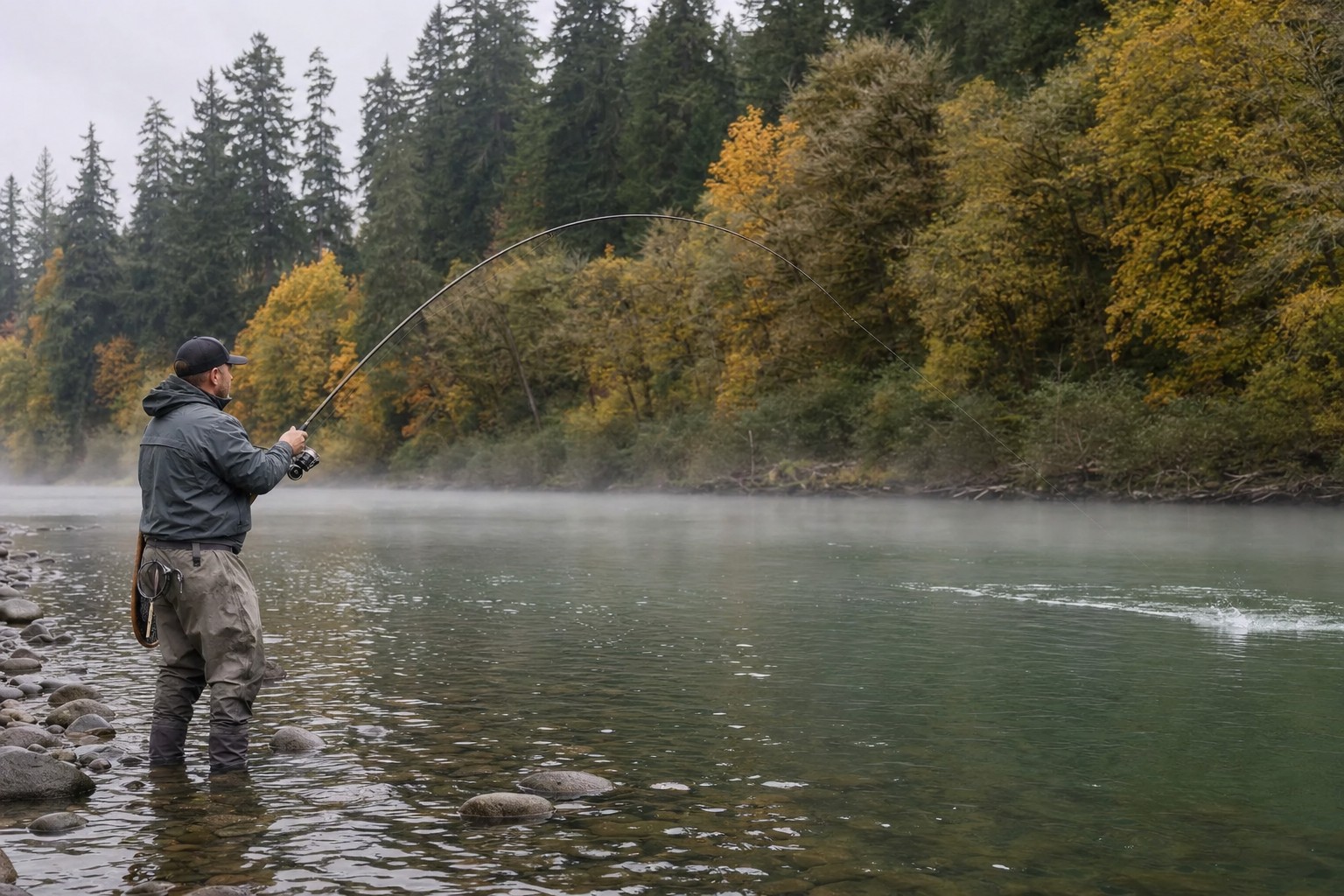
When fish are moving and aggressive in murky post-rain flows, a large spinner — #5 or #6 blue-silver or orange-gold — worked slow and deep through slots and behind boulders can be deadly. Blue Fox and Mepps Syclops-style spoons in bright finishes are popular among local guides. Cast across current, let the lure sink, and retrieve just fast enough to maintain blade rotation.
Plugging from a Drift Boat
When fish are stacked in a known hole, back-trolling Kwikfish or FlatFish wrapped with sardine gives boaters a serious edge. Wrap the lure with a fillet of fresh sardine using a fine mesh, then back-troll upstream, holding the boat in current while the plug digs and wiggles. It's a slow technique, but it puts big Chinook in the net when nothing else works.
Reading the River
The Siuslaw is a classic coastal river — it fishes best on a rise or as flows begin dropping after a rain event. Crystal-clear summer-condition water sees fish become almost unkillable. You want visibility in the 18–30 inch range and rising flows that push fish upriver. The USGS Florence gauge is your best friend; target flows between 2,500 and 7,000 CFS for the middle river sections.
Look for deep inside bends, log-jam eddies, and the tailout below riffles. Chinook rest in these features during migration and are catchable with patient presentations.
Regulations and Retention
Always check the current Oregon Sport Fishing Regulations before your trip. The Siuslaw has specific hatchery retention rules — wild Chinook must be released unharmed. Hatchery fish are identified by a clipped adipose fin. Bag limits, bait restrictions, and gear rules can change year to year, and ODFW occasionally issues emergency orders based on run strength. The ODFW Florence field office is a good local contact for current run conditions.
What to Bring
- 8–10 ft medium-heavy spinning or casting rod with 30–50 lb braid mainline
- Fluorocarbon leader material (15–25 lb)
- Drift bobbers in pink, orange, and chartreuse
- Cured salmon eggs or fresh sand shrimp (available at local bait shops in Florence)
- A valid Oregon fishing license with Combined Angling Tag
- Chest waders — many of the best bank spots require wading
Final Thoughts
The Siuslaw won't be empty forever. As word gets out about its consistent Chinook returns and uncrowded access, pressure will grow. For now, it remains a legitimate mid-coast sleeper — a river that rewards the angler who does their homework and shows up when the fish do. Check the gauge, grab some fresh eggs, and give the Siuslaw a shot this fall. You might not go back to fighting for elbow room on the Wilson.