Most Oregon anglers drive past the Willamette on their way to steelhead streams or high-country trout lakes. That's their loss. From late June through early September, the mainstem Willamette between Corvallis and Salem holds some of the best summer smallmouth bass fishing in the Pacific Northwest — and it's almost entirely uncrowded.
Why the Willamette in Summer
As water temperatures climb into the mid-60s, smallmouth bass shift from their winter deep-water holds and scatter across the gravel bars, rocky riffles, and mid-river structure that define the Willamette's character. By July, fish that were 20 feet down in April are now stacked on two-foot gravel flats, chasing baitfish and aggressively defending territory.
The stretch from Willamette Park in Corvallis downstream past the Santiam River mouth and through Independence offers consistent action on fish averaging 12 to 16 inches, with genuine 18-plus-inch bronze backs turning up several times per trip when you're working the right water.
Reading the River
Willamette smallmouth are structure fish. They predictably hold in a handful of habitat types:
- Rocky riffles and tailouts: Anywhere the river drops over a gravel-and-cobble shelf, bass stack up to ambush baitfish. These are your most consistent summer producers.
- Wing dams: Old rock wing dams built for navigation dot the river between Corvallis and Salem. Each one creates an eddy seam that smallmouth love.
- Gravel bar edges: Where a shallow flat drops off into a deeper run, smallmouth use the shelf as a hunting lane. Work parallel to the drop, not across it.
- Woody debris: Logjams in calm backwaters hold the occasional big smallmouth. These fish are often larger but harder to tempt in mid-summer heat.
Gear and Presentation
A medium-light spinning rod in the 6'6" to 7' range spooled with 10-pound braid and a 6-pound fluorocarbon leader is the standard Willamette setup. The lighter leader matters — the river runs surprisingly clear at summer flows, and smallmouth here are accustomed to scrutinizing forage before committing.
Top Summer Lures
- Ned rig (3-inch ElaZtech worm on a 1/10 oz head): Deadly on any hard-bottom flat. Drag it slowly across gravel and let it pause frequently.
- Small crankbaits (2–3 inch shallow divers): A Rapala DT-3 or Strike King Series 3 in shad or crawdad colors covers water fast and triggers reaction strikes through riffles.
- Tube jigs (3–4 inch, 3/16 oz): The old-school Willamette bait. Drop it into eddies behind boulders and let it pendulum on a tight line.
- Topwater (Heddon Zara Spook Jr., Rebel Pop-R): The most fun you'll have all summer. Early morning and evening topwater on calm backwater flats produces explosive strikes from aggressive fish.
Best Access Points
The Willamette is a navigable waterway — bank access is legal from the ordinary high-water mark. Good wade access requires some homework:
- Willamette Park, Corvallis: Paved launch, good gravel bar access upstream and down. Wading-friendly at summer flows.
- Hyak Park, Albany: City park with boat ramp on the west bank. Gravel bars downstream hold consistent fish.
- Buena Vista Ferry crossing: The gravel bars and riffles in this stretch between Albany and Independence are some of the most productive water on the river.
- Independence Riverview Park: Excellent float-through access. The wing dam 300 yards downstream is a go-to summer spot.
- Wheatland Ferry area: Upper reach of the Salem fishery. Big water here with excellent rock structure in late-summer low flows.
Float vs. Wade
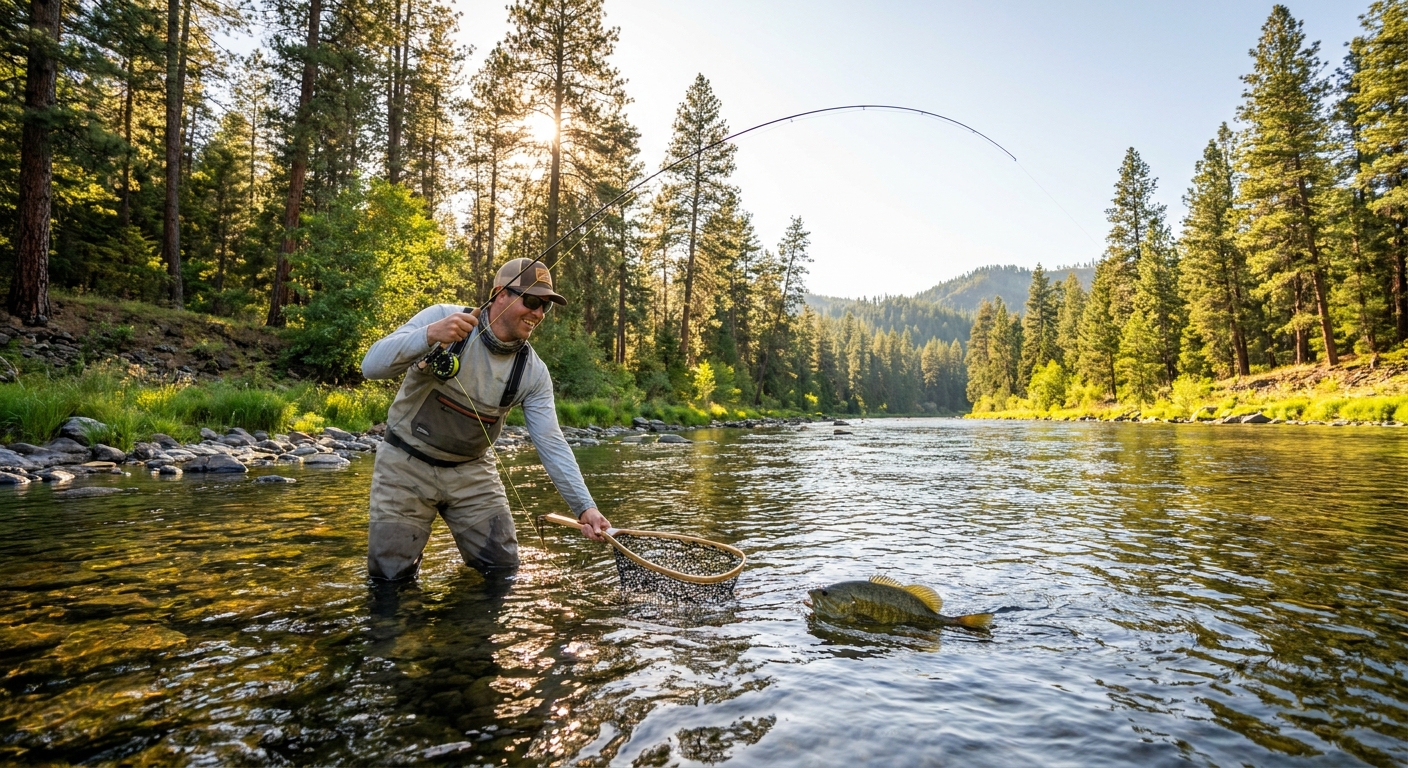
Both approaches work, but they suit different anglers. Waders can pick apart a single productive riffle methodically and often catch more fish per hour on known water. Float anglers — in a drift boat, raft, or inflatable kayak — can cover miles and cherry-pick the best structure en route.
A popular day float runs Hyak Park in Albany to Buena Vista, roughly 12 miles. Put in early, fish the prime morning bite on riffles, eat lunch on a gravel bar, and float out in the afternoon. Expect 15 to 30 smallmouth on a solid day.
Regulations and Timing
The mainstem Willamette from Corvallis downstream is open year-round for bass with no size limit or daily bag limit as of 2026. Smallmouth are warm-water game fish, and ODFW encourages harvest. Check current regulations for tributary closures near confluence zones, particularly the Santiam River mouth during salmon and steelhead seasons.
Peak timing runs July through mid-August when water temperatures hold in the 62–70°F range. Above 72°F, fish become lethargic and post-release survival drops. Fish early — first light to 10 a.m. — and again from 5 p.m. to dark. The Willamette's smallmouth fishery is a legitimate summer destination most Oregon anglers are still sleeping on.