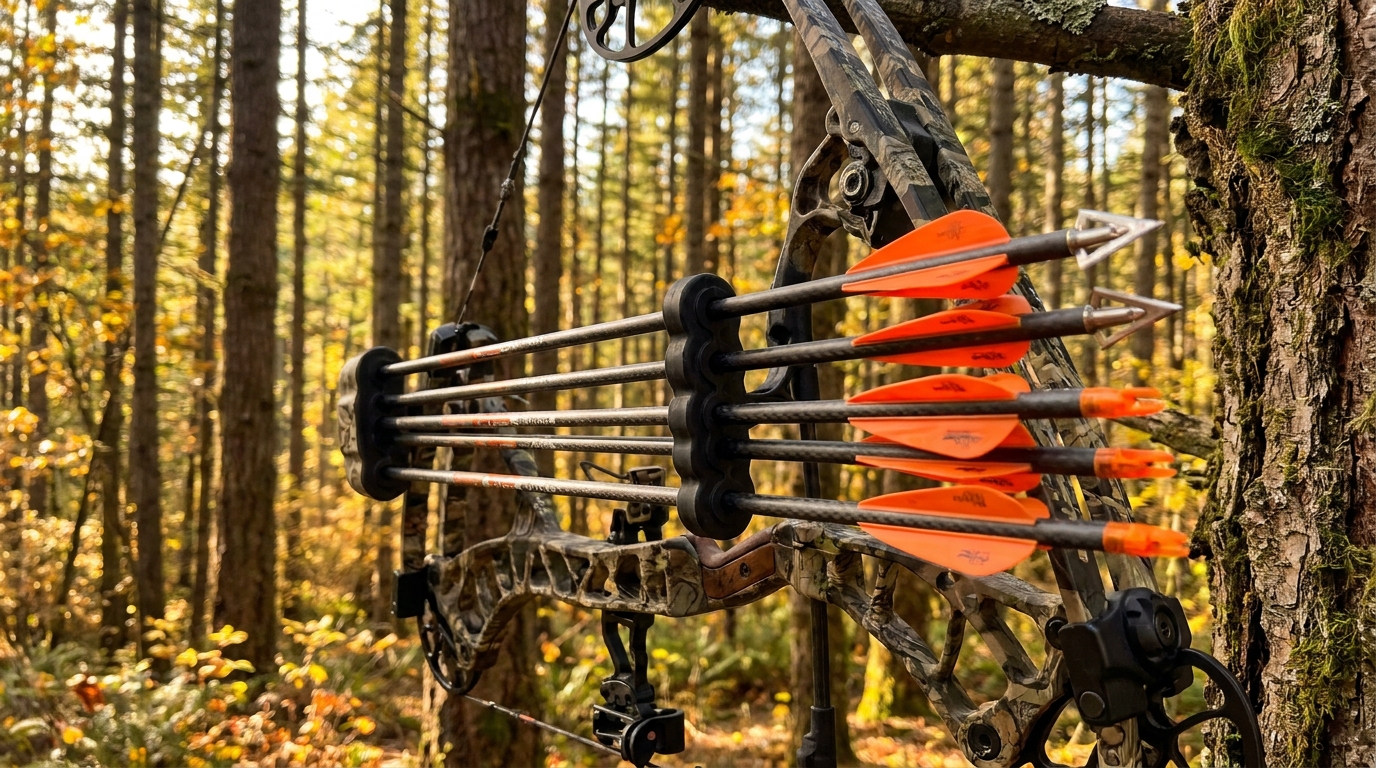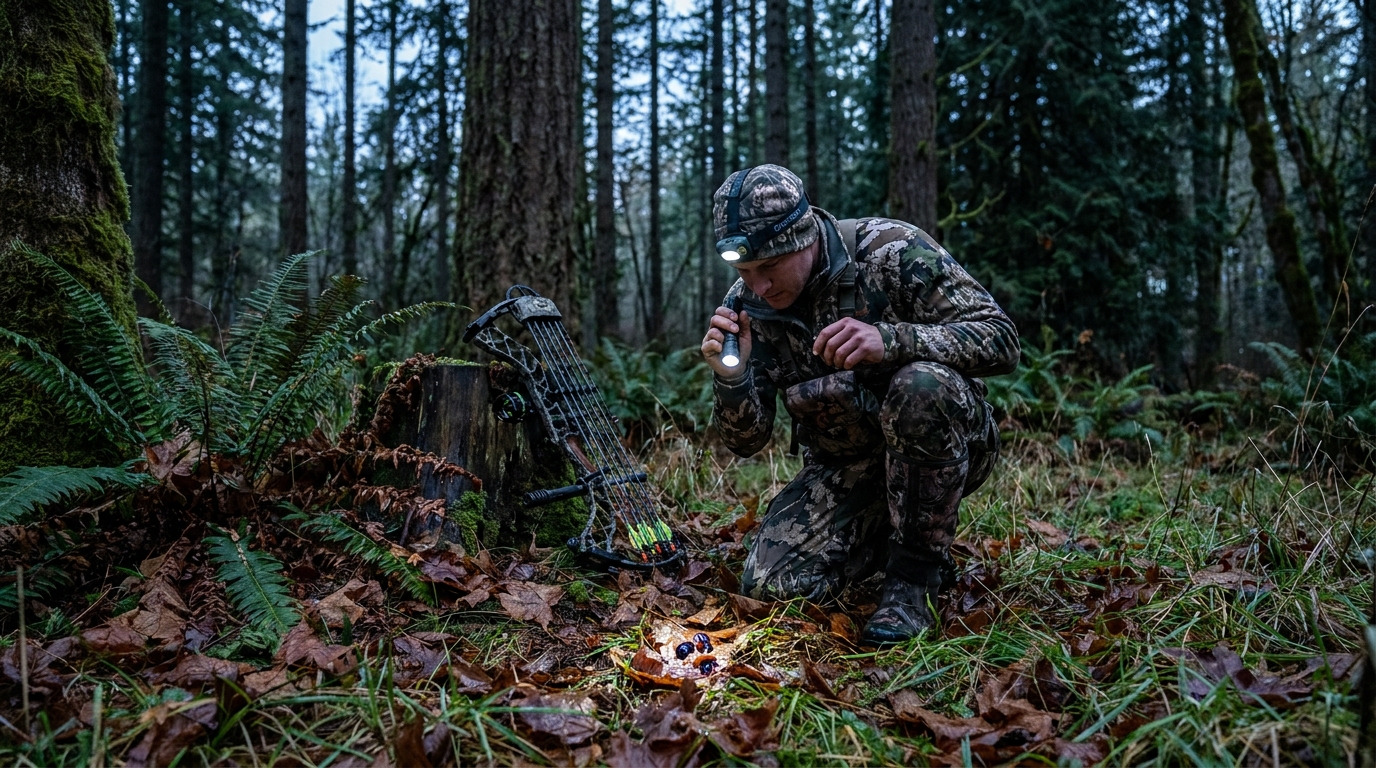
The archery industry has spent 30 years selling speed. Bows are marketed by IBO ratings. Arrows are advertised as “flat-shooting” and “fast.” Carbon shafts get lighter every season. The message is consistent: faster is better. In competitive 3D archery at known distances, that’s arguably true. In the Oregon timber and backcountry elk country where most of us actually hunt, the physics tell a different story.
The Physics of Arrow Energy
Kinetic energy is what drives penetration, and the formula is KE = ½ × mass × velocity². Velocity is squared, which tempts hunters toward lighter, faster arrows. But here’s what that formula doesn’t capture: momentum, which equals mass × velocity. Momentum — not kinetic energy — is what drives an arrow through resistance. A heavy, slower arrow carries more momentum than a light, faster arrow at the same kinetic energy level. Against the shoulder blade of a bull elk, or through the rib cage of a quartering-away deer in thick brush, momentum wins.
Archery researchers and experienced bowhunters have converged on this conclusion for decades. Dr. Ed Ashby’s extensive arrow penetration studies remain the most comprehensive data set in bowhunting. His work consistently shows that heavy arrows (500 grains and above) with high FOC (forward of center, 15%+) and quality fixed-blade broadheads penetrate significantly deeper than lighter setups — often twice as deep — on identical shots.
What “Heavy” Means in Practice
The modern bowhunting market defaults to arrows in the 350–425 grain total weight range (shaft + insert + nock + broadhead). This is the sweet spot for speed marketing. A well-built hunting arrow for Pacific Northwest conditions should be in the 450–550 grain range. For elk specifically, 500+ grains total arrow weight is a reasonable target.
How to get there:
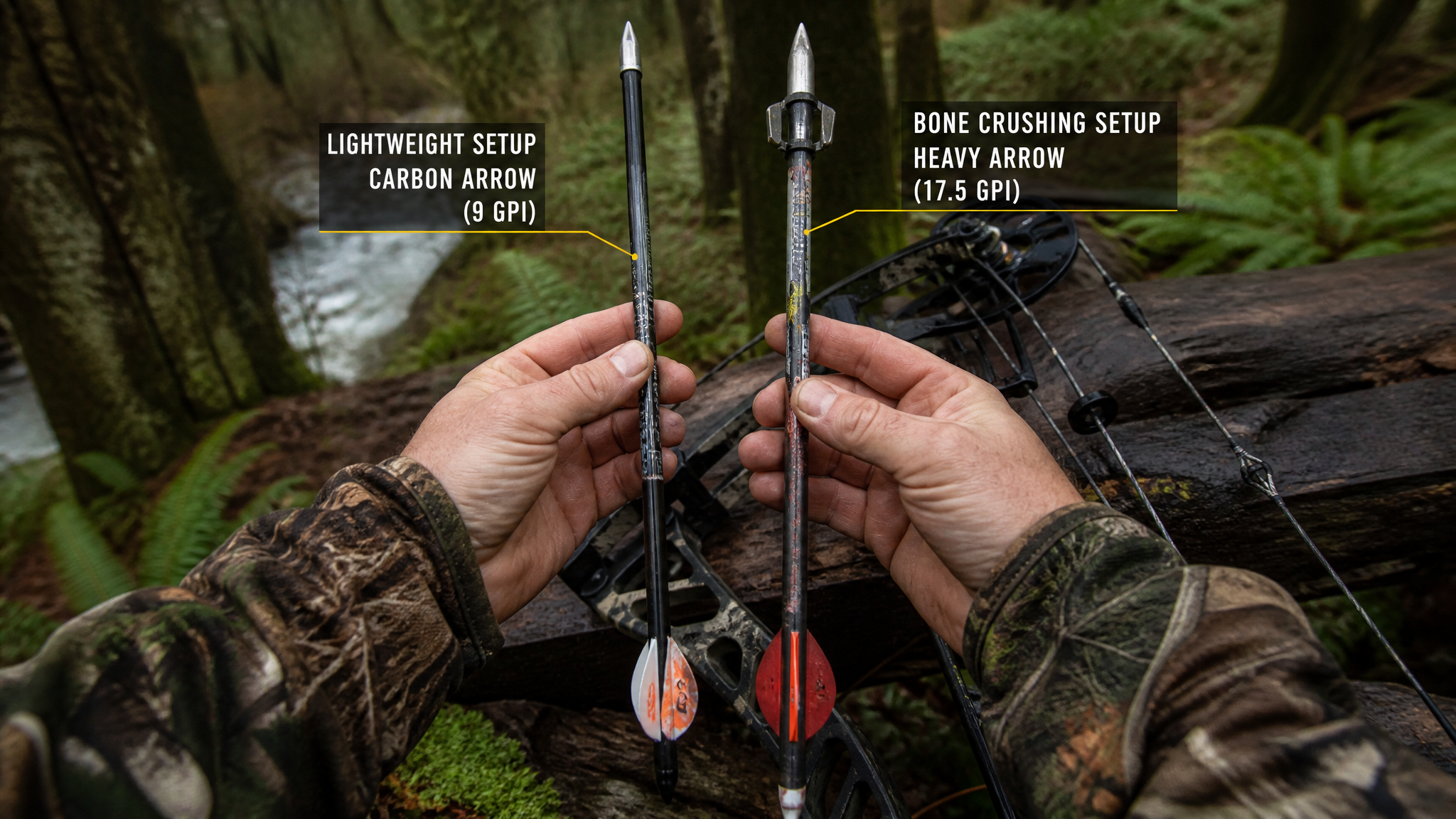
- Choose a heavier shaft: Gold Tip Kinetic, Easton FMJ, Victory VAP-V6 in heavier spine and wall thickness configurations. These run 10–12 grains per inch (GPI) instead of the 7–8 GPI of varmint-weight shafts.
- Use a heavy insert or brass insert: Swap the standard aluminum insert (15 grains) for a brass insert (50–75 grains) or a screw-in system like the Sword MX insert. This moves weight forward and improves FOC dramatically.
- Choose a heavier broadhead: 125 or 150 grain fixed-blade heads instead of the industry-standard 100 grain mechanical. A fixed-blade at these weights adds structural integrity and additional penetration.
- Account for nock and fletching: Lumenok nocks (20+ grains), vanes vs. feathers, wrap or no wrap — these matter when you’re fine-tuning total weight.
The Speed Trade-Off Is Real, But Smaller Than You Think
Going from a 380-grain arrow to a 520-grain arrow from the same bow will cost you roughly 20–25 fps at the same draw weight and length. At typical Oregon elk hunting distances (30–50 yards), here’s what that means:
- At 30 yards: essentially zero difference in point of impact
- At 40 yards: approximately 1–1.5 inches of additional drop with the heavy arrow
- At 50 yards: approximately 2–3 inches of additional drop
If you’re shooting 90% of your shots inside 45 yards — which describes most Pacific Northwest bowhunters in timber country — the trajectory penalty is functionally irrelevant. Re-pin your sight, confirm your yardage tape, and that speed difference disappears as a practical concern.
When Lighter Arrows Make Sense
The argument for lighter, faster arrows has legitimacy in specific scenarios:
- Open-country spot-and-stalk for deer or pronghorn: When shots may be 60–75 yards in the eastern Oregon desert, the flatter trajectory of a lighter arrow reduces the consequences of a yardage miscalculation.
- 3D competition at known distances: Speed makes pin gaps smaller, which improves precision. In competition, penetration is irrelevant.
- Hunting species where penetration is not a challenge: Whitetail through the ribs on a broadside shot does not require maximum penetration. Any reasonable hunting arrow will punch through clean.
For Roosevelt or Rocky Mountain elk — which is what most Oregon bowhunters are chasing — there is no argument for a sub-400-grain arrow. The bone structure, musculature, and the likelihood of a non-ideal shot angle (quartering-to, heavy shoulder contact) demand every grain of momentum you can provide.
Noise and Vibration: Another Win for Heavy Arrows
Heavy arrows absorb more of the bow’s energy as stored arrow energy rather than vibration. The result: a quieter, smoother shot. For bowhunters who shoot uncut or lightly modified arrows at close range, bow noise matters. A bull elk at 28 yards can jump the string of a loud, fast setup faster than a heavy arrow can reach him. Heavy arrows reduce that window and dampen the bow shot in the process.
Building Your Heavy Arrow Setup
Start with your current bow’s draw weight and length and calculate a baseline IBO speed estimate. Then use an arrow selection chart (Easton, Gold Tip, and Victory all publish them) to find appropriate spine for a 500–540 grain total arrow weight. You may need to drop a spine stiffness compared to what you currently shoot, since adding weight to the front of the arrow (high FOC) effectively stiffens the dynamic spine.
Build three arrows, shoot them for paper tune and broadhead flight, and confirm your new distance tape on a rangefinder target. The heavier arrow will feel different off the bow — softer, quieter, and more planted. That’s not your imagination. That’s physics doing its job.