Most hunters who reload focus their energy on powder selection, primer choice, and brass prep. Those variables matter — but there's one that often gets skipped entirely: bullet seating depth. Cartridge overall length (COAL) and the related measurement of bullet jump to the rifling can have a dramatic effect on accuracy and pressure. Get it right, and it's like tuning your rifle without touching anything on the outside. Get it wrong, and you'll chase groups with better powder data and never find the answer.
What Is Seating Depth and Why Does It Matter?
Seating depth refers to how deep the bullet is pressed into the case neck. COAL is the measurement from the base of the case to the tip of the bullet. These two measurements are related — seating the bullet deeper decreases COAL, while seating it shallower increases COAL.
The relationship between your bullet's ogive and the rifling lands in your barrel is the key variable. When a bullet is seated close to the lands, it doesn't have to travel far ("jump") before engaging the rifling. When it's seated deeper in the case, it has more jump. Most barrels have a preference — a distance from the lands at which a given bullet shoots its best groups. Finding that distance is what seating depth tuning is all about.
Measuring Your Lands: The Hornady OAL Gauge
The first step is measuring the distance from your bolt face to your rifling. The Hornady OAL Gauge (also called the Lock-N-Load Bullet Comparator) is the standard tool. It uses a modified case that chambers in your rifle and a rod that contacts the rifling to give you a reference measurement called the Cartridge Base to Ogive (CBTO) at the lands.
How to Measure
- Use the Hornady Bullet Comparator insert that matches your bullet diameter.
- Chamber the modified case and push the bullet forward until it contacts the lands. Mark or measure the rod position.
- Convert this CBTO at the lands measurement to COAL by using the comparator on a dummy round — measuring from case base to bullet ogive.
- Record this number. It's your lands distance baseline. Everything else is measured from here.
Jump: Where to Start
Most hunting rifle loads perform well with the bullet seated 0.010" to 0.050" off the lands. Maximum accuracy is often found somewhere in this range, though some bullets and barrels prefer more jump (0.050"–0.100") and a handful perform best jammed hard into the lands.
As a practical starting point for a hunting load:
- Start at 0.020" off the lands for most hunting bullets.
- Seat 0.010" deeper or shallower in 0.010" increments to test.
- Load 3–5 cartridges at each seating depth — same powder charge, same everything else.
- Shoot groups and measure. Consistent group size matters more than group location on paper.
Magazine Length Limits
For hunting rifles that feed from a box magazine, seating depth isn't unlimited. The bullet must fit inside the magazine. Maximum magazine COAL varies by action — most short-action box magazines top out around 2.800" to 2.850", and long-action magazines cap around 3.340".
If your best seating depth puts the round too long for the magazine, you have two practical options: seat the bullet back to fit (and use that COAL), or single-load rounds. For a hunting rifle in the field, single-loading is rarely realistic. Work within your magazine constraints and optimize within that range.
On the flip side, bullets seated too deeply can compress the powder charge in shorter cases or reduce case volume enough to spike pressure. Always check your load data minimum COAL before going deep.
Seating Depth and Pressure
Here's the part that matters for safety: seating bullets closer to the lands increases pressure because the bullet engages the rifling sooner and with more resistance. If you're already running a load at or near maximum published pressure, decreasing jump (seating bullets shallower) can push you over the edge. Watch for pressure signs: flattened primers, stiff bolt lift, ejector marks on the case head.
The safe approach is to develop seating depth tests with a moderate powder charge, find your preferred depth first, and then fine-tune powder from there. Don't combine maximum powder with minimum jump without working up carefully.
The Practical Hunting Test Protocol
You don't need to fire 50 rounds to find a good seating depth. A focused three-session approach works well:
- Session 1: Load 5 dummy rounds (no powder or primer) at 0.010", 0.020", 0.030", 0.040", and 0.050" off the lands. Verify they feed and chamber reliably.
- Session 2: Load 3 live rounds at each of 3 seating depths within your magazine and pressure constraints. Shoot from a supported position at 100 yards. Note group sizes.
- Session 3: Refine around the best-performing depth. Load 5-round groups at your top candidate and the two depths immediately around it. Confirm with a cold-bore shot.
Consistency Over Perfection
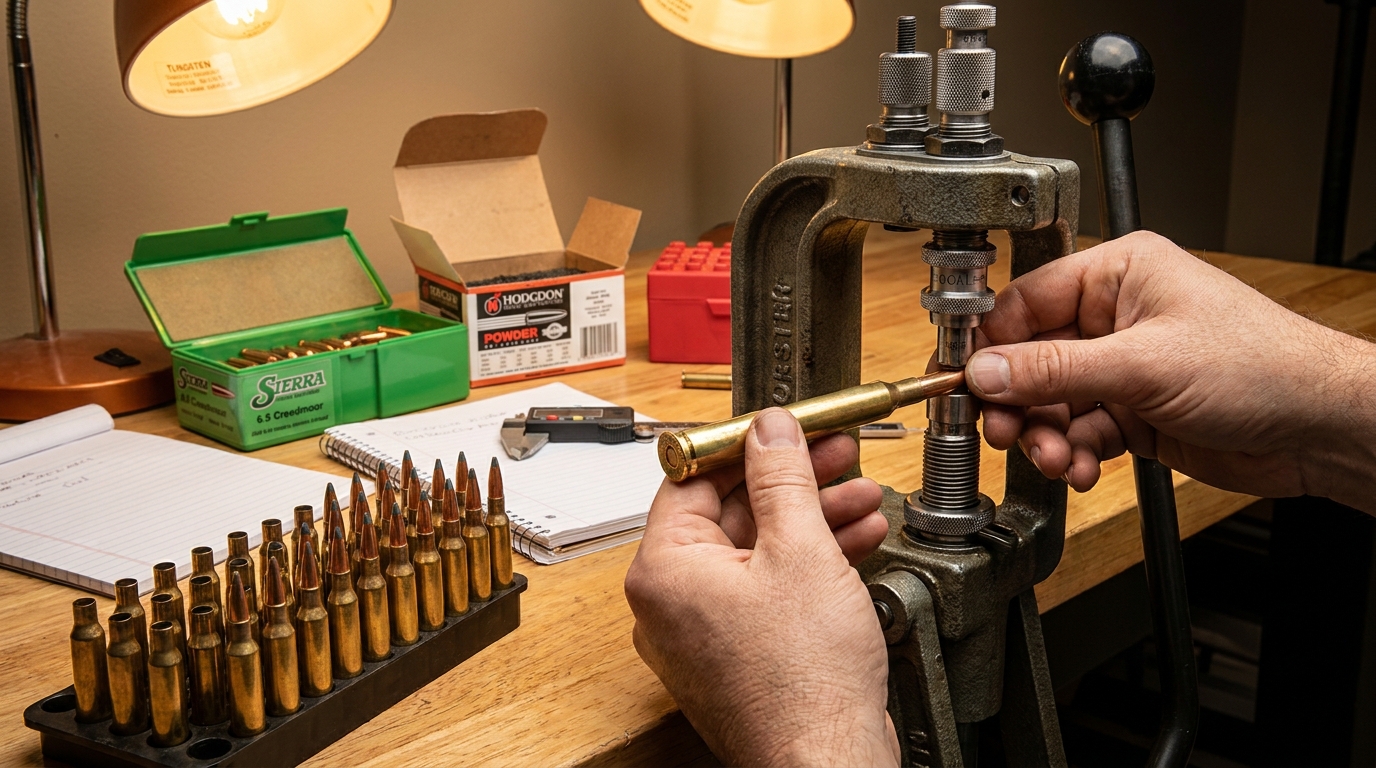
For hunting loads, consistency matters more than absolute minimum group size. A load that prints 0.75 MOA groups with 0.002" standard deviation in COAL is better than a load that occasionally prints 0.5 MOA but varies with bullet seating. Use a quality micrometer die — Redding, RCBS, or Hornady Precision Micrometer dies — and check your seating depth with a comparator on every fifth or tenth round during loading sessions.
Once you've found a depth that works, don't change it. Same bullet lot, same seating depth, same trim length. Handloading precision is built through repetition and consistency, and seating depth is one of the most repeatable variables once you have it dialed.
Final Thoughts
If you've been loading the same charge weight for years and wondering why your rifle won't shoot quite as well as you know it should, seating depth is often the missing variable. It costs nothing to test — just a bit of powder, some time at the bench, and a willingness to track your data. For a deer rifle that's printing 1.5 MOA, a seating depth adjustment can easily cut that to 0.8 MOA without changing anything else. That's the kind of improvement that translates directly to confidence in the field.