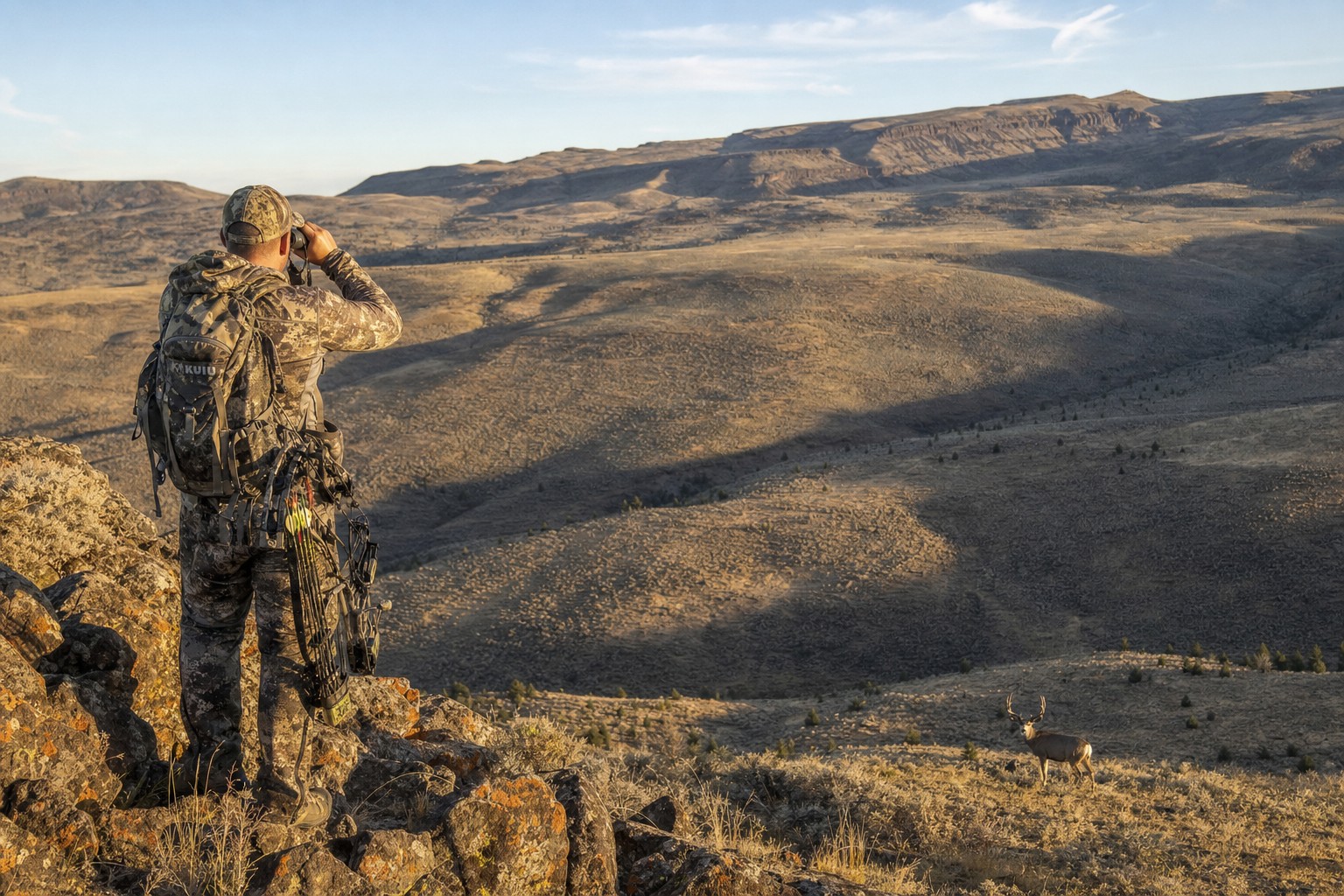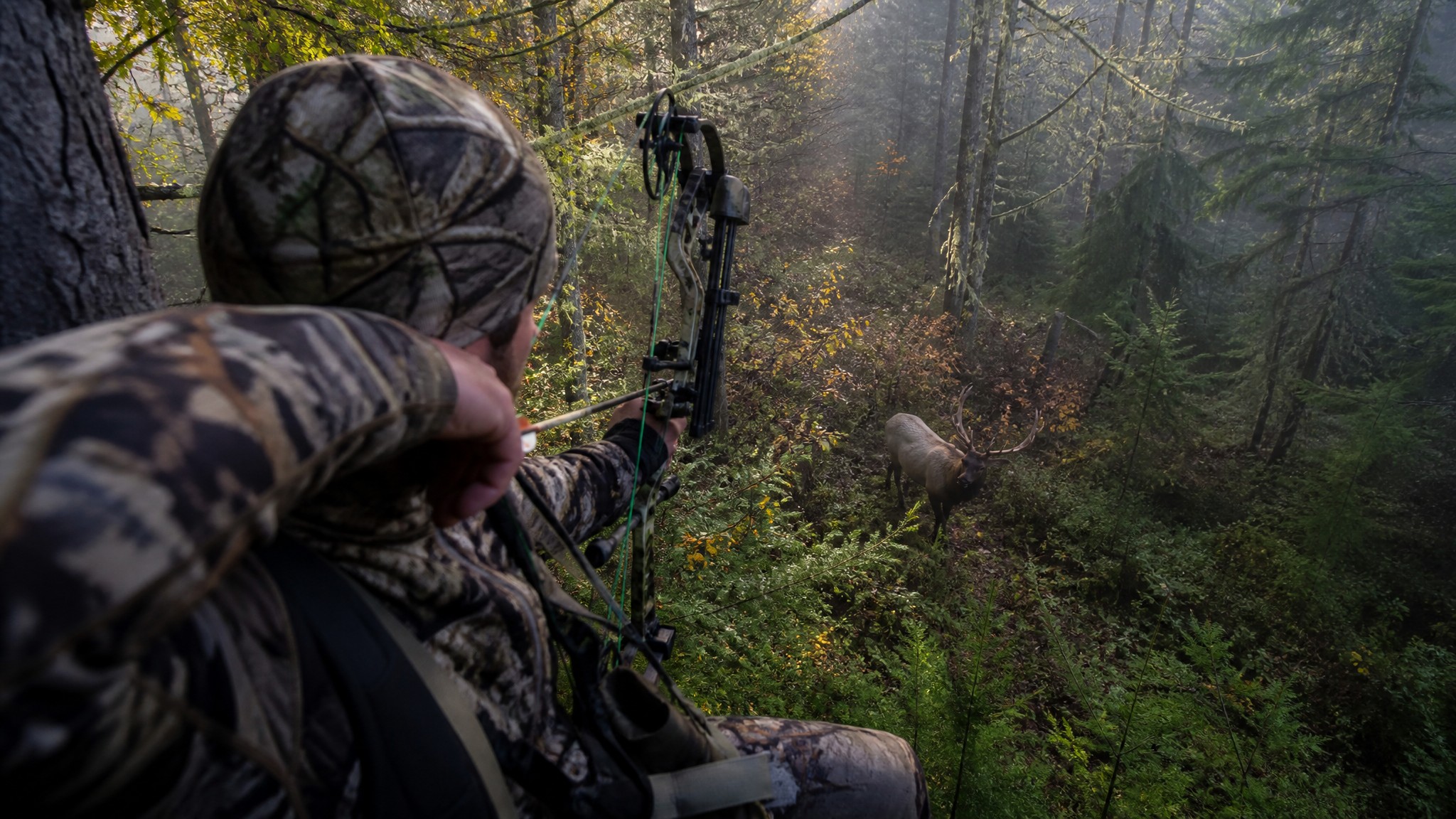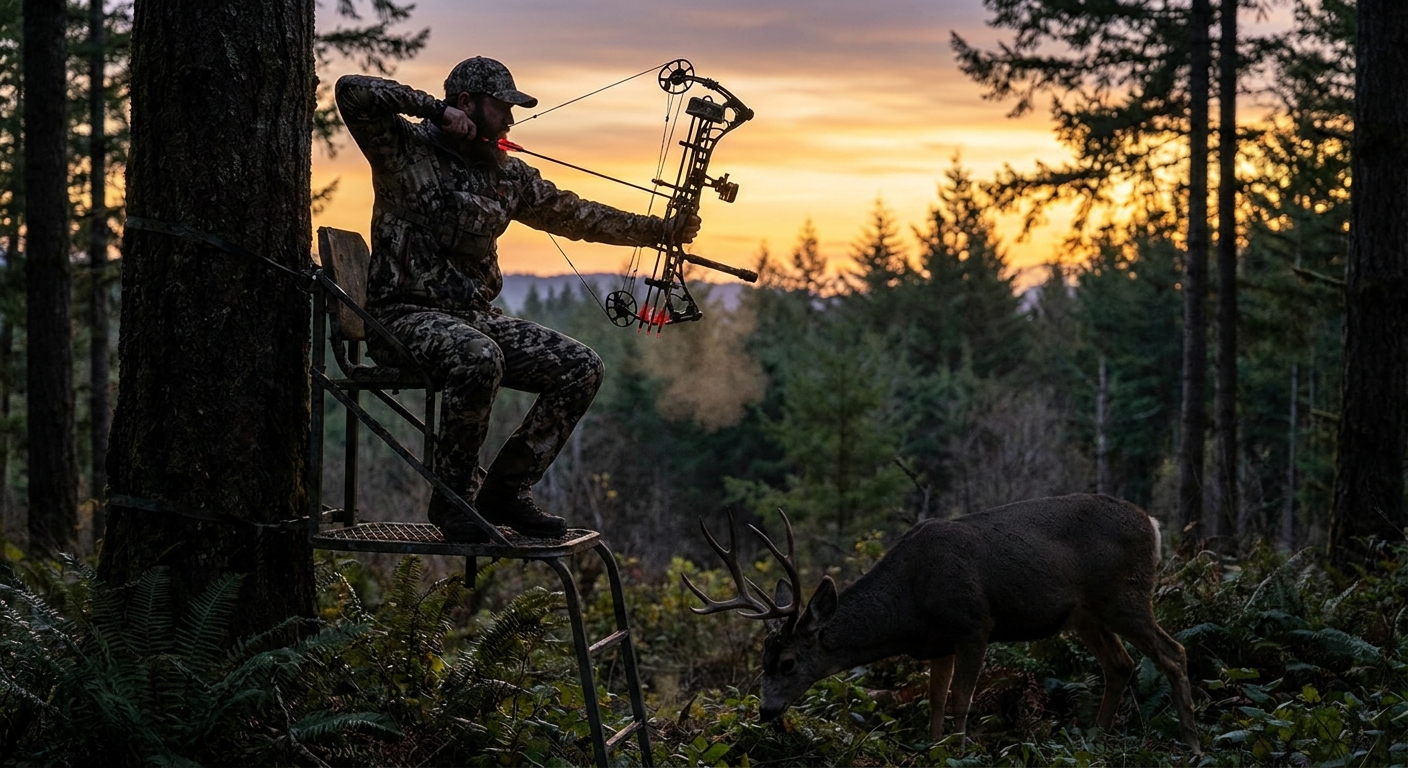
Ask any experienced bowhunter when the biggest buck or bull of the season showed up, and the answer is almost always the same: the last 10 minutes of legal shooting light. That thin window — when thermals have settled, human activity has quieted, and big animals finally let their guard down — is where archery tags get filled. It's also when your equipment and preparation are tested harder than at any other moment of the hunt.
Understanding Legal Shooting Light
In Oregon, legal hunting hours for archery deer and elk run from 30 minutes before sunrise to 30 minutes after sunset. That 30-minute window past sunset is legitimate hunting time — but the light during those final minutes is genuinely dim. A mature blacktail buck at 25 yards in the dense timber of the Coast Range at 8:45 p.m. in August is not the same shot as that same deer at 6 p.m. If your equipment isn't dialed for low-light conditions, you're hunting without your full toolkit.
Peep Sight Setup for Low Light
Your peep sight is the first bottleneck in your low-light system. A peep that's perfectly adequate at midday becomes a dark circle of guesswork when the light drops.
Peep Diameter
Larger peep diameters let in more light. A 3/16-inch or 1/4-inch peep is the standard low-light choice for hunting setups. Target archers use small peeps for precise sight alignment — hunters sacrifice that precision for the light transmission that makes a dim sight picture possible.
Peep Illuminators
Clarifier rings and fiber-optic peep illuminators like those from Specialty Archery or Arizona EH Peep use a fiber-optic loop to gather ambient light and brighten the peep aperture. These are worth every penny. On a dim evening setup, a lit peep ring transforms a guessing game into a clear sight picture. Install one before the season and confirm your form hasn't changed — the sight alignment still needs to be consistent shot to shot.
String Angle and Peep Rotation
A peep that rotates under draw is a low-light disaster. Make sure your peep is tied in at the correct angle so it aligns perfectly at full draw without rotation. If your peep ever doesn't line up under draw, address it at the bow press before the season — not in the stand at 8:40 p.m. with a buck at 30 yards.
Bow Sights for Low Light
Most quality bow sights use fiber-optic pins that collect daylight and glow without batteries. In genuine low light, those pins lose brightness quickly. The solutions:
- Large diameter fiber coils: Sights with longer fiber-optic strands coiled inside the housing collect more light and stay bright longer. Spot-Hogg, Black Gold, and Axcel all make sights with extended fiber collection.
- Battery-powered illuminators: Add-on pin illuminators like the Trijicon AccuPin or Spot-Hogg Hogg-It use a small LED to backlight your pins. These are legal in Oregon for archery hunting and make a dramatic difference in a 10-minute window. They run on coin cell batteries — carry spares in your pack.
- Single wide-diameter pin: A single 0.029-inch or larger pin is easier to acquire in low light than a cluster of five thin pins. If you're consistently hunting the 20-to-30-yard range that timber hunting demands, a single large pin simplifies your low-light sight picture considerably.
Lighted Nocks
Lighted nocks are legal for archery hunting in Oregon and are one of the highest-value equipment upgrades available. They serve two critical functions:
- Arrow flight observation: In low light, watching a lighted nock through the shot tells you immediately where your arrow hit. The color and flight path of that nock in the first 20 feet after release will tell you more about the shot than any sound — and in dense timber, the sound of an arrow hit is often obscured anyway.
- Arrow recovery: Finding an arrow buried in the forest floor in fading light is a 20-minute project without illumination. A lighted nock marks your arrow exactly where it ended up.
Lumenok, Nockturnal, and Easton Tracer nocks are the most popular options. Make sure your chosen nock fits your arrow shaft precisely — a loose nock affects arrow flight. Test fit and function before the season.
Range Estimation in Low Light
Rangefinders struggle in low light. The reflective beam that bounces off a deer or a tree in broad daylight may return a weak signal or no signal at all when the target is in shadow at dusk. Strategies to compensate:
- Pre-range your shooting lanes: Before the light drops, range every landmark in your shooting lanes. Know that the big fir tree to the left is 22 yards, the brush clump is 31 yards, the trail crossing is 18 yards. When a deer materializes between those landmarks in the last minutes of light, you have your distance without lifting a rangefinder.
- Use a rangefinder with angle compensation: Downhill and uphill shots are common from treestands. At low light, the cosine error from a 30-degree angle on a 35-yard shot is enough to miss. An angle-compensating rangefinder (or archery mode) gives you the true horizontal distance automatically.
- Know your maximum low-light distance: Be honest with yourself. If you can't clearly see your pins and identify the target's vitals at 35 yards in the specific light conditions you're hunting, then 35 yards is not an ethical shot in those conditions. Low light contracts your effective range — adjust accordingly.
Stand Setup for Maximum Low-Light Opportunity
Equipment matters, but setup determines whether you have a shot in the first place.
- East-facing stands for mornings, west-facing for evenings: Position your stand so the deer is backlit by ambient sky light at the critical moment, not silhouetted against darkness while you're staring into the remaining light.
- Clear shooting lanes at low angles: A branch that's invisible at eye level in daylight becomes an arrow-deflecting obstacle in low-light tunnel vision. Clear shooting lanes aggressively, especially for the angles you'll most likely need in the final minutes of light.
- Know your exit route: If you shoot an animal at last light and need to leave the stand to recover it, know exactly how you're getting down and out in the dark. A lighted nock and a quality headlamp make recovery in the dark a workable problem rather than an impossible one.
The Mental Game
Everything that makes a shot difficult — movement, sound discipline, controlling your heart rate — is harder when the light is almost gone and you know the clock is ticking. The hunters who consistently convert low-light opportunities have one thing in common: they've practiced drawing and shooting in low light until the mechanics are completely automatic.
Set up a target in your backyard 15 minutes after sunset and practice drawing, aiming, and releasing in genuine dim conditions. It's a different experience than your 2 p.m. practice session. Your eyes adapt differently, your pins look different, and the temptation to rush is real. Know what that feels like before a deer is standing in front of you.
The last 20 minutes of the day are yours if you're ready for them. Most hunters aren't. Be the exception.