Oregon's mountain quail is the largest native quail in North America, and also among the most challenging upland birds to hunt in the Pacific Northwest. While valley quail thrive in lowland farms and brushy edges accessible to any bird hunter, mountain quail demand steep terrain, thick cover, and dogs that can work brutal slopes. For hunters willing to put in the boot work, the Cascades, the Klamath Mountains, and the northern Coast Range hold coveys that most people never see — and shooting one on the wing, in its habitat, is a genuine accomplishment.
Know Your Bird: Mountain Quail Basics
Mountain quail (Oreortyx pictus) are distinctive: they carry a tall, straight topknot plume rather than the curved crest of a California valley quail. The breast and flanks are richly barred with chestnut and white, and the birds have a richer, deeper coloration overall. At 8–9 inches long and up to 7 oz, they run large for quail.
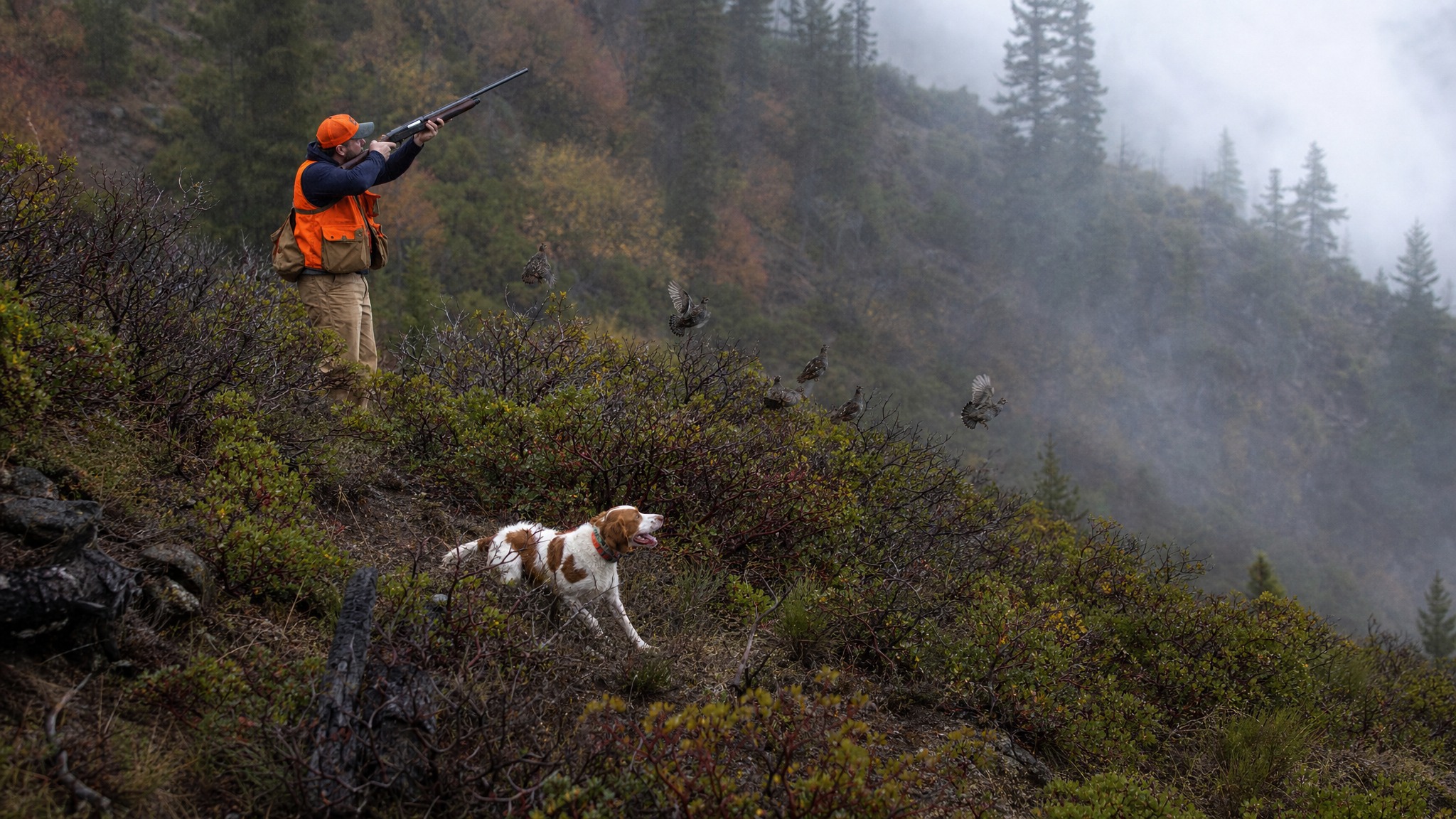
They are notoriously reluctant to flush. When pressed, mountain quail run uphill through brush rather than taking wing — a maddening trait that makes working dogs essential and shooting opportunities fleeting. When they do flush, they go hard and fast, often dropping immediately into dense vegetation. Close points from a disciplined pointer or the intensity of a good flusher make all the difference.
Where to Find Mountain Quail in Oregon
Mountain quail occupy a specific habitat niche: brushy slopes with dense chaparral-type cover adjacent to forest edges, typically between 1,500 and 5,000 feet elevation. The best Oregon populations are found in:
- Cascade Foothills (Marion, Linn, Douglas, and Jackson Counties): The brushy slopes of the western Cascades between 1,500–3,500 feet hold good numbers. Look for areas where Oregon grape, manzanita, ceanothus, and young Douglas fir regeneration grow thick on south-facing slopes. The upper McKenzie, North Umpqua, and Rogue drainages all have huntable mountain quail populations.
- Klamath Mountains (Josephine and Jackson Counties): The Applegate Valley and the drainages north of the Siskiyou Mountains are arguably Oregon's best mountain quail country. Hot, dry, dense chaparral on the Medford District BLM holds birds year after year. The Illinois Valley and Rough and Ready area near Cave Junction produce consistently.
- North Coast Range (Clatsop, Columbia, and Tillamook Counties): The denser, wetter Coast Range holds a smaller and more scattered population, but brushy clearcuts in young plantation timber and the forest edge habitats above the Nehalem and Wilson drainages hold birds.
- Eastern Cascades Transition: The Fremont-Winema NF and the drier eastern Cascade slopes near Klamath Falls and Medford have birds where chaparral meets ponderosa pine.
Hunting Tactics
Mountain quail coveys roost on steep slopes in dense brush and feed downhill in the morning before retreating to midday cover. This creates a window:
- Morning (8–10 AM): Work the edges where brush meets more open terrain — old logging roads, powerline cuts, and rocky brushy south slopes. Birds will be moving and feeding. This is your best shooting window.
- Midday: Birds pile into the thickest manzanita and ceanothus you can find. This is brutal dog country and even more brutal walking. Productive, but expect running birds and wild flushes.
- Afternoon: Birds begin moving again toward evening roost sites. Work the same slope features as morning, slightly higher elevation.
Unlike valley quail, coveys won't re-bunch predictably after a flush. Work a large area and cover ground. When you find a covey in productive habitat, that same slope will likely hold birds all season.
Dogs for Mountain Quail
Mountain quail can be hunted without dogs, but it's an exercise in frustration. These birds run, and without a nose on the ground, you'll walk past dozens of holding birds without knowing it. The best breeds for mountain quail include:
- Brittany Spaniel: The most popular mountain quail dog in Oregon for good reason. They work close, handle steep terrain confidently, and have the energy to push through dense brush all day. A broke Brittany that will hold a point even as the bird runs is worth its weight in gold.
- English Setter: Classic pointer breeds work well where terrain allows a bigger-running dog to operate. The denser Klamath chaparral suits a tighter-working setter style.
- German Shorthaired Pointer: Versatile, tough, and willing to work heavy cover. Many mountain hunters prefer the GSP's drive and athleticism on steep Cascade ground.
- Labrador or Springer: Flushing dogs work in the dense brush but require hunters to get close before the dog works. Effective in hands that know how to control range.
Shot and Gun Selection
Mountain quail are tough birds that often present crossing or going-away shots in heavy cover. This isn't a sport for a 28 gauge light target load:
- Gauge: 12 or 20 gauge. The 20 is perfect — light enough to carry on steep hills all day, with enough payload for clean kills.
- Choke: Improved Cylinder or Modified. Shots in heavy brush come fast and close. IC for tight cover, Modified for more open slope shooting.
- Load: 1 oz or 1-1/8 oz of #6 or #7.5 shot. Mountain quail are sturdy — go with #6 when shots run past 25 yards. High-velocity loads of 1,200–1,300 fps work well in the typically short shooting windows.
Season and Regulations
Oregon mountain quail season generally runs October 1 through January 31 (check current ODFW upland game regulations — zones and dates can vary). The daily bag limit is typically 5 birds, with a possession limit of 15. No hunting license endorsements beyond a basic Oregon hunting license are required. Mountain quail are not on a tag system.
Many of the best mountain quail areas in the Klamath Mountains and western Cascades are BLM or USFS public land. The Medford BLM District's Rogue River Valley area and the Ashland Resource Area are worth exploring. Download the USFS Motor Vehicle Use Maps and BLM surface maps before heading out — many of the brushy slopes hold unimproved roads only accessible by high-clearance 4WD.
Making It Happen
Mountain quail hunting in Oregon is a niche pursuit among a small and dedicated following. That's exactly what makes it special. You won't find crowds, stocked birds, or easy limits. What you'll find is wild country, a dog running hard through chest-high manzanita, and — if the morning comes together — a covey exploding off a south-facing Cascade slope with the whole Rogue Valley dropping away below you. Shot or missed, that flush alone is worth the climb.
Start in the Applegate Valley or the upper Illinois Valley in Josephine County. Put boots on the brushy slopes between 1,800 and 2,800 feet. Work your dog methodically on south-facing aspects. The birds are there — you just have to earn them.