The 28 gauge occupies a strange and wonderful place in the shotgun world. It does not have the raw power of the 12, the versatility of the 20, or the novelty of the .410. What it has is something harder to define — a kind of mechanical elegance that makes every shot feel deliberate. A well-fitted 28-gauge double gun is one of the most pleasant things you can carry through Oregon's upland country, and the hunting experience it provides is genuinely different from what you get behind a 12-bore. The only real downside is factory ammunition: expensive, limited in selection, and often loaded with mediocre components. That's exactly why reloading the 28 gauge makes so much sense.
Why Reload the 28?
Factory 28-gauge shells typically run $1.50-$2.25 per round — expensive enough that many shooters flinch at practice sessions. Reloading cuts that cost to $0.40-$0.65 per round depending on components, and more importantly, gives you control over payload, shot size, and pattern characteristics that factory ammo simply cannot match. For an Oregon chukar, quail, or ruffed grouse hunter who shoots 200-400 rounds per season between practice and hunting, the savings and performance gains are significant.
The 28-Gauge Reloading Setup
Not all reloading presses handle the 28 gauge, and it is important to buy equipment specifically designed for this gauge. The hull dimensions are small and exact — do not try to adapt 20-gauge tooling.
Recommended Presses
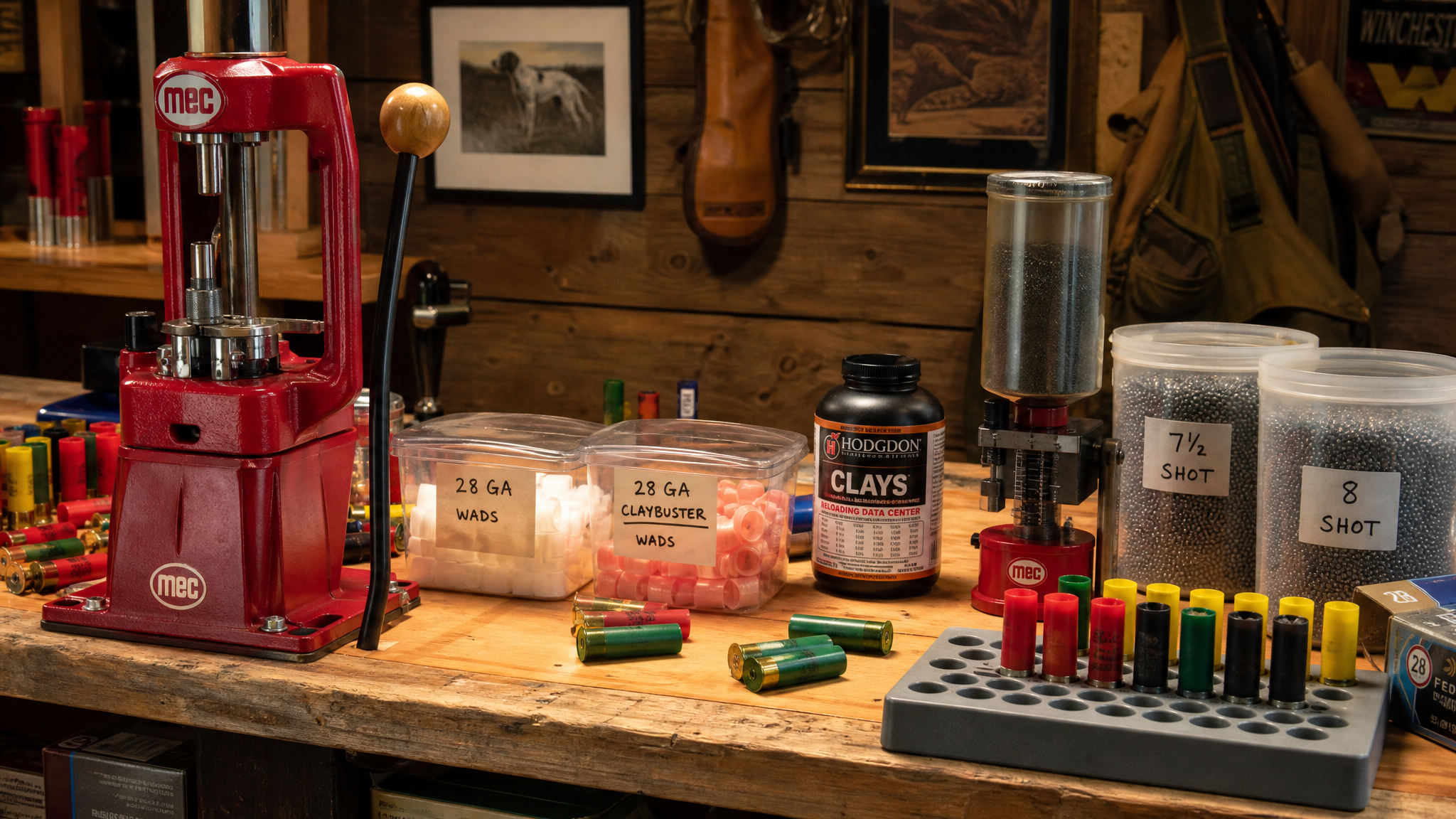
- MEC 600 Jr. Mark V (28 gauge): The classic single-stage shotshell press. Reliable, inexpensive, and available configured specifically for the 28. Expect to reload 100-150 rounds per hour once dialed in.
- MEC 9000G (28 gauge): Progressive version of the 600 Jr. for high-volume loading. Worth the investment if you shoot competitively or have multiple 28-gauge guns in the family.
- Ponsness Warren Size-O-Matic 900: A well-regarded alternative that many competitive shooters prefer for consistency.
Hull Selection
The 28 gauge is less forgiving of hull substitution than larger gauges. Stick with established, widely-tested hulls and do not mix and match. The most reliable options:
- Remington STS and Gun Club (28 gauge): The gold standard for reloading. Consistently thick basewads, hold primers well, and give 8-10 reloads before the brass head loosens.
- Winchester AA (28 gauge): Excellent hull, very consistent. The compression-formed design handles multiple reloads well.
- Federal Gold Medal (28 gauge): Slightly harder to find, but a great hull for reloaders who shoot Federal factory ammo.
Avoid once-fired bargain hulls from unknown sources. A cracked hull in the chamber of your expensive side-by-side is a bad day.
Primers
The 28 gauge uses a 209 shotshell primer — the same as 12, 20, and other gauges. However, primer sensitivity and seating depth matter more in the smaller gauges. Use only primers specifically listed in your load data. For most upland 28-gauge loads:
- Federal 209A: Consistent, reliable, and listed in more 28-gauge recipes than any other primer. A safe default choice.
- Winchester 209: Works well with Winchester hulls and powders. Good for mild target-style loads.
- CCI 209M: Slightly hotter, useful for cold-weather hunting loads when reliable ignition matters more.
Powders for 28-Gauge Upland Loads
The 28 gauge uses fast-burning powders in small charges. Measure carefully — this is not a gauge where you can eyeball the charge. Use a quality powder measure or digital scale verified against a known weight.
- Hodgdon Clays: The most popular powder for light 28-gauge target loads. Very clean burning, mild recoil, excellent patterns. Start with published data — typically 12-14 grains with a 3/4 oz payload.
- Alliant Red Dot: A classic upland powder. Slightly more efficient than Clays for hunting loads, and widely available at Oregon sporting goods stores.
- Hodgdon International Clays: Good for slightly heavier hunting loads pushing 3/4 to 7/8 oz payloads at higher velocities. Pattern testing is more important with this powder.
- Alliant Green Dot: Works well for full-power hunting loads when you need 1,200+ fps velocity for reaching birds at the edge of the gauge's effective range.
Never substitute powders without referencing published load data for that specific hull/primer/wad/powder combination. The 28 gauge operates at higher pressures than the 20 gauge despite its smaller size, and overlapping data tables is not acceptable.
Wads
Wad selection is critical in the 28 gauge. The small bore diameter means the wad must fit precisely to seal properly and protect the shot charge. Use only wads listed in your specific load recipe:
- Claybuster CB1118-28: Excellent general-purpose wad for Remington and Winchester hulls. Consistent crimp and good shot protection.
- Federal 28S: The companion wad for Federal hull loads. Use with Federal Gold Medal hulls for best results.
- WAA28 (Winchester): The factory wad for Winchester AA loads. Available through Ballistic Products and Natchez Shooters Supply.
A Practical Oregon Upland Load
For most Oregon upland applications — valley quail, ruffed grouse, and chukar at moderate ranges — the following load profile is hard to beat:
- Hull: Remington STS 28 gauge, 2.75 inch
- Primer: Federal 209A
- Powder: Hodgdon Clays, 13.5 grains
- Wad: Claybuster CB1118-28
- Shot: 3/4 oz #7.5 for quail and grouse; #6 for chukar and pheasant
- Velocity: Approximately 1,150-1,175 fps
- Crimp: 6-point fold crimp
Always verify load data with a current Hodgdon, Alliant, or Ballistic Products reloading manual before loading. This data is provided for reference only.
Pattern Testing
Pattern your 28-gauge loads at 30 yards on a 30-inch circle before taking them afield. A properly loaded 3/4 oz payload should put 70% or more of its pellets in that circle through a modified choke. The 28 gauge rewards open choke selection — most Oregon upland hunting happens inside 35 yards, and improved cylinder to light modified gives you the densest, most even patterns for that range.
The 28 gauge will never replace the 12 in the field, and it should not. But for the hunter who wants to engage their upland shooting at a more deliberate level — to really earn every bird — there is nothing quite like it. And when you are shooting a load you built yourself, component by component, it is even better.