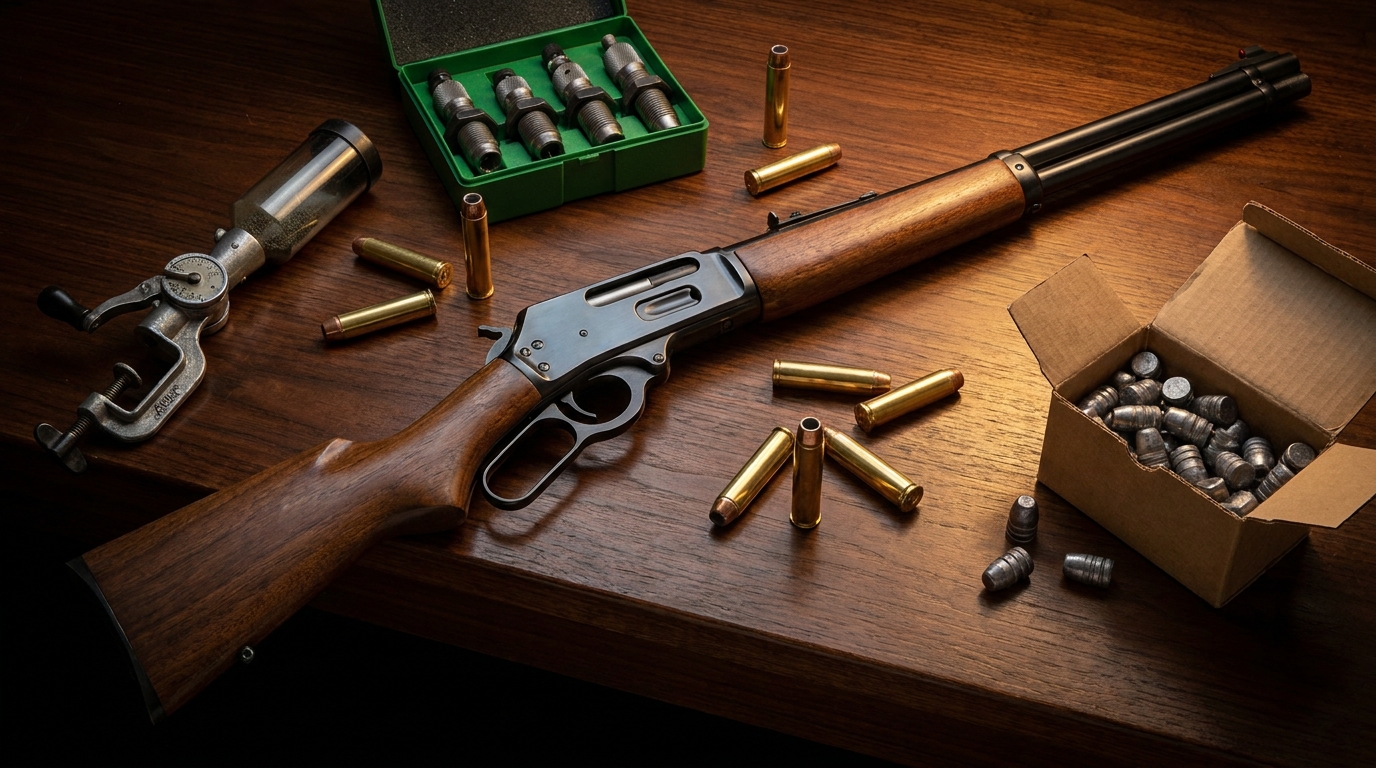
The .450 Marlin arrived in 2000 as a solution to a specific problem: the classic .45-70 Government, while excellent, is chambered in both modern and antique actions. Handloaders pushing the .45-70 to its full potential in a Marlin 1895 occasionally approached pressures that older rifle designs were never intended to handle. The .450 Marlin's belted case and slightly shorter overall length prevented any accidental interchange and allowed a cartridge designed from the start for higher sustained pressures — no guessing whether a load is appropriate for a particular action.
The result is a cartridge that delivers roughly equivalent energy to the .458 Winchester Magnum from a standard-length lever action. For Oregon hunters who work timber, close-country bear haunts, or the wet, dense elk country of the Cascades and Coast Range, this is a serious tool with a specific purpose. Here's how to load it well.
The .450 Marlin at a Glance
- Case length: 2.100 inches
- Overall length (COAL): 2.550 inches
- Bullet diameter: .458 inches
- Maximum average pressure (SAAMI): 43,500 psi
- Typical factory velocity (350 gr): 2,100 fps / 3,427 ft-lbs
- Parent case: .458 Winchester Magnum (rebated belt, shorter case)
Only Hornady loads factory ammunition for the .450 Marlin currently, which makes reloading not just appealing but nearly essential for regular shooters. The good news: brass is high quality, dies are available from all major manufacturers, and bullet selection in .458-inch diameter is excellent.
Brass and Case Prep
Hornady is the primary source for .450 Marlin brass. Buy a significant supply when you find it; availability can be inconsistent. Cases are thick-walled and strong, and the belt means headspace is controlled independently of case shoulder. Trim to 2.095 inches after the first firing; subsequent firings require less trimming than many high-pressure cases.
Full-length resize after every firing for lever-action use — the Marlin 1895 has a generous chamber and partial sizing leads to feeding issues in the tube magazine. Ensure primer pockets are uniform and primers are fully seated flush. Large rifle magnum primers are specified in most published load data; use them and don't substitute standard large rifle primers at maximum loads.
Bullets for Oregon Big Game
350-Grain Flat Point — The Standard
The classic lever-action flat point in .458-inch is the workhorse load for the .450 Marlin. Hornady's 350 gr FP is the reference bullet for most published load data and is excellent for black bear and elk inside 150 yards. At 2,100 fps, it delivers approximately 3,400 ft-lbs of muzzle energy — more than enough for any North American game. The flat nose is required for safe tube magazine use.
300-Grain Flat Point — Higher Velocity
Lighter 300-grain flat points push velocities into the 2,300 to 2,400 fps range and are a good choice for deer-sized game and predators. They sacrifice sectional density for speed but are an effective option when a flatter trajectory matters — say, on eastern Oregon mule deer habitat where shots to 150 yards are realistic.
400-Grain Hard Cast — Maximum Penetration
For heavy black bear or any situation where maximum penetration is the priority, hard cast flat-nose bullets at 400 grains are formidable. Expect velocities around 1,900 to 1,950 fps from a 22-inch barrel, but the deep penetration of a heavy hard cast at these velocities is exceptional. Recommended for backup use when spot-and-stalk bear hunting in dense timber.
Powder Selection
The .450 Marlin performs best with medium-burning rifle powders in the IMR 4198 to H322 burn rate range. Here are the most consistent performers:
- H322: Excellent with 350-grain loads. Consistent metering and good velocity with manageable pressure.
- IMR 4198: A classic big-bore rifle powder with great performance in .45-caliber lever guns. Slightly faster burn than H322.
- Lil' Gun: An underrated choice for the .450 Marlin, especially with lighter 300-grain bullets. Dense packing, excellent consistency.
- Reloder 7: Achieves top velocities with 350-grain bullets; slightly more temperature-sensitive than H322.
Always use current published load data from Hornady's reloading manual, which contains the most complete .450 Marlin load data available. Start 10 percent below maximum and work up in 0.5 gr increments while watching for pressure signs: flattened primers, sticky bolt lift, or ejector marks on the case head.
Sample Load Guidance
These are general reference loads only. Always consult a current published reloading manual and start at the minimum charge listed. Conditions, components, and individual chambers vary. Never exceed published maximum loads.
- 350 gr Hornady FP / H322: Start at the minimum published charge, work toward max velocity near 2,100 fps
- 300 gr FP / Lil' Gun: Start at the minimum published charge, work toward max near 2,350 fps
- 400 gr hard cast / IMR 4198: Start at the minimum published charge, work toward max near 1,950 fps
Recoil Management
The .450 Marlin hits back hard — expect 40 to 50 ft-lbs of free recoil from a typical 7.5-pound Marlin 1895. A quality recoil pad is non-negotiable; the factory pad on older Marlins is thin. Limbsaver and Pachmayr slip-on pads are a quick fix that makes a meaningful difference in a day of load development. From a shooting position, the Marlin's lever action allows for a firm but relaxed grip that manages straight-stock recoil better than most bolt actions in similar chamberings.
Oregon Applications
The .450 Marlin is built for specific Oregon terrain: wet-side elk woods where shots rarely exceed 100 yards, coastal black bear hunts over bait or in logged clearcuts, and the kind of close-cover Cascade mule deer hunting where a lever gun makes more practical sense than a 26-inch magnum bolt rifle. Its limitation is range — even at 2,100 fps, the 350-grain bullet drops sharply beyond 150 yards. Within its intended envelope, it is one of the most effective hunting cartridges available.
If you're already running a Marlin 1895 in .45-70 and considering a .450 Marlin, the answer is yes — if you hunt the kind of country this cartridge was built for. Load it carefully, shoot it thoroughly, and take it somewhere that tests it the way it deserves to be tested.