Few cartridges have earned such loyal followings on both ends of the hunting spectrum as the .243 Winchester. Introduced in 1955 on a necked-down .308 Winchester case, the .243 Win pushed a sleek, high-BC .24-caliber bullet fast enough to anchor varmints at 400 yards and quiet enough — with the right loads — to be a genuine pleasure to shoot all day on a prairie dog town. In Oregon, where a hunter might draw a pronghorn tag in the morning and spend the afternoon blasting ground squirrels in the wheat stubble, the .243 is as practical as it gets.
This guide covers reloading the .243 Winchester from the ground up: brass selection, primer and powder choices, and proven load recipes for both varmint work and big-game hunting in the Pacific Northwest.
Why the .243 Winchester Still Makes Sense in 2026
Newer cartridges like the 6mm Creedmoor and 6mm ARC have grabbed headlines, but the .243 Win offers something they don't: 70 years of factory ammunition availability and reloading data. In rural Oregon towns, your local hardware store carries .243 Win brass and bullets. That accessibility matters when you're running low on components before an early-season trip.
The cartridge is also inherently accurate. Its case geometry and moderate pressure ceiling allow it to run efficiently in short-action platforms — Remington 700s, Winchester Model 70 Featherweights, Tikka T3s — that are light and easy to carry on long blacktail deer pushes through the Coast Range.
Brass Selection and Preparation
Start with quality brass. Lapua .243 Win brass is the gold standard — consistent case weight, thick web, and exceptional longevity. Norma and Nosler brass are strong alternatives. Winchester and Federal factory brass are perfectly serviceable for hunting loads, especially if you're sorting by weight before loading.
Trim to the SAAMI spec length of 2.035 inches after every firing, or at minimum every other firing. Full-length resize unless your rifle is a dedicated single-firearm, in which case neck sizing extends case life considerably. Deburr flash holes on new brass, and uniform primer pockets if you're building bench-rest-level varmint loads.
Primers
The .243 Win operates at modest pressures (~60,000 PSI) and feeds small rifle primers. Federal 205M Small Rifle Match primers produce exceptional ignition consistency for accuracy-focused varmint loads. For hunting loads where you're less concerned about extreme spread, CCI 400 or Winchester Small Rifle primers are reliable and widely available throughout Oregon's sporting goods stores.
Powders
The .243 Win's 55.5-grain case capacity (water) pairs beautifully with medium-burn-rate powders. The following options cover the range from varmint to big game:
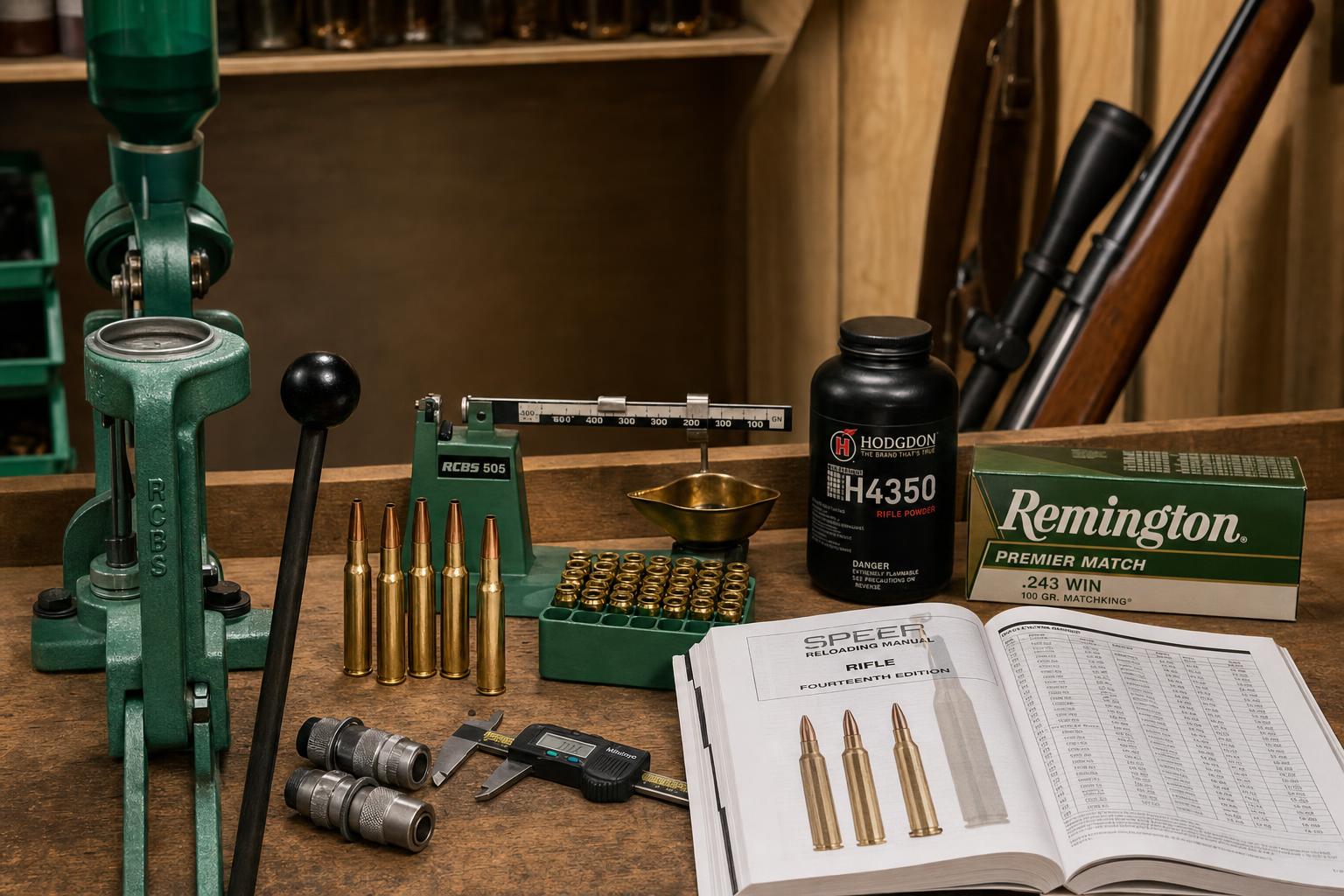
- Hodgdon H4350 — The single best all-around powder for the .243. Excellent accuracy with 87–105 grain hunting bullets, good temperature stability for Oregon's swinging fall temps.
- Hodgdon Varget — Slightly faster burn; ideal for 55–80 grain varmint bullets at top velocity. Very temperature insensitive.
- IMR 4350 — Classic choice for heavier bullets. Pairs well with 95-grain Nosler Partitions for blacktail deer.
- Reloader 22 (Alliant) — Pushes heavy 105-grain bullets at high velocity; excellent for long-range ground squirrel work where a flat trajectory is critical.
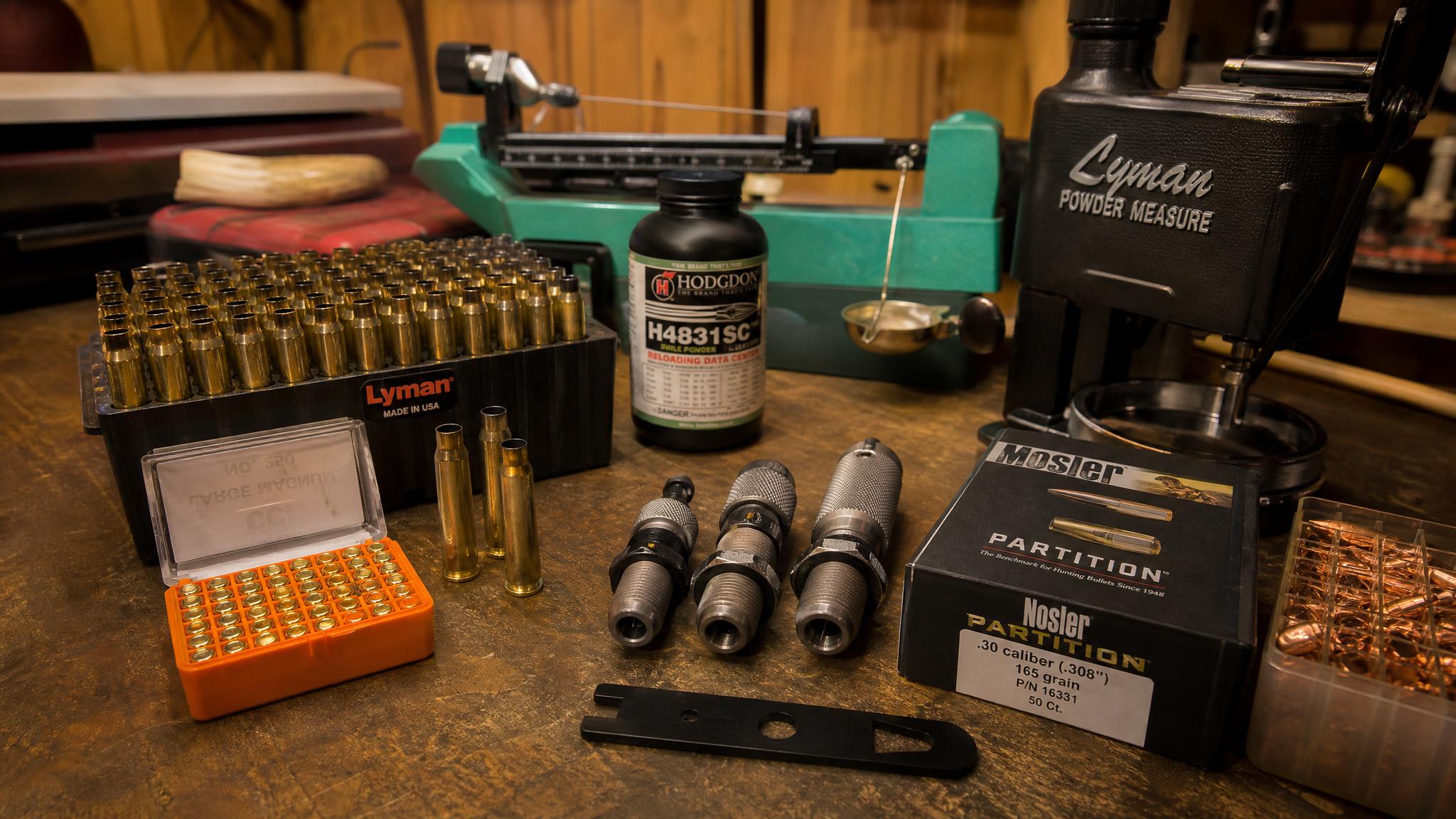
- Hodgdon H4831SC — Short-cut granules meter easily; good for 90–105 grain bullets with top-end velocity.
Load Data: Varmint Loads (55–70 Grain Bullets)
Always start 10% below max and work up. Verify against a current reloading manual.
55 gr Nosler Ballistic Tip (Varmint)
- Powder: Varget | Start: 37.5 gr | Max: 41.0 gr | MV: ~3,950 fps
- Powder: H4350 | Start: 39.0 gr | Max: 42.5 gr | MV: ~3,850 fps
- Primer: CCI 400 | COAL: 2.700"
70 gr Sierra Blitz-King
- Powder: Varget | Start: 36.0 gr | Max: 39.5 gr | MV: ~3,600 fps
- Powder: H4350 | Start: 38.0 gr | Max: 41.5 gr | MV: ~3,550 fps
- Primer: CCI 400 | COAL: 2.740"
These loads are ideal for ground squirrel control in Eastern Oregon wheat country — the Pendleton area, Morrow County, and the fields around Burns see significant squirrel populations that devastate hay crops. A 55-grain Ballistic Tip at 3,900+ fps is explosive at typical varmint distances.
Load Data: Hunting Loads (87–100 Grain Bullets)
87 gr Hornady ELD-X (Deer Load)
- Powder: H4350 | Start: 38.0 gr | Max: 41.5 gr | MV: ~3,300 fps
- Primer: Federal 205 | COAL: 2.710"
95 gr Nosler Partition (Blacktail / Columbian Whitetail)
- Powder: IMR 4350 | Start: 36.5 gr | Max: 40.0 gr | MV: ~3,050 fps
- Powder: H4350 | Start: 37.0 gr | Max: 40.5 gr | MV: ~3,100 fps
- Primer: Federal 205M | COAL: 2.710"
100 gr Sierra GameKing (Mule Deer / Pronghorn)
- Powder: H4831SC | Start: 38.0 gr | Max: 41.0 gr | MV: ~3,000 fps
- Powder: RL-22 | Start: 39.0 gr | Max: 42.0 gr | MV: ~3,050 fps
- Primer: CCI 400 | COAL: 2.710"
Oregon Applications: Where the .243 Shines
The .243 Winchester isn't a beast — it won't anchor Roosevelt elk at 300 yards with confidence. But for Oregon's most common hunting situations, it's hard to beat:
- Blacktail deer in the Coast Range — the 95-grain Partition at 3,050 fps handles timber shots at 50–150 yards with authority
- Columbia Basin pronghorn — the 100-grain GameKing is flat-shooting enough for 300-yard open-country shots
- Mule deer in the Ochoco and Maury units — manageable recoil for youth or recoil-sensitive hunters
- Ground squirrels in Eastern Oregon's wheat country — nothing beats a light, fast 55-grain varmint bullet for all-day shooting
- Coyotes year-round — the .243's flat trajectory and explosive varmint bullets make it a top predator cartridge
Tips from the Bench
Seat bullets to within 0.015" of the lands for best accuracy in bolt guns. Use a comparator tool to find your chamber's actual freebore. The .243 Win responds dramatically to seating depth experimentation — sometimes 0.010" makes the difference between a 1-MOA group and a 0.5-MOA group.
Neck tension matters too. Run an expander that gives you 0.001"–0.002" of interference fit on the bullet shank. Too little tension and you'll see ES (extreme spread) blow up at distance.
Finally, watch your barrel heat on varmint days. The .243's small bore and high velocity generate significant heat — many factory barrels start walking shots after 5–6 rapid rounds. Let it cool, and your groups will thank you.
The .243 Winchester has been sending Oregon hunters and varmint shooters home happy for seven decades. With quality handloads dialed in, it remains one of the most versatile and enjoyable cartridges you can put at your bench.