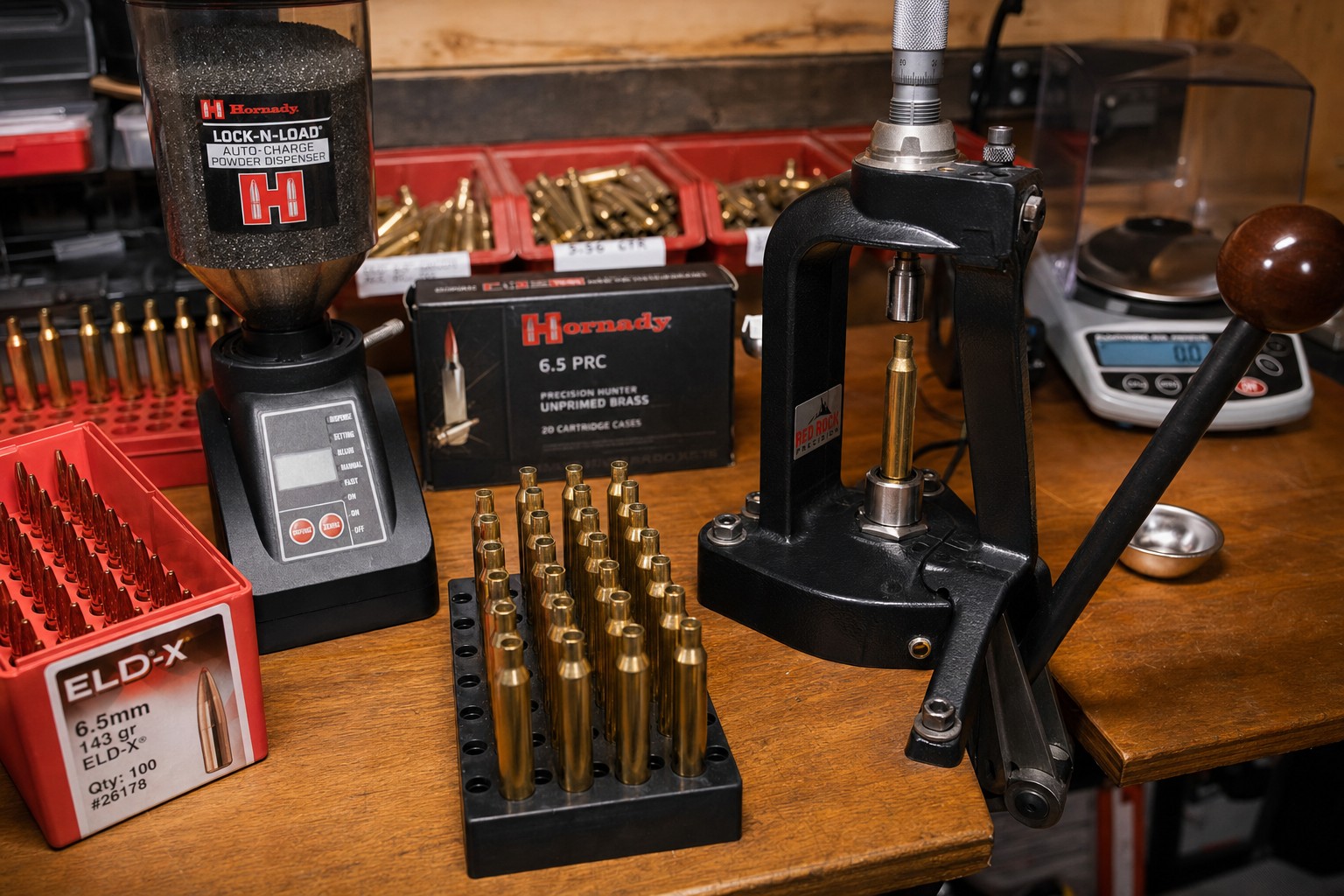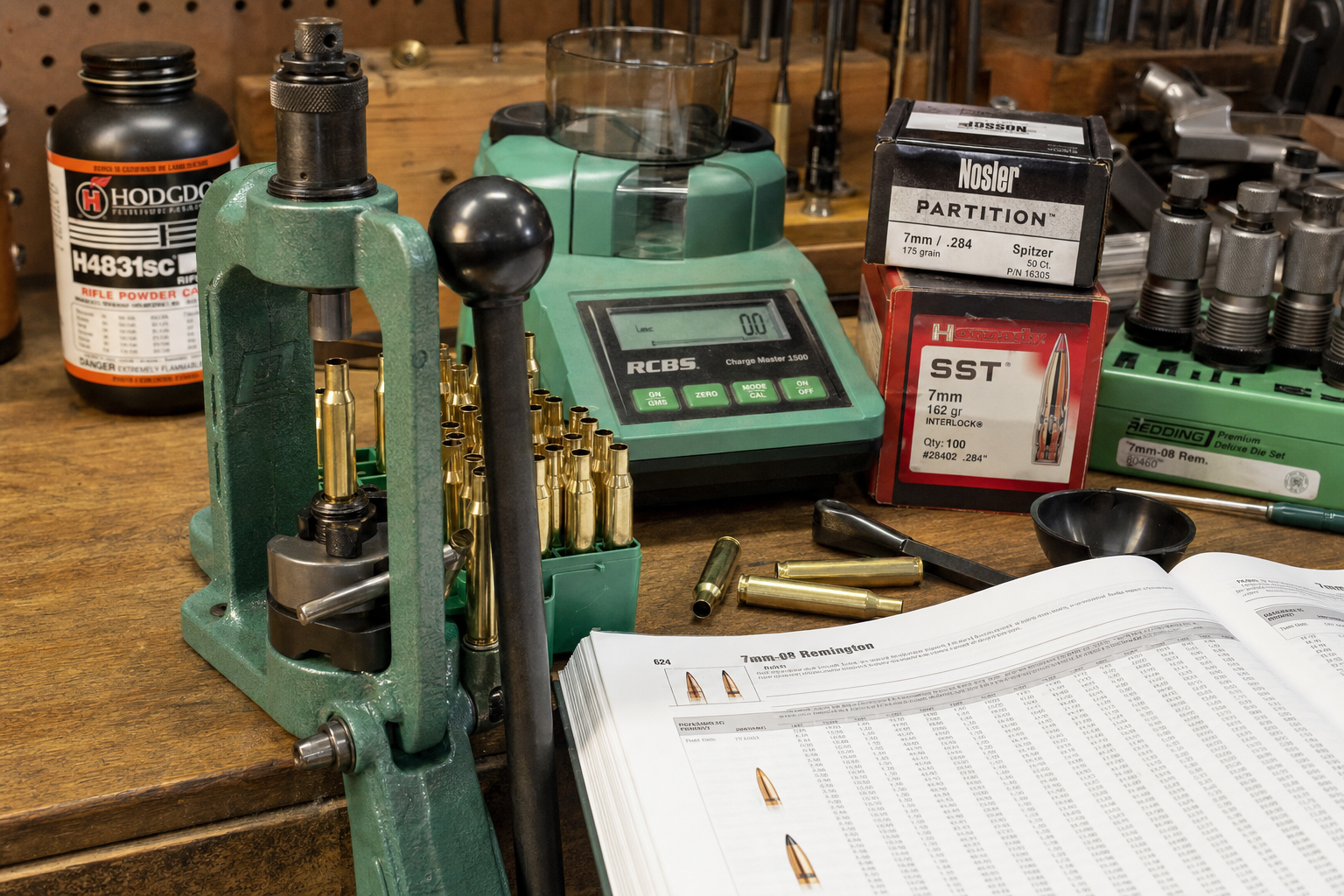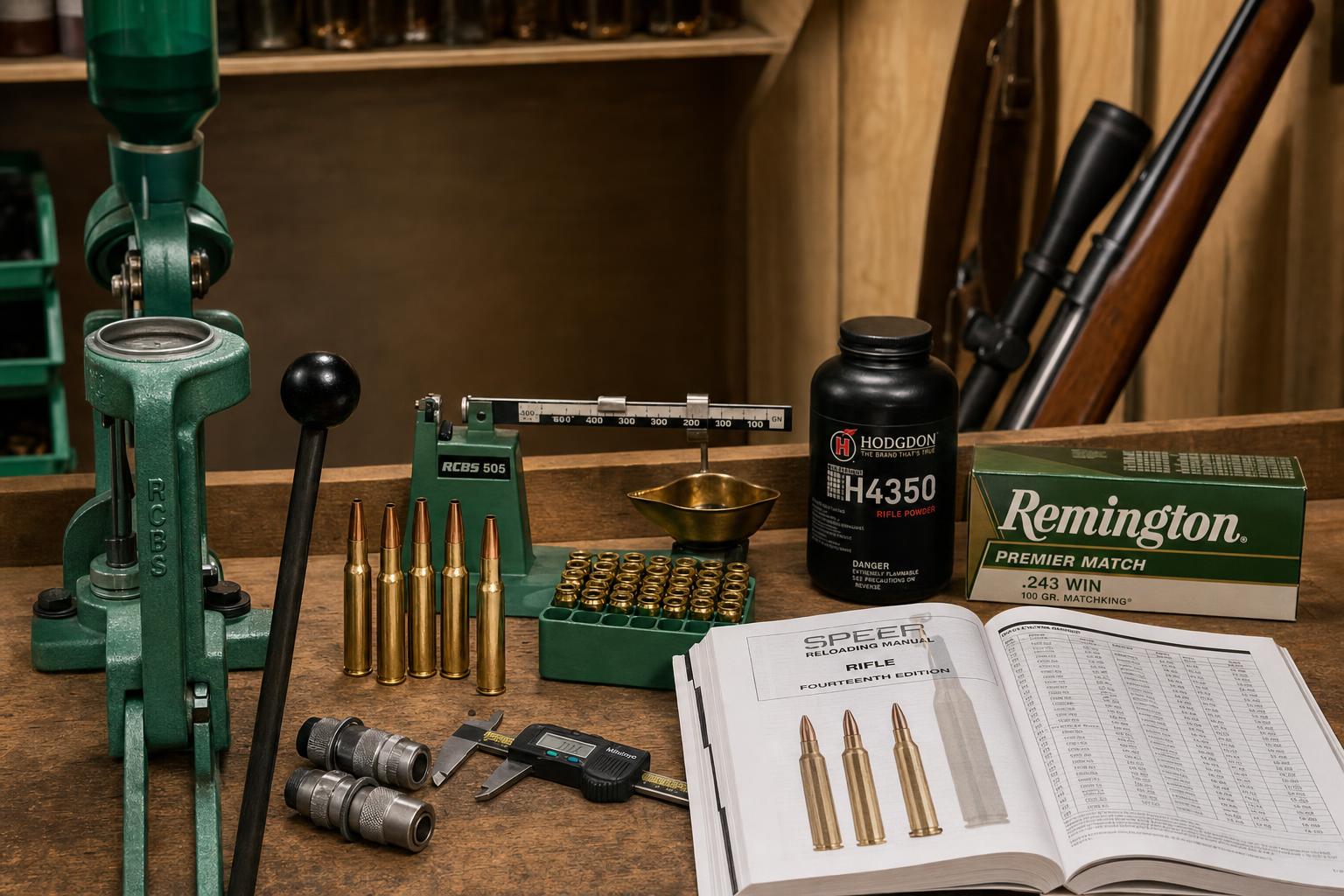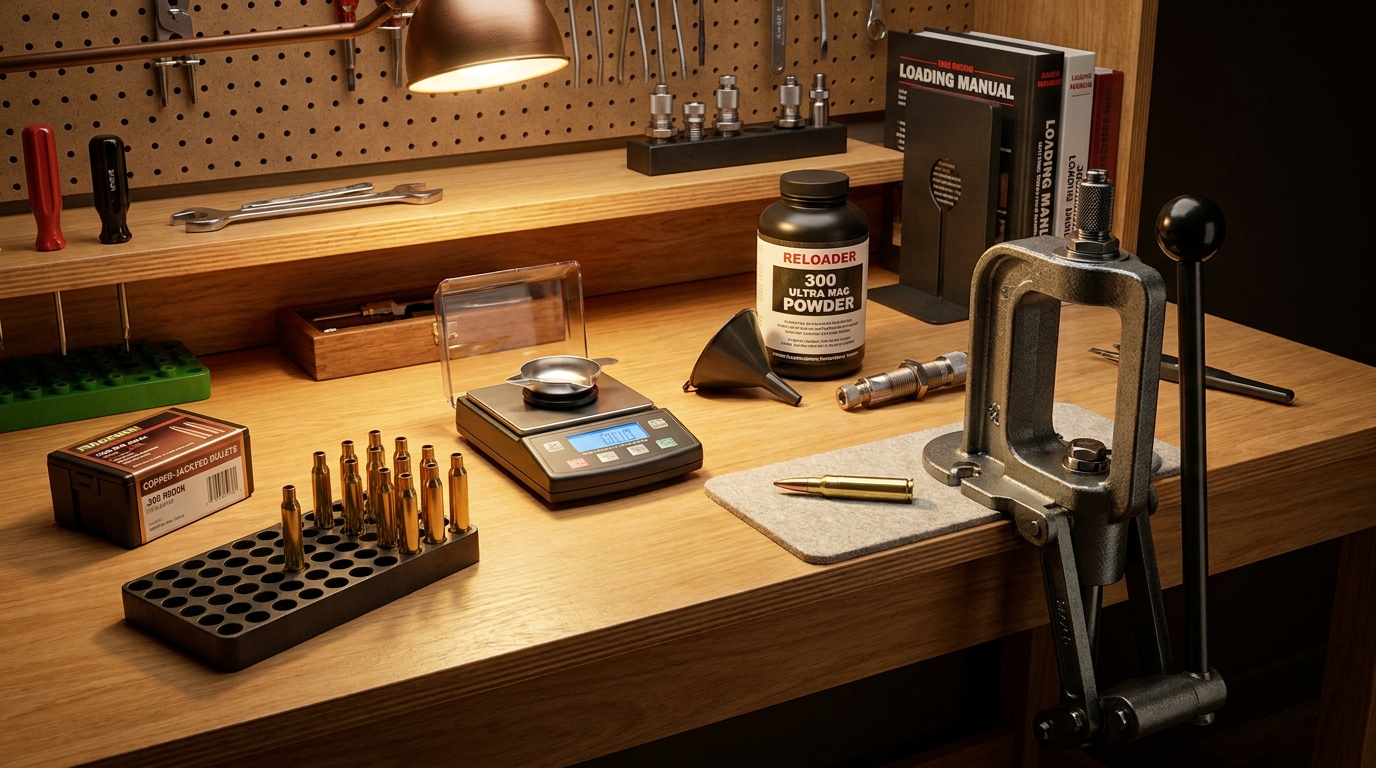
Remington introduced the .300 Ultra Mag in 1999 as the most powerful commercial .30-caliber cartridge available in a standard bolt-action rifle. It delivers on that promise—with the right handloads, you can push a 180-grain bullet past 3,250 fps and a 200-grain past 3,050 fps from a 26-inch barrel. That performance comes at a cost: factory ammunition runs $4–6 per round, recoil is substantial, and barrel life is measured in hundreds of rounds rather than thousands. Handloading mitigates the cost issue significantly and lets you tune loads for your specific rifle.
The Case: A Rebated Rim Monster
The .300 RUM is based on the .404 Jeffery case, rebated to accept a standard .534-inch bolt face. It is a beltless magnum with a 30-degree shoulder and enormous case capacity—roughly 110 grains of water capacity. This dwarfs even the .300 Winchester Magnum (90 grains) and explains both the performance and the powder consumption. Expect to use 80–90 grains of slow-burning powder per load, which means a pound of Retumbo yields approximately 70–80 loaded rounds.
Brass Life and Prep
The .300 RUM operates at high pressures (65,000 PSI SAAMI max), which accelerates primer pocket wear and brass stretching. Remington brass—the most common on the market—is functional but relatively soft. Nosler and Norma brass are meaningfully thicker at the web and last significantly longer. Either way, sort your brass by headstamp, anneal cases every 2–3 firings, and full-length size with a carbide or quality steel die. Trim to 2.840 inches (SAAMI max: 2.850); the big case stretches predictably with hot loads.
Flash hole uniforming and primer pocket uniforming are worthwhile at this pressure level. Consistent primer seating depth—.002–.003 inches below flush—matters for standard deviation. A Sinclair or Wilson hand primer seating tool is worth the investment on a cartridge you’re going to use for serious hunting.
Powder Selection
The .300 RUM requires the slowest powders available to take full advantage of its case capacity. Faster powders peak pressure too early and leave velocity on the table while spiking peak pressure. The following are proven performers:
- Hodgdon Retumbo: The benchmark powder for this cartridge. Burns clean, meters well, and produces excellent velocity with standard deviation in the single digits when loads are properly developed. Start around 88 grains with 180-grain bullets and work up carefully.
- Alliant Reloder 25: Slightly temperature-sensitive compared to Retumbo but produces excellent velocity in milder conditions. Good choice for Pacific Northwest hunters who aren’t dealing with extreme heat or cold swings.
- Hodgdon H1000: A tick faster than Retumbo, which makes it useful with heavier 200–220-grain bullets where you don’t need every last foot-per-second. Produces a bit less velocity with 180-grain pills but with exceptional consistency.
- IMR 7977 and IMR 8133: Enduron-series powders with built-in heat-stabilizing additives—excellent for hunters who move between cold morning stands and hot afternoon road trips. The temperature insensitivity is a genuine field advantage.
Bullet Selection
The .300 RUM is primarily an open-country cartridge, and bullet selection should reflect that. At the velocities this case generates, cup-and-core bullets can jacket-separate on shoulder hits at close range. Bonded and monolithic options handle the full velocity envelope safely.
For Elk (180–200 grain)
- Nosler Partition 180 gr: The original controlled-expansion bullet. Proven on elk for decades. The dual-core design ensures reliable expansion even after long-range velocity bleed-down.
- Federal Trophy Bonded Bear Claw 180 gr: Extremely high weight retention on heavy bone. A top choice for close-range shots where velocity is still very high.
- Hornady ELD-X 200 gr: For hunters pushing past 500 yards, the 200-grain ELD-X retains enough velocity for reliable expansion at distance. BC of .597 in G1—exceptional for a hunting bullet.
- Berger Hybrid Hunter 185 gr: Offers match-grade accuracy potential in a hunting-appropriate jacket design. Excellent choice if your rifle has a tighter-than-standard twist barrel.
For Mule Deer (165–180 grain)
- Nosler AccuBond 165 gr: High BC, excellent accuracy, and enough toughness for elk if the opportunity arises. A versatile go-to for eastern Oregon’s open country where shots can range from 100 to 600 yards in a single hunt.
- Swift Scirocco II 165 gr: Polymer-tipped bonded bullet with exceptional long-range terminal performance. Holds together well at the high impact velocities the RUM generates on close shots.
Starting Load Data (Always Work Up from Published Minimums)
Important: The following data is for reference only. Always begin 10% below maximum and work up in 1-grain increments while watching for pressure signs (flattened primers, sticky extraction, cratered primer pockets). The .300 RUM is an unforgiving cartridge when overloaded.
- 180 gr Nosler Partition / Retumbo: Start 85.0 gr → max approximately 92.0 gr | Velocity: 3,150–3,260 fps (26-inch barrel)
- 200 gr Hornady ELD-X / H1000: Start 82.0 gr → max approximately 88.0 gr | Velocity: 2,960–3,050 fps
- 165 gr Nosler AccuBond / Retumbo: Start 87.0 gr → max approximately 94.0 gr | Velocity: 3,280–3,400 fps
Always verify against current Hodgdon, Nosler, or Sierra reloading manuals. Published maximums vary by source and barrel length.
Seating Depth and Accuracy
The .300 RUM’s long action and generous freebore give handloaders flexibility in seating depth. Most rifles prefer bullets seated 0.010–0.040 inches off the lands. Use a Hornady OAL gauge or Sinclair comparator to measure your specific chamber and experiment with seating depth in 0.005-inch increments. The difference between a 1.5 MOA load and a sub-MOA load in these rifles is often entirely seating depth.
If your .300 RUM shoots in the 0.75–1.25 MOA range with factory ammunition, don’t expect handloads to automatically do better. Barrel quality, action bedding, and stock-to-action fit all matter. A properly bedded rifle in a quality synthetic stock will almost always outperform a pressure-fitted factory stock, especially as the barrel heats up over multiple shots.
Managing the Recoil Factor
A 10-pound .300 RUM rifle generates roughly 45–50 foot-pounds of recoil—about double a .30-06. A quality muzzle brake reduces felt recoil to manageable levels but is not practical for hunting situations without adequate hearing protection. A suppressor is a better field solution and is legal for hunting in Oregon. If hunting without either, practice from field positions (prone, kneeling) rather than the bench to build real-world confidence with the recoil.
The .300 RUM isn’t for everyone. But for the hunter who needs maximum performance at extreme range in Oregon’s open country—glassing mule deer across a canyon in Harney County, or reaching a bull elk bedded on a sidehill in the Wallowas—it remains one of the most capable tools available when loaded correctly.