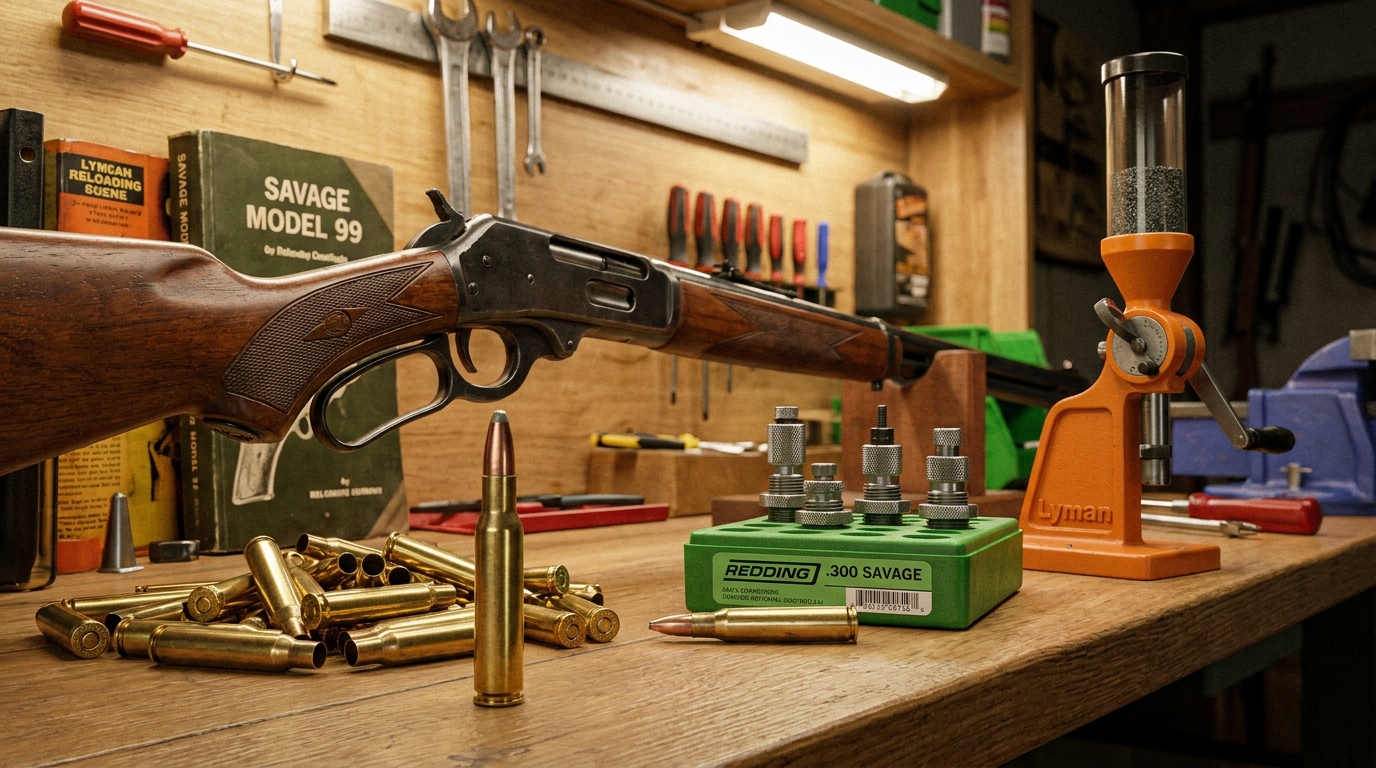
The .300 Savage doesn't come up much in modern reloading conversations. It's not a precision cartridge, it's not a magnum, and it doesn't appear on any competitive shooting circuit. What it is, however, is one of the most historically significant deer cartridges ever chambered in an American rifle — and for owners of a Savage 99, Savage 720, or any of the other lever and bolt actions chambered for it, handloading the .300 Savage opens the door to a cartridge that punches well above its humble reputation.
A Brief History
Introduced by Savage Arms in 1920, the .300 Savage was designed to approximate the ballistics of the .30-06 Springfield in a package short enough to cycle through the rotary magazine of the Savage Model 99 lever action. At the time, this was a genuine engineering achievement — delivering around 2,630 fps with a 150-grain bullet from a cartridge less than 2 inches overall length. The .300 Savage was adopted by the U.S. military for development trials in the late 1940s, work that ultimately led directly to the development of the 7.62x51mm NATO (.308 Winchester). It's not an exaggeration to say the .300 Savage shaped modern cartridge design.
For hunters, it remains a legitimate deer and black bear cartridge out to 250–300 yards. Modern components and careful handloading can wring significantly better performance from it than factory ammunition typically delivers.
Case and Brass
Quality brass for the .300 Savage is available but not abundant — Starline is your best option and is widely regarded as the finest .300 Savage brass on the market. Remington brass is also available and serviceable. Avoid reloading military or mystery-headstamp brass of unknown provenance.
The .300 Savage case is a rimless, bottlenecked design with a relatively short case body (1.871 inches) and moderate taper. Case prep is straightforward:
- Trim to 1.871 inches; max length is 1.871 inches
- Primer pocket uniforming is worthwhile, especially in Remington brass
- Full-length resize for semi-auto or lever actions; neck size only for dedicated bolt-gun accuracy work
- Deburr and chamfer case mouths after trimming
- Anneal every 3–4 firings to maintain neck tension consistency
Primers
The .300 Savage uses Large Rifle primers. Standard LR primers are appropriate for most hunting loads. Federal 210, CCI 200, and Winchester WLR are all proven choices. For magnum-charge powders near the top of the load data range, Federal 210M (Match) primers can improve ignition consistency, though most standard hunting loads don't require them.
Powder Selection
The .300 Savage's moderate case capacity (roughly 52–54 grains of water) responds best to medium-burn-rate powders in the IMR 4064 / Varget / IMR 4895 range. Faster powders like IMR 3031 also perform well with lighter bullets. Avoid slow-burning powders (H4831, RL-25) — the case simply isn't large enough to use them efficiently.
Top Powder Choices
- Varget (Hodgdon): Excellent all-around choice; excellent temperature stability; ideal for 150–165 grain bullets; start at 40.0 gr, work toward 43.0 gr maximum
- IMR 4064: Classic powder for this cartridge; good metering; works well with 150 and 165 grain bullets; start at 39.5 gr, max around 42.5 gr
- IMR 4895: Slightly faster than 4064; excellent with 150 grain projectiles; start at 38.5 gr, max around 41.5 gr
- IMR 3031: Faster burn rate; best suited for 110–130 grain varmint loads; start at 35.0 gr, max 38.0 gr
- H4895: Very similar to IMR 4895; good consistency; recommended for starting loads at 60% of max when developing new recipes
All load data should be cross-referenced against current published data from Hodgdon, Sierra, Hornady, or Nosler. Do not exceed published maximum loads. Pressure signs vary by firearm condition and age — approach maximums conservatively, especially in older Savage 99 actions.
Bullet Selection and Performance
For deer and black bear hunting, the .300 Savage shines with 150–165 grain bullets at velocities of 2,500–2,650 fps from a 24-inch barrel (somewhat less from the Model 99's 22-inch tube). This puts it in the same practical ballistic neighborhood as a mild .308 Winchester load — adequate for shots to 250 yards on deer-sized game with proper bullet selection.
Recommended Bullets
- Sierra 150 gr GameKing SPBT: Excellent accuracy and terminal performance; a natural fit for the .300 Savage
- Hornady 150 gr InterLock SP: Proven deer bullet, feeds well in the Savage 99 rotary magazine
- Nosler 165 gr Partition: For bear or elk work; the Partition's controlled expansion holds up on heavier game
- Sierra 165 gr GameKing: Maximum practical bullet weight for the .300 Savage; drops velocity but retains excellent sectional density
- Speer 130 gr Hot-Cor: A lighter option for reduced recoil training loads or antelope-class game
One important note for Savage 99 owners: bullet seating depth matters. The Model 99's rotary magazine limits overall cartridge length to approximately 2.600 inches. Most 150–165 grain hunting bullets seat comfortably within this constraint, but verify your specific load before running a full batch.
Sample Loads
These are representative starting points only — always begin 10% below max and work up while watching for pressure signs:
- 150 gr Sierra GameKing / Varget 41.5 gr / CCI 200 / ~2,580 fps (24-inch barrel)
- 150 gr Hornady InterLock / IMR 4064 41.0 gr / Federal 210 / ~2,560 fps
- 165 gr Nosler Partition / Varget 40.0 gr / Federal 210 / ~2,420 fps
The .300 Savage Today
If you inherited a Savage 99 from your grandfather, or picked one up at a gun show because the rotary magazine is one of the coolest mechanical designs in American firearms history, the .300 Savage is worth shooting seriously. Factory ammunition is available but limited — and most of what's on shelves is loaded conservatively. Handloading this cartridge lets you access its real potential: a smooth-cycling, accurate, genuinely capable deer round in a rifle with more character than anything currently rolling off a production line. That's worth the time at the bench.