The .380 ACP — also known as 9mm Kurz, 9mm Short, or 9x17mm — has become the dominant cartridge in America's concealed carry market. Pocket pistols chambered in .380 are everywhere: the Ruger LCP, Smith & Wesson Bodyguard, Glock 42, SIG P238, and dozens more. And factory .380 ACP ammunition, while plentiful, isn't cheap — and quality varies dramatically between manufacturers. Loading your own changes the economics and the performance.
The .380 ACP isn't the easiest cartridge to reload. Small cases, finicky overall length tolerances, and the tight chambers on some pocket pistols demand attention to detail. But done right, handloaded .380 is accurate, consistent, and significantly cheaper than anything off the shelf.
Cases and Brass Selection
Start with once-fired brass if you can get it, and stick to a single headstamp. .380 ACP cases have very little case volume, which means charge weight variation is amplified. Mixed brass from various manufacturers can produce noticeable velocity spreads even with identical charge weights. For serious load development, sort by headstamp and stick to one brand.
Popular and consistent .380 brass includes Starline (excellent, highly recommended), Federal, and Remington. Avoid cheap steel-case .380 — it's not reloadable and if it gets mixed into your brass bin, it'll be obvious when you run it into the sizer die.
Inspect cases carefully before loading. .380 ACP runs at 21,500 PSI max, which is moderate pressure, but the small case doesn't leave much room for errors in case condition. Look for case head separations, cracks, and heavily work-hardened necks. Because pocket pistols often eject onto hard surfaces, case mouths frequently get dinged or dented. Trim damaged cases or discard them.
Full-length size every case. The .380 headspaces on the case mouth, so consistent case length is critical for function in tight-chambered pocket guns. Use a case trimmer to keep length at 0.680 inches (trim to 0.670"). Deburr and chamfer after trimming.
Primers
Small pistol primers are the call here. Standard (not magnum) primers work well with any of the powders listed below. Federal 100, CCI 500, Winchester WSP, and Remington 1½ are all solid choices. For pocket pistols with heavy hammer strikes, any of these will provide reliable ignition. Magnum small pistol primers are unnecessary for .380 ACP with fast-burning powders.
Seat primers to 0.004 to 0.006 inches below flush. A proud primer in a pocket pistol is a liability — these guns have minimal lockwork and any primer protrusion can cause slam-fire risk.
Powder Selection
The .380 ACP needs fast-burning pistol powder. The case is tiny — there's simply no room for slower powders — and you want clean, complete combustion in short barrels that typically run 2.75 to 3.75 inches.
- Hodgdon TiteGroup: The top choice for .380 ACP. Extremely position-insensitive, very consistent, and meters beautifully in rotary powder measures. Low charge weights mean a pound of TiteGroup goes a long way.
- Alliant Power Pistol: A bit slower than ideal but works well for hotter practice loads. Slightly more flash in short barrels.
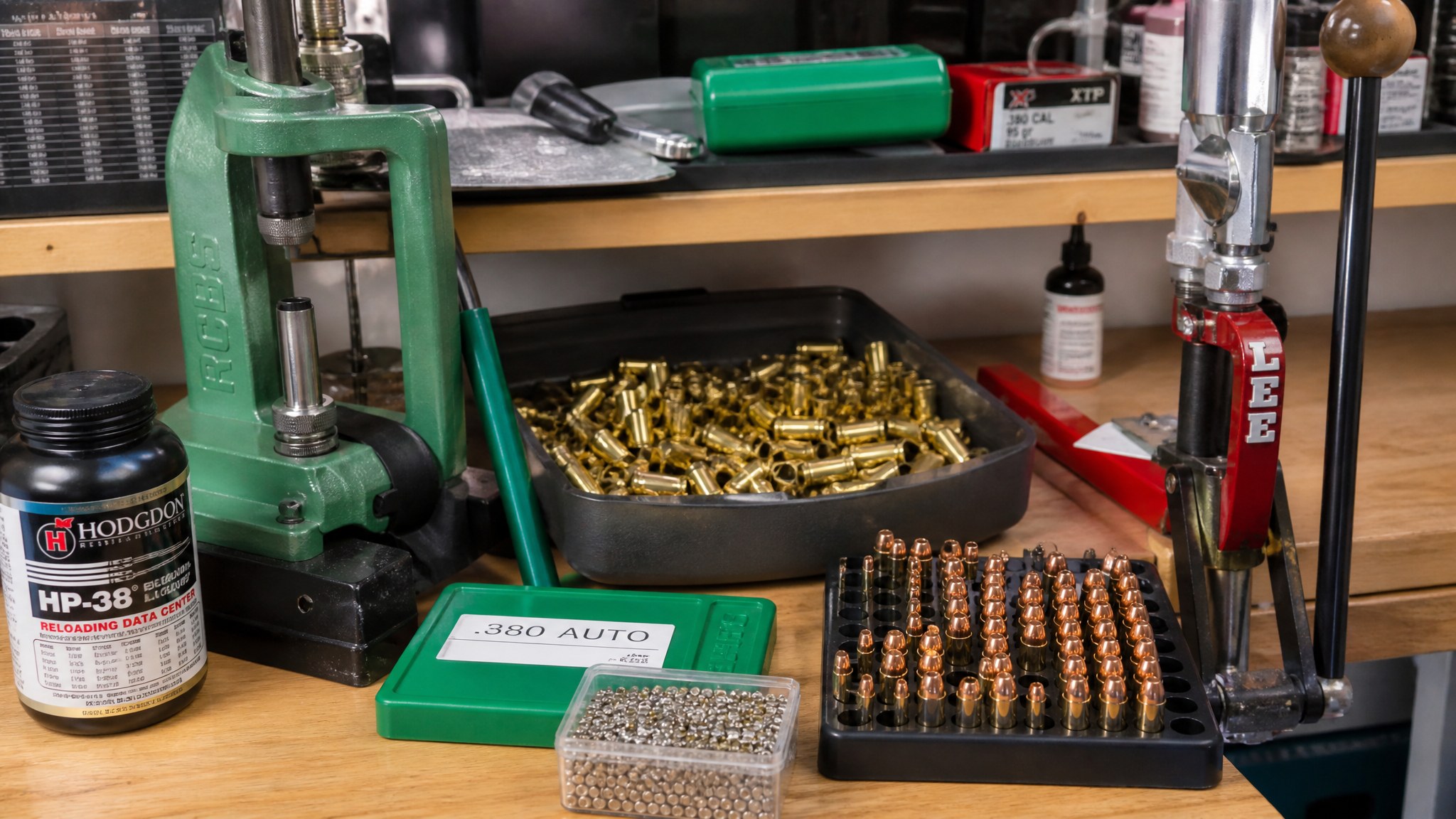
- Hodgdon HP-38 / Winchester 231: These are the same powder. Clean-burning, excellent metering, very popular for .380 practice loads. Great all-around choice.
- Accurate No. 2: Fast-burning, low charge weights, good for light practice loads.
Proven Load Data
Always cross-reference with your specific reloading manual. These are representative loads from published sources — start at the minimum charge and work up, watching for pressure signs.
95gr FMJ Practice Load (Using TiteGroup)
- Bullet: 95gr FMJ RN (Hornady or Berry's)
- Powder: TiteGroup 3.1gr (start) to 3.4gr (max)
- Primer: CCI 500
- COAL: 0.984"
- Expected velocity: 870–920 fps from a 3.75" barrel
90gr HP Defensive Load (Using HP-38)
- Bullet: 90gr XTP (Hornady)
- Powder: HP-38 / W231 3.3gr (start) to 3.8gr (max)
- Primer: Federal 100
- COAL: 0.972"
- Expected velocity: 900–970 fps
The 90gr XTP is the classic .380 ACP defensive bullet for handloaders. It expands reliably at .380 velocities (unlike many bonded defensive bullets designed for higher-velocity 9mm or .40 S&W), and it's been around long enough that its terminal performance is well-documented.
Crimp and Overall Length
The .380 ACP is a straight-walled case that headspaces on the case mouth, which means you cannot use a roll crimp — it would destroy the headspace surface. Use a taper crimp only, removing just enough bell from the case mouth to allow reliable feeding. Your completed round should gauge correctly in a case gauge (Dillon or L.E. Wilson .380 ACP gauge) and drop freely from the chamber of your pistol.
Overall length is critical in the .380. Many pocket pistols have extremely tight feed ramps and short chambers. The standard COAL for most .380 ACP loads is 0.960" to 0.984". Stay within the published data for your specific bullet. A round loaded too long won't chamber; too short, and you may spike pressure to unsafe levels in this small case.
Function Testing
Before loading up 500 rounds of a new .380 load, make 20 to 25 rounds and run them through your carry gun from various magazine positions — fully loaded, half-loaded, and with the last round in the magazine. Pocket pistols are notoriously ammunition-sensitive, and your handloads need to feed, fire, extract, and eject reliably before you trust them.
If you're loading for a carry gun, put at least 50 rounds of your defensive load through the gun before carrying it. The .380 ACP is a small-case cartridge with no room for reliability concerns.
Cost and Yield
A pound of TiteGroup yields approximately 1,900 rounds of .380 ACP at the charge weights above. With brass you've tumbled and reused, your cost per round runs roughly 8 to 12 cents depending on current component prices — compared to 25 to 40 cents per round for comparable factory practice ammunition. Load a few hundred rounds of good practice ammo, spend the savings on range time, and your .380 shooting will improve dramatically.