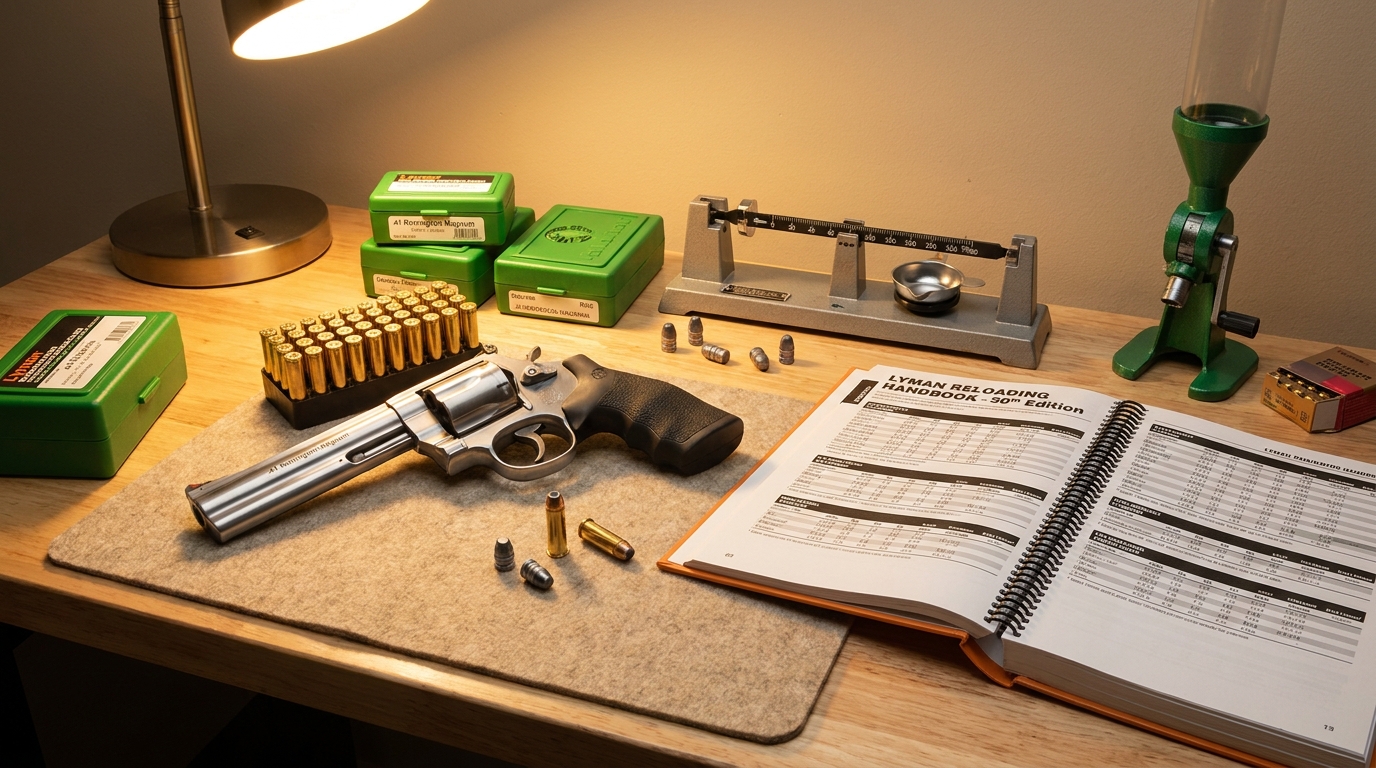
The .41 Remington Magnum has always been caught between two louder siblings. The .357 Magnum gets the nod for versatility and controllability; the .44 Magnum gets the nod for raw power and recognition. The .41 sits in the middle, misunderstood and underutilized—which is unfortunate, because it's genuinely excellent. For handgun hunters, backcountry hikers carrying sidearms in Oregon's black bear and cougar country, or anyone who wants a hard-hitting revolver cartridge that doesn't beat them senseless, the .41 Magnum deserves a second look. And once you're reloading for it, it deserves a very long look indeed.
A Brief History
Bill Jordan and Skeeter Skelton pitched the .41 Magnum to Remington in the early 1960s as a law enforcement cartridge that would outperform the .357 Magnum without the ferocity of the .44. Smith & Wesson produced the Model 57 and 58 to chamber it, and Remington introduced the round in 1964. Law enforcement never adopted it widely, but hunters embraced it. Today the cartridge enjoys a loyal following among serious handgun hunters who appreciate its ballistic efficiency and reloadability.
Case Preparation
The .41 Magnum brass is straightforward to work with. New Starline brass is the gold standard—consistent wall thickness, tight primer pockets, and excellent durability through multiple reloads. Once-fired commercial brass from Federal or Remington works well but inspect it carefully; the cartridge generates substantial pressure and weak spots show up as case head separation after several loadings.
- Decapping and resizing: Standard carbide sizing dies (RCBS, Redding, Lee) handle the .41 without case lube required—a major convenience advantage over bottleneck rifle brass
- Trimming: The .41 Magnum SAAMI trim length is 1.285 inches. Trim to this after each firing if cases are approaching max length; straight-wall pistol brass usually requires trimming less frequently than rifle brass
- Primer pockets: Inspect and clean after each decapping. .41 Magnum runs at significant pressure—keep primer pockets snug and consistent
- Primer size: Large pistol magnum primers (Federal 150, CCI 350, Winchester WLP) are standard
Hunting Loads: Heavy Bullets for Deep Penetration
The .41 Magnum shines as a hunting cartridge when loaded with 210–265 grain hard-cast or jacketed bullets. These loads are appropriate for Oregon deer, black bear, and as a backup sidearm in big cat country.
210 Grain JHP – All-Around Hunter
- Bullet: Hornady XTP 210 gr or Sierra JHC 210 gr
- Powder: H110 or W296 – 21.0–23.5 grains (work up carefully; these powders are pressure-sensitive near max)
- Primer: CCI 350 Magnum Large Pistol
- COAL: 1.590 inches
- Velocity: Approximately 1,400 fps from a 6-inch barrel
- Notes: Excellent for deer-size game; controlled expansion and good penetration through shoulder
265 Grain Hard Cast – Bear and Defense
- Bullet: Cast Performance 265 gr WFNGC or Beartooth Bullets 265 gr FNGC
- Powder: Lil' Gun – 17.5–19.5 grains
- Primer: Federal 150 or CCI 350
- COAL: 1.590 inches
- Velocity: Approximately 1,175 fps from a 6-inch barrel
- Notes: Non-expanding hard cast loads penetrate deeply and are the correct choice for defense against Oregon black bear; the wide flat nose crushes tissue rather than deflecting off bone
Mid-Range Practice Loads: Stay Sharp Without the Beating
Full-power .41 Magnum loads are punishing to shoot in volume. Smart reloaders develop a mid-range load that keeps the gun running without destroying your hands or concentration.
210 Grain Cast – Reduced Recoil Trainer
- Bullet: Any 210 gr lead SWC or LSWC cast to 15–16 BHN
- Powder: Unique – 8.5–9.5 grains
- Primer: CCI 300 Large Pistol (standard, not magnum)
- COAL: 1.570 inches
- Velocity: Approximately 950–1,000 fps from a 6-inch barrel
- Notes: Pleasant to shoot, accurate, and economical with cast bullets at pennies per round. Excellent for trigger work and practice at the range
Powders That Work
The .41 Magnum responds to a range of propellants depending on bullet weight and intended use:
- H110 / W296: The go-to for maximum velocity with jacketed bullets. Fills the case well, meters consistently, and produces the authentic magnum experience. Do not reduce below 90% of maximum—these powders can cause pressure spikes with reduced charges.
- Lil' Gun: Excellent with heavy cast bullets. Slightly more forgiving than H110 in reduced loads, consistent ignition, and mild muzzle flash.
- Alliant 2400: A classic magnum pistol powder with a long track record in the .41. Slightly softer recoil impulse than H110, well-suited for mid-weight bullets in the 210–220 grain range.
- Unique / Power Pistol: Best for mid-range and plinking loads. Not appropriate for full-power hunting loads but excellent for building volume practice ammo.
Reloading Safety Notes
The .41 Magnum operates at up to 36,000 CUP. A few fundamentals bear repeating:
- Always start at published minimum loads and work up incrementally, checking for pressure signs at each step
- Never mix data from different manuals without cross-referencing—the .41 has decades of load data spanning different pressure standards
- Check COAL against your specific revolver's cylinder length—some older Smith & Wesson Model 57 cylinders are tighter than modern data assumes
- Inspect brass carefully for case head cracking, especially in older or heavily reloaded cases
The .41 Magnum won't replace the .357 or the .44 in your gun safe. It isn't trying to. It's doing its own thing—accurate, hard-hitting, and almost completely overlooked by the hunting public. Get a Smith & Wesson Model 57 or 657 (or a Ruger Blackhawk if you lean single-action), load it thoughtfully, and discover why the handgunners who shoot this cartridge tend to never give it up.