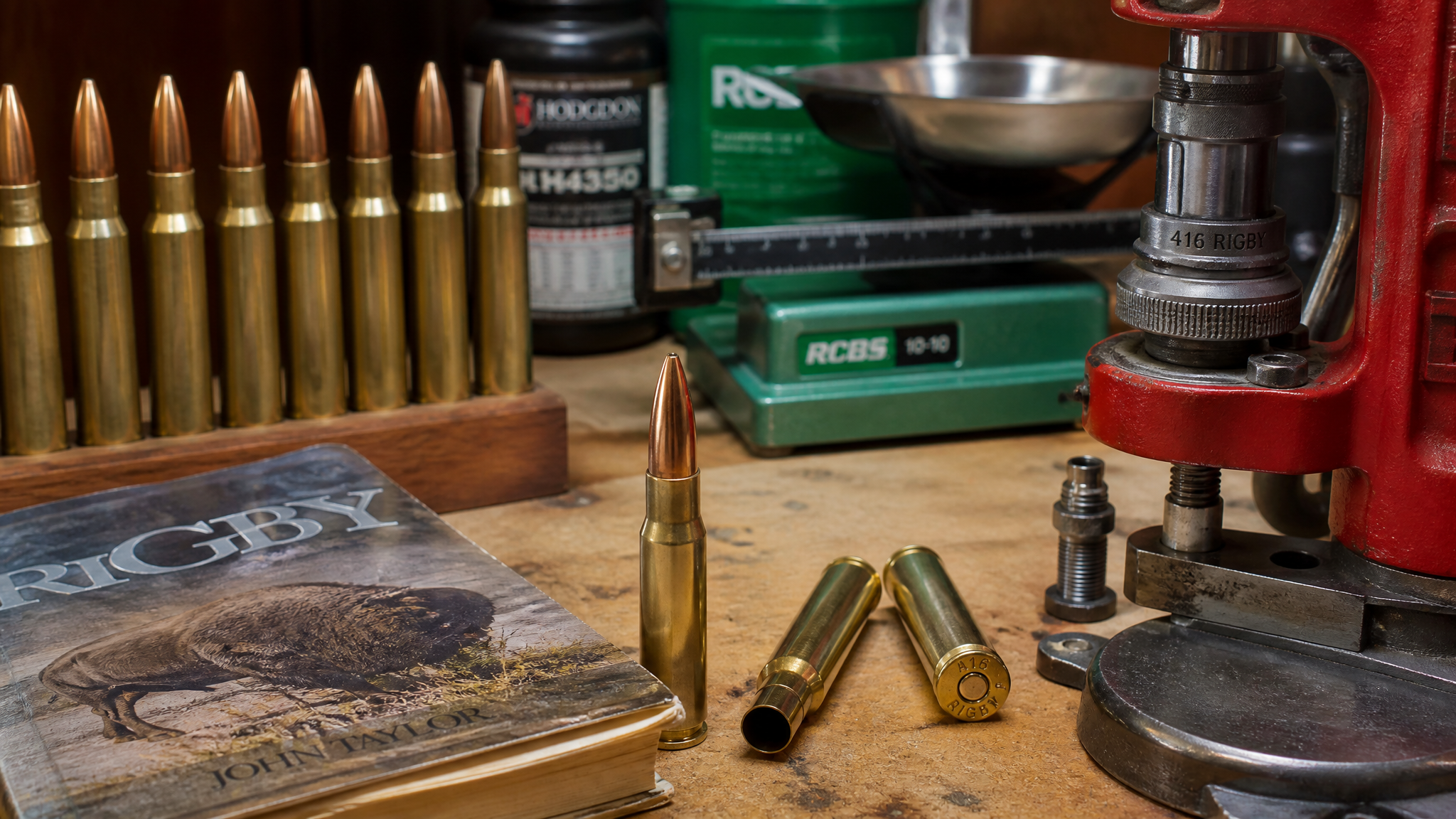
There's a reason the .416 Rigby has been in continuous production since John Rigby introduced it in 1911. The cartridge was engineered from the ground up to stop dangerous game under the worst possible conditions — short distances, dense cover, an animal that doesn't want to stop. A 400-grain solid at 2,400 fps with over 5,100 ft-lbs of muzzle energy isn't a subtle proposition, and the big Rigby case delivers it with authority in rifles that feed reliably and cycle without drama.
For Oregon hunters, the .416 Rigby might seem like overkill. It is, by most metrics, if you're hunting whitetail. But for the hunter who runs hounds on black bear through the Siskiyou brush, who goes on dangerous game hunts in Africa or Alaska, or who simply wants a double rifle cartridge with a long and proven pedigree, learning to handload the .416 Rigby is a worthwhile investment. Custom loads outperform factory offerings significantly, and the cost savings on a cartridge that typically runs $12 to $18 per round factory are substantial.
Case Preparation
The .416 Rigby operates at relatively modest pressures — SAAMI max is 57,000 PSI — but the large case volume and thick brass require thorough prep. Start with quality brass from Norma, RWS, or A-Square. Lapua does not currently offer .416 Rigby brass commercially, though Norma is the gold standard and what most serious handloaders use.
- Full-length sizing: The .416 Rigby headspaces on the belt-less, rimless case with a generous taper. Full-length size after every firing for dangerous game loads — reliability of feeding is non-negotiable. Set your die to bump the shoulder back 0.001 to 0.002 inches from fired dimensions.
- Case trimming: Trim to 2.895 inches per SAAMI spec after every third firing. The large case doesn't grow dramatically, but don't skip this step.
- Primer pocket uniforming: Large rifle magnum primers are the standard. Uniform the pocket to 0.128 to 0.130 inches depth. Fed 215M or CCI 250 are go-to choices. The large flash hole on this case (some lots use a different spec — verify with a drill bit) ignites powder consistently.
- Annealing: Anneal every 3 to 4 firings. The neck work on a .416-bore case is substantial, and work-hardened brass at the neck and shoulder splits faster than you'd expect on a case this large. Proper annealing extends brass life dramatically.
Powder Selection
The .416 Rigby's large case — roughly 120 grains water capacity — requires slow to medium-slow powders for best results. This is not a cartridge for fast powders. The following options perform reliably:
- IMR 4350: The most commonly recommended powder for the .416 Rigby. Charges in the 100 to 108 grain range (depending on bullet weight) produce excellent velocity and consistent pressure. Start at 95 grains and work up in 1-grain increments.
- Hodgdon H4831SC: Slightly slower burn rate than IMR 4350 and an excellent choice for maximum velocity loads. The short-cut granules meter consistently through a powder measure, which matters when you're loading 100+ grain charges. Start at 96 grains.
- Reloder 19: Another proven option. Temperature-stable formulation makes it a good choice for hunts where conditions vary. Similar charge weights to H4831SC.
- IMR 7977 / IMR 4831: Both work well with 400-grain bullets. Slightly slower than the above; maximum charges may be slightly lower in some rifles.
Always consult a current manual — Nosler, Hornady, or Lyman — for maximum charge weights specific to your bullet weight and rifle. Published data is your ceiling, not a starting suggestion.
Bullet Selection
The .416 caliber (.416-inch nominal diameter) has a strong selection of premium hunting bullets designed for the cartridge's specific application. At 400 grains, you have two primary choices:
Controlled Expansion (Soft Points)
For black bear in Oregon or any application where you need expansion and penetration, premium soft points are the choice:
- Woodleigh Weldcore 400-grain SP: The gold standard. Designed specifically for large bore hunting, this bullet retains 90%+ of its weight through heavy bone and muscle and produces a broad wound channel.
- Swift A-Frame 400-grain: Bonded core construction with the mechanical bonding of the A-Frame partition. Exceptional weight retention and consistent double-diameter expansion. An excellent bear bullet.
- Hornady DGX Bonded 400-grain: The most affordable premium option. Designed specifically for dangerous game with a steel jacket insert and bonded core. Good penetration, good expansion.
Solids (Non-Expanding)
For true dangerous game follow-up shots where penetration and straight tracking matter above all else:
- Woodleigh Hydrostatically Stabilized Solid: The modern benchmark for big-bore solids. Round-nose profile, mono-metal construction, consistent track through heavy media.
- Barnes Banded Solid: Copper alloy with circumferential grooves that reduce bearing surface pressure. Extremely accurate and consistent.
A Baseline Load for 400-Grain Bullets
For a general-purpose Oregon black bear or plains game load, the following is a proven starting point with Norma brass and CCI 250 primers. Work up from the starting charge — do not begin at maximum:
- Bullet: Swift A-Frame 400-grain
- Powder: IMR 4350
- Start charge: 96.0 grains
- Maximum charge: 104.0 grains (verify against your manual)
- Expected velocity at max: 2,370 to 2,420 fps (24-inch barrel)
- COAL: 3.750 inches (verify for your specific magazine and chamber)
Watch for pressure signs during load development: flattened or cratered primers, stiff bolt lift, case head expansion. The .416 Rigby at pressure is not subtle — it will tell you when you've exceeded the case's comfort zone.
Practical Reloading Notes
At 100+ grain powder charges, a beam scale or high-resolution electronic scale is mandatory. Powder measures struggle with granular extruded powders at this volume and will throw inconsistent charges that affect accuracy. Throw a slightly-under charge with your measure and trickle up to weight.
The .416 Rigby is a pleasure to load once you have the process dialed in. Cases last well when properly annealed, accuracy is easily sub-1.5 MOA with quality components, and the performance at the business end of a 400-grain premium bullet justifies every step of the preparation. Whether it's a coastal bear in the Siskiyous or a Cape buffalo on the Limpopo, handloaded .416 Rigby is a round you can carry with complete confidence.