If there is a round more deserving of a handloader's attention than the 5.56 NATO, it is hard to think of one. It's inexpensive enough that the savings of handloading add up fast, brass is everywhere, and the cartridge rewards precision work with exceptional accuracy out of a quality AR-15 barrel. Yet a surprising number of AR owners stick with bulk factory ammo, not realizing how much performance they are leaving on the table.
Whether you are building economical high-volume loads for ground squirrel season in Oregon's high desert or pushing toward sub-MOA performance for precision rifle competition, here is a complete guide to handloading 5.56 NATO.
5.56 NATO vs. .223 Remington: The Handloader's Reality
The 5.56 NATO allows higher chamber pressures (up to 62,366 psi by NATO standards vs. 55,000 psi for .223 Rem SAAMI). In practice, most AR-15s with 5.56 or Wylde chambers handle both with no issue. If you are loading for a .223 Remington-specific chamber (common on bolt-action rifles), use .223 Remington data and stay conservative. All load data below is derived from published reloading manuals. Always start 10 percent below max and work up while watching for pressure signs: flattened primers, sticky extraction, ejector swipes on case heads.
Brass Prep for 5.56
Military 5.56 brass (Lake City, Federal) has a heavier case wall than commercial .223 brass, which means slightly less internal volume. Military brass also has crimped primer pockets — remove the crimp with a Dillon Super Swage 600 or RCBS Primer Pocket Swager before repriming.
- Full-length resize for semi-auto use — neck sizing alone risks extraction issues
- Trim to 1.750 inch (trim-to length) — 5.56 brass grows with firing, especially in gas guns
- Deburr and chamfer case mouth after trimming
- Remove primer crimp on military brass
- Clean primer pockets every 3–4 firings for consistent ignition
Powder Selection
For 55-Grain Varmint Loads
- Hodgdon CFE 223: Outstanding with 55-grain bullets — high velocity, excellent accuracy, copper-fouling-reducing additive. 24.5–26.0 grains.
- Varget: The all-around workhorse. Extremely consistent across temperatures — a plus for the Pacific Northwest. 24.0–25.5 grains.
- IMR 4064 / H4895: Classic 55-grain powders with long track records.
For 62–69 Grain Match and Hunting Bullets
- Varget: Ideal with 69–77 grain match bullets. 23.0–24.5 grains with 69 SMK is a tested sub-MOA recipe in 1:8 and 1:9 twist barrels.
- Hodgdon H4895: Great mid-range performer with 62-grain bullets.
- Benchmark: Excels with 68-grain BTHP at shorter seating depths.
Bullet Selection by Purpose
High-Volume Varmint (Ground Squirrels, Coyotes)
- Hornady 55-grain V-MAX: Exceptional explosive expansion, polymer tip for reliable feeding.
- Sierra 55-grain BlitzKing: Slightly more accurate than V-MAX on average, similar terminal performance.
Deer and Predator Hunting
- Hornady 60-grain GMX: Lead-free, good expansion through 16-inch barrels at typical distances.
- Federal 62-grain Fusion (component): Designed for bonded expansion in AR-velocity rifles.
- Nosler 60-grain Partition: Classic controlled expansion at any range.
Match and Target
- Sierra 69-grain MatchKing: The gold standard for 1:9 twist barrels.
- Berger 73-grain Boat Tail: Outstanding BC, sub-MOA from quality 1:8 twist AR-15s.
- Hornady 75-grain BTHP: Requires 1:8 twist or faster.
A Starting Load Recipe (55-Grain V-MAX, Varmint)
Case: Lake City or Remington commercial brass, trimmed to 1.750 inch
Primer: CCI 400 small rifle
Powder: CFE 223, 25.0 grains (start at 23.5 and work up)
Bullet: Hornady 55-grain V-MAX, seated to 2.200 inch OAL
Expected velocity: 3,100–3,200 fps from a 16-inch barrel
Expected accuracy: 0.75–1.25 MOA from a quality factory AR barrel
Semi-Auto Considerations
AR-15s extract and eject emphatically — brass can travel 15 feet. Use a brass catcher or budget for some loss. Inspect every case for case head separation, neck cracks, and primer pocket looseness. 5.56 brass fired 8–10 times through a gas gun is approaching retirement. When primer pockets become noticeably loose, recycle the brass.
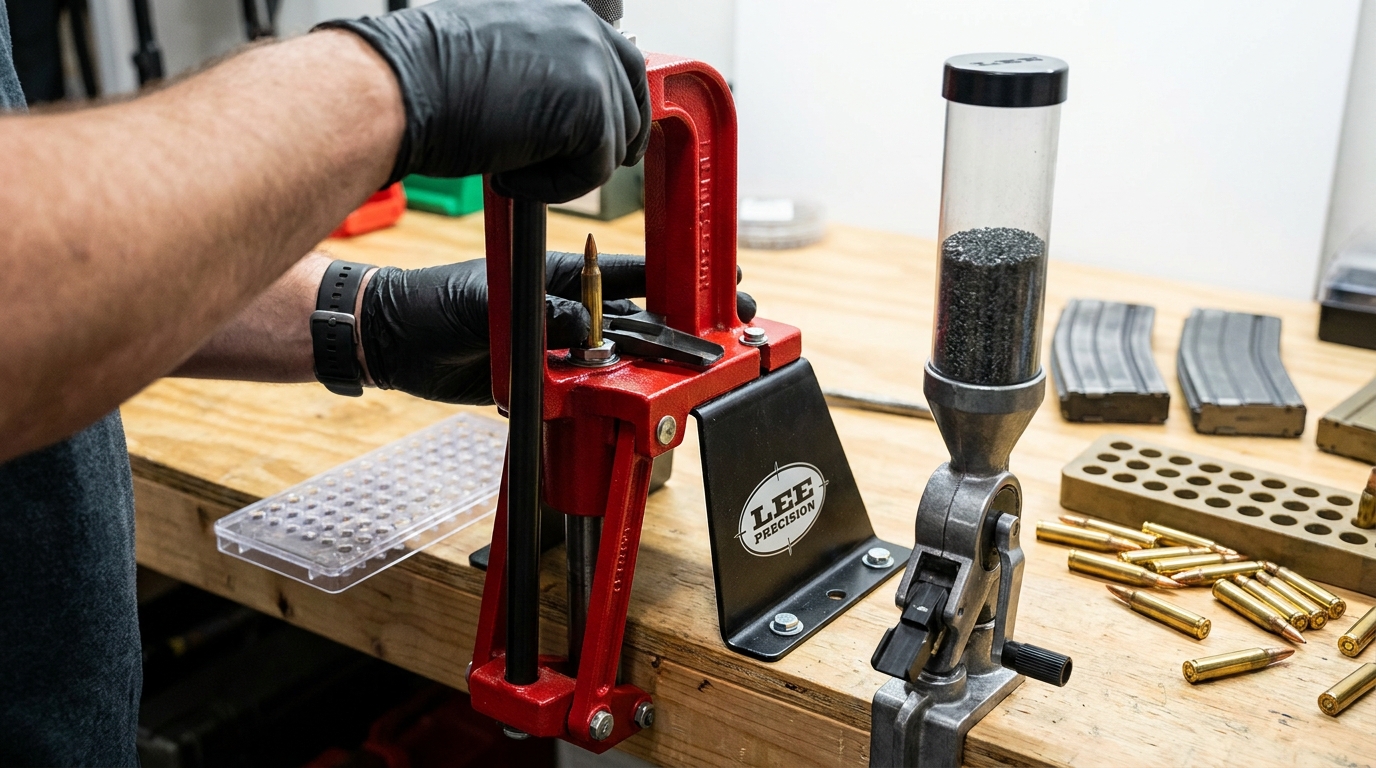
Crimp your bullets using a Lee Factory Crimp Die for semi-auto loads. The AR's feeding and ejection process can pull bullets under heavy use if they are not crimped at least lightly.
The Bottom Line
Handloading 5.56 NATO is one of the best returns on investment in the reloading hobby. Savings over factory match ammo are substantial, accuracy gains over bulk military surplus are significant, and the process teaches you more about ballistics than any factory box ever will. Start with a quality progressive press, invest in a good case trimmer, and let the data drive your decisions. Your AR-15 will thank you in the form of smaller groups and more dead ground squirrels.