The 6.8 Remington SPC (Special Purpose Cartridge) was developed in the early 2000s by U.S. Army Special Forces and Remington Arms as a more effective combat round for the M4 platform. Its civilian adoption as a hunting cartridge never quite hit critical mass — overshadowed first by .300 Blackout and later by 6.8 Western — but among serious handloaders who've worked with it, the 6.8 SPC has a devoted following for good reason. In an AR-15 with a quality barrel and carefully developed handloads, it's a capable deer and blacktail cartridge out to 250 yards, and it deserves more attention than it gets.
The 6.8 SPC at a Glance
The 6.8 SPC fires .277-caliber bullets — the same diameter as the .270 Winchester — from a cartridge case slightly larger than 5.56 NATO. It runs in a standard AR-15 lower with a dedicated upper, bolt, and magazines. At typical hunting distances, a 110-grain bullet at 2,550 fps delivers approximately 1,590 ft-lbs of muzzle energy — significantly more than 5.56 NATO and enough to cleanly take deer, blacktail, and pronghorn with proper shot placement.
The cartridge has one critical quirk: there are two chamber specifications in common use — the original SAAMI spec chamber and the 6.8 SPC II spec developed by Silver Shadow. Most modern barrels are cut to the SPC II spec, which offers meaningfully higher velocities and better accuracy. Before you develop loads, confirm which chamber your barrel uses. This guide covers the more common SPC II spec.
Brass Selection and Prep
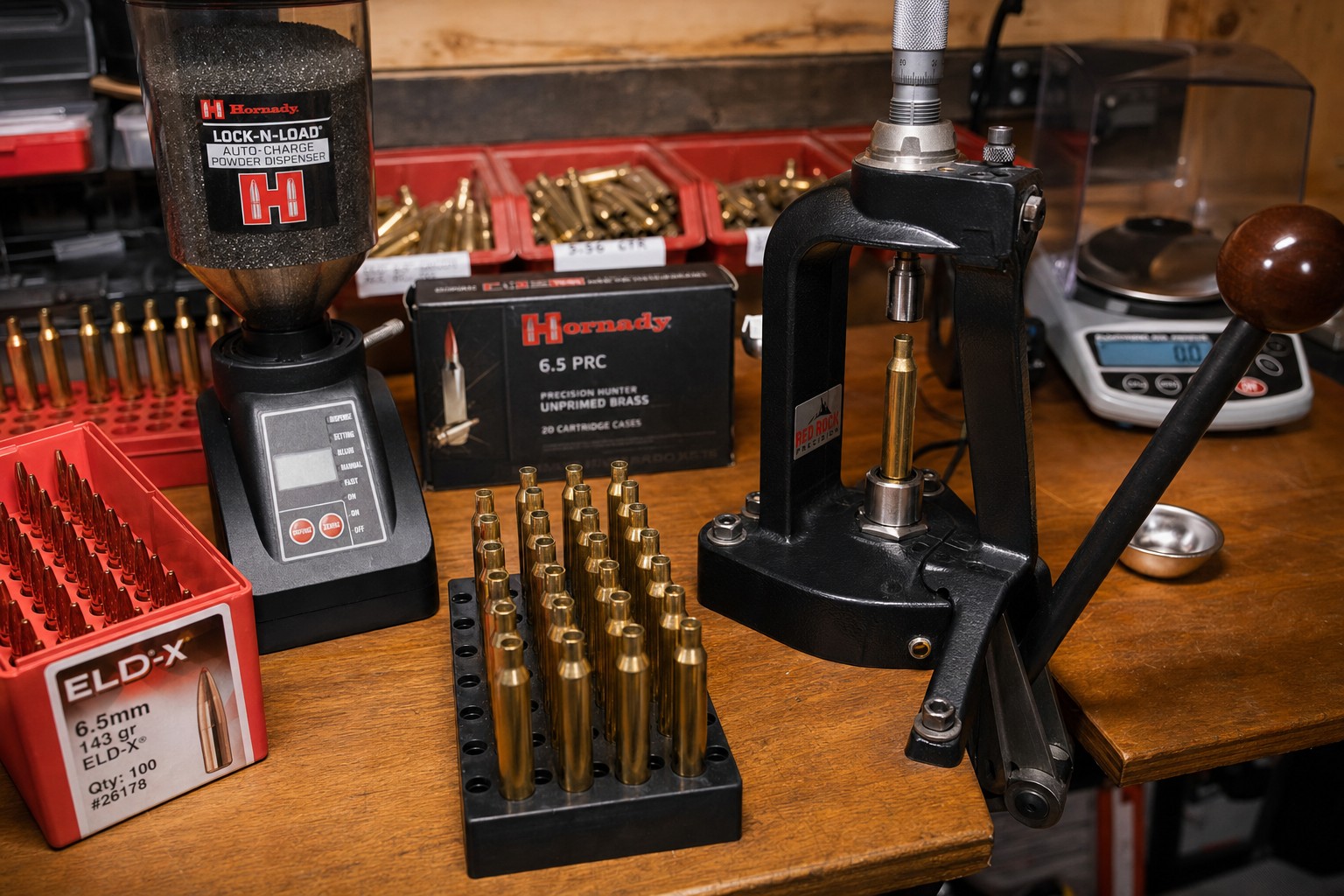
6.8 SPC brass availability is more limited than mainstream cartridges, but quality options exist. Hornady, Remington, and Starline all produce 6.8 SPC brass. Starline is the handloader's choice — consistent case weight, excellent neck thickness uniformity, and remarkable durability through multiple reloadings.
Case Prep Steps
- Trim to length: SAAMI trim length is 1.676". Trim to 1.673" and maintain consistency. The 6.8 SPC is sensitive to case length variation — long cases increase pressure and affect velocity consistency.
- Deburr and chamfer: Inside and outside the case mouth after trimming. A sharp case mouth tears bullet jackets.
- Primer pocket uniforming: Military brass may have crimped primers. Ream or swage the crimp before repriming.
- Full-length resize for AR feeding: Unlike bolt actions where you can get away with neck sizing, the AR's semi-auto feeding system requires full-length resizing to ensure reliable chambering.
Primer Selection
Small rifle primers are standard for 6.8 SPC. For hunting loads where ignition consistency matters most, CCI 450 small rifle magnum primers are worth considering — the hotter ignition improves consistency with slower powders that fill the case efficiently. Standard CCI 400 or Federal 205 also work well with faster powders. Avoid large rifle primers entirely — the primer pocket is sized for small rifle only.
Powder Selection for Hunting Loads
The 6.8 SPC works best with powders in the medium burn rate range — think H335, Benchmark, TAC, and CFE 223. Here are proven performers for hunting applications:
Hodgdon H335
The benchmark powder for 6.8 SPC, H335 fills the case efficiently and produces excellent velocity with good consistency. With a 110-grain BTHP, expect 2,500–2,560 fps from a 16" SPC II barrel at charges around 29.5–30.5 grains. Start 10% below published max and work up watching for pressure signs.
Accurate TAC
Slightly slower than H335, TAC meters beautifully through powder measures and produces low extreme spread numbers — important for consistent field accuracy. It's a top choice for the 110–120 grain bullet weight range.
Hodgdon CFE 223
The copper fouling eraser additive is a practical benefit for a semi-auto hunting rifle that may see significant volume use during varmint or predator seasons. Velocity with CFE 223 is competitive with H335, and bore maintenance is noticeably easier.
Benchmark
Excellent temperature stability makes Benchmark worth considering for Oregon hunters who might be shooting in cold morning conditions — critical in November elk country or during an early deer season with wide temp swings.
Bullet Selection for Oregon Hunting
The .277 bullet diameter gives 6.8 SPC handloaders access to excellent projectiles:
- Hornady 110-grain GMX: Monolithic copper, full weight retention, zero fragmentation. Ideal for blacktail and deer where shots may be close and angle-dependent. Penetration is excellent.
- Sierra 110-grain Pro-Hunter: A traditional cup-and-core hunting bullet that performs well at 6.8 SPC velocities. Good expansion, reliable on deer at typical ranges.
- Nosler 110-grain AccuBond: Bonded construction for controlled expansion and high weight retention. The best choice for heavy-bodied deer and pronghorn where you want maximum penetration with expansion.
- Speer 130-grain Hot-Cor: The heavier option for deer in heavy cover. Slightly lower velocity but deeper penetration — relevant for Roosevelt elk-country blacktail hunts in the Oregon Coast Range.
A Starting Load for Oregon Blacktail
For hunting Columbia blacktail or mule deer in Oregon's mixed terrain, this is a proven starting point on the SPC II platform:
- Brass: Starline 6.8 SPC, full-length resized, trimmed to 1.673"
- Primer: CCI 450 small rifle magnum
- Powder: H335, 30.0 grains (start at 28.5 and work up)
- Bullet: Hornady 110-grain GMX, seated to 2.260" COAL
- Expected velocity: 2,510–2,545 fps from a 16" SPC II barrel
Always consult current reloading manual data for your specific components. Pressure can vary significantly between barrel chambers and lot-to-lot component variation. Never start at max charges.
Accuracy Expectations and Barrel Quality
The 6.8 SPC is inherently accurate. A quality SPC II barrel from a reputable manufacturer (Ballistic Advantage, Criterion, Faxon) with well-developed handloads should produce groups of 1–1.5 MOA from a supported rest — entirely adequate for hunting applications at 200 yards and under. Poor accuracy is almost always traceable to inconsistent case prep, wrong chamber spec, or a budget barrel with loose tolerances.
If you've overlooked the 6.8 SPC, it's worth a second look — especially if you already own an AR-15 lower. The upper conversion is straightforward, the platform is soft-shooting and reliable, and with the right handload behind the right bullet, it's a clean, ethical cartridge for the deer and blacktail hunting Oregon does best.