When Tillamook County anglers talk fall salmon, the conversation usually starts with the Wilson River. But two smaller streams flowing into the same bay — the Trask and the Kilchis — quietly offer some of the most productive coho salmon fishing on the entire Oregon coast. October is the heart of the silver run on both rivers, and savvy bank anglers know these drainages can fish better than the Wilson on the right tide and the right rain event.
If you haven't fished the Trask or Kilchis for coho, this October is the time to start. Here's a complete guide to both rivers.
Understanding the Trask River Coho Run
The Trask River drains the Tillamook State Forest and flows roughly 55 miles before entering Tillamook Bay. It receives a strong wild coho run that typically peaks between mid-October and mid-November, with the first significant push often arriving on the heels of the first major fall rain event after September 15th.
Key bank fishing spots on the Trask include:
- Tillamook Fish Hatchery (Tillamook County Road) — The hatchery pool below the facility is a natural salmon congregation point; bank access is good and fish stack here waiting for river conditions to allow further migration
- Loren's Hole and the Long Hole — Classic Trask pools that hold coho on their upstream push; fish these deep, slow tailouts on an outgoing tide influence
- Trask River Road pullouts — Numerous pullouts along Trask River Road above the hatchery offer access to productive bank water; look for gravel bars with slow inside seams
The Kilchis River: The Overlooked Gem
The Kilchis is a shorter, smaller stream than the Trask, but what it lacks in size it makes up for in concentration. Coho push into the Kilchis quickly after a rain event, often stacking in lower-river pools in impressive numbers. Because the river gets less attention than the Wilson or even the Trask, the Kilchis can offer fast action with minimal competition.
The Kilchis County Park boat ramp and nearby bank water is the primary access point. Fish the lower river pools closest to the bay on the incoming and early outgoing tide — fresh chrome coho often move through fast and don't linger. The lower Kilchis is also excellent from a drift boat or raft for those who want to cover water.
Tide and Rain: Timing Your Trask and Kilchis Trip
Both rivers are tidal in their lower reaches, and tidal influence significantly affects fishing quality. The most productive windows are typically:
- Incoming to high tide — Saltwater pushes fish upriver and coho become active, hitting lures and bait more aggressively
- First 2–3 days after a significant rain event — A half-inch or more of rain in the Tillamook watershed brings fresh fish and clears residual warm-water fish from holding spots, replacing them with chrome new arrivals
- Early morning (first two hours of light) — Coho move and bite best in low-light conditions; be on the water at first light
Watch the gauge at waterdata.usgs.gov for the Trask River near Tillamook. Ideal bank fishing conditions are roughly 2.5–4.5 feet on the gauge — below that fish are pushed into deep holes, above that the water gets too fast and turbid for consistent bank fishing.
Tackle and Presentations
Coho on the Trask and Kilchis respond to a variety of presentations. Bank anglers do well with:
- Spinners — Size 3–4 Blue Fox Vibrax or Mepps Aglia in chartreuse, pink, or orange are classic Tillamook coho producers. Cast across and slightly downstream, retrieve at medium speed through the seam
- Jigs under a float — Marabou jigs in pink, white, or chartreuse under a 3–4 foot leader below a bobber excel in slower pool water. Fish them through the bubble line on an 8–12 foot drift
- Cured roe — Cure your salmon eggs with BorX O' Fire or Pro-Cure and tie small clusters in pink or orange mesh. Drift them natural on a 12–18 inch leader behind a pencil lead or drift bobber
- Spoons — Coho are aggressive — a 3/4 oz Cleo or Kastmaster in silver/blue will draw strikes from fresh fish, especially in the first few hours after a rain pulse
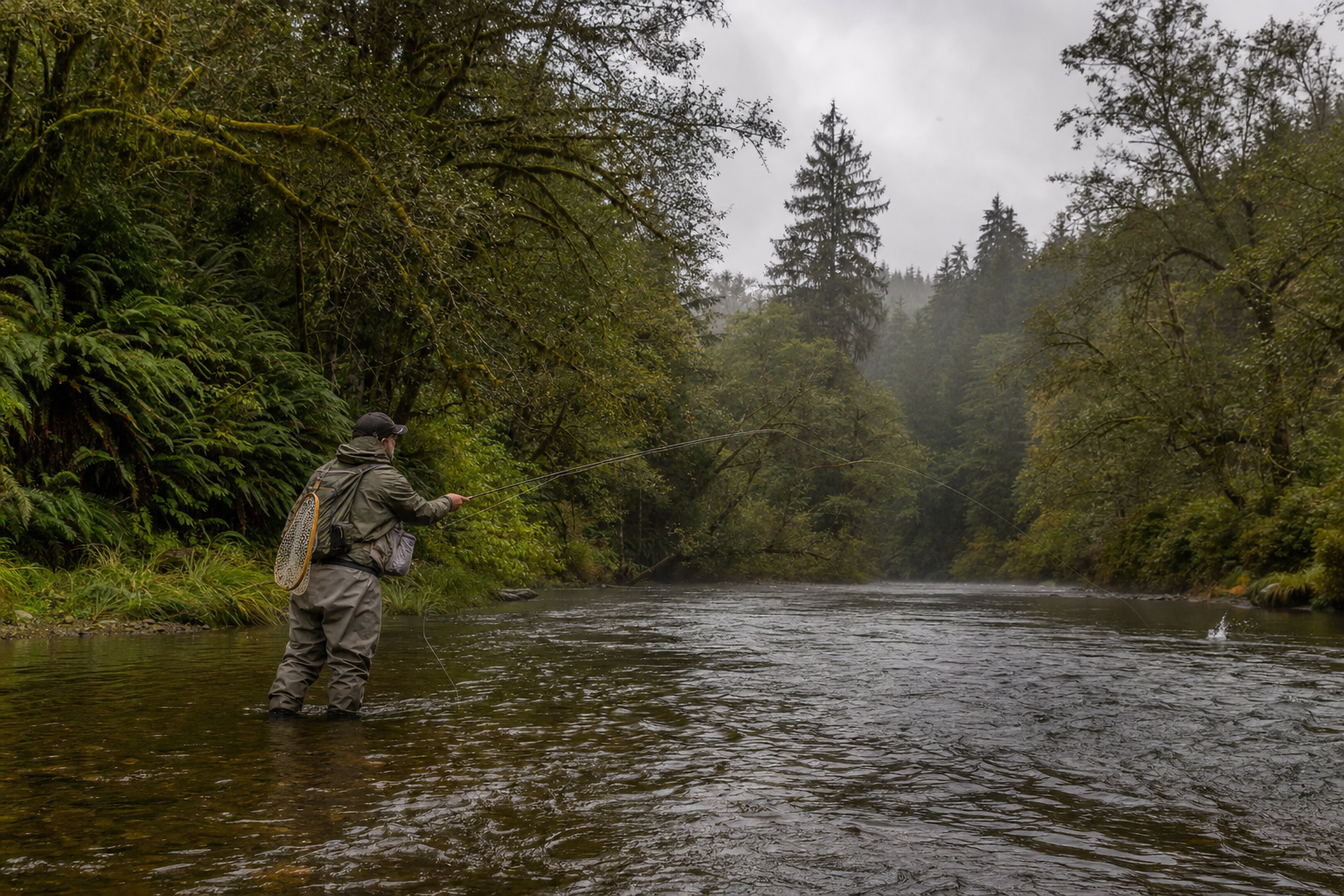
For fly anglers, an 8-weight with a sink-tip line and a pink or chartreuse intruder-style fly fished on the swing through pool tailouts is the go-to approach. The lower Trask and Kilchis both offer stretches well-suited to a two-handed swing setup.
Regulations and Hatchery vs. Wild Coho
Both the Trask and Kilchis have hatchery coho programs, but wild coho retention rules vary by year and regulation. Always check the current ODFW Sport Fishing Regulations before heading out. In most years, adipose fin-clipped (hatchery) coho are retainable while wild (unclipped) coho must be released. Mark your fish before bonking — look for the missing adipose fin just above the tail.
A standard Oregon fishing license plus a Combined Angling Tag is required to fish for salmon. Tillamook Bay and its tributaries can also require a Tillamook Bay Combination Tag in some regulation years — confirm before your trip.
Getting There
Both rivers are easily reached from Tillamook. The Trask River Road runs east from Tillamook directly along the river. The Kilchis River is accessed via Kilchis River Road, heading north from Tillamook off of US-101. Drive times from Portland are approximately 90 minutes via US-26 over the Coast Range, making the Trask and Kilchis a very viable day-trip option for metro-area anglers.
Don't sleep on the Trask and Kilchis this October. While other anglers pile onto the Wilson, these two Tillamook County rivers reward the angler who does their homework with chrome coho, manageable crowds, and some of the most beautiful coastal alder-and-fern river scenery the PNW has to offer.