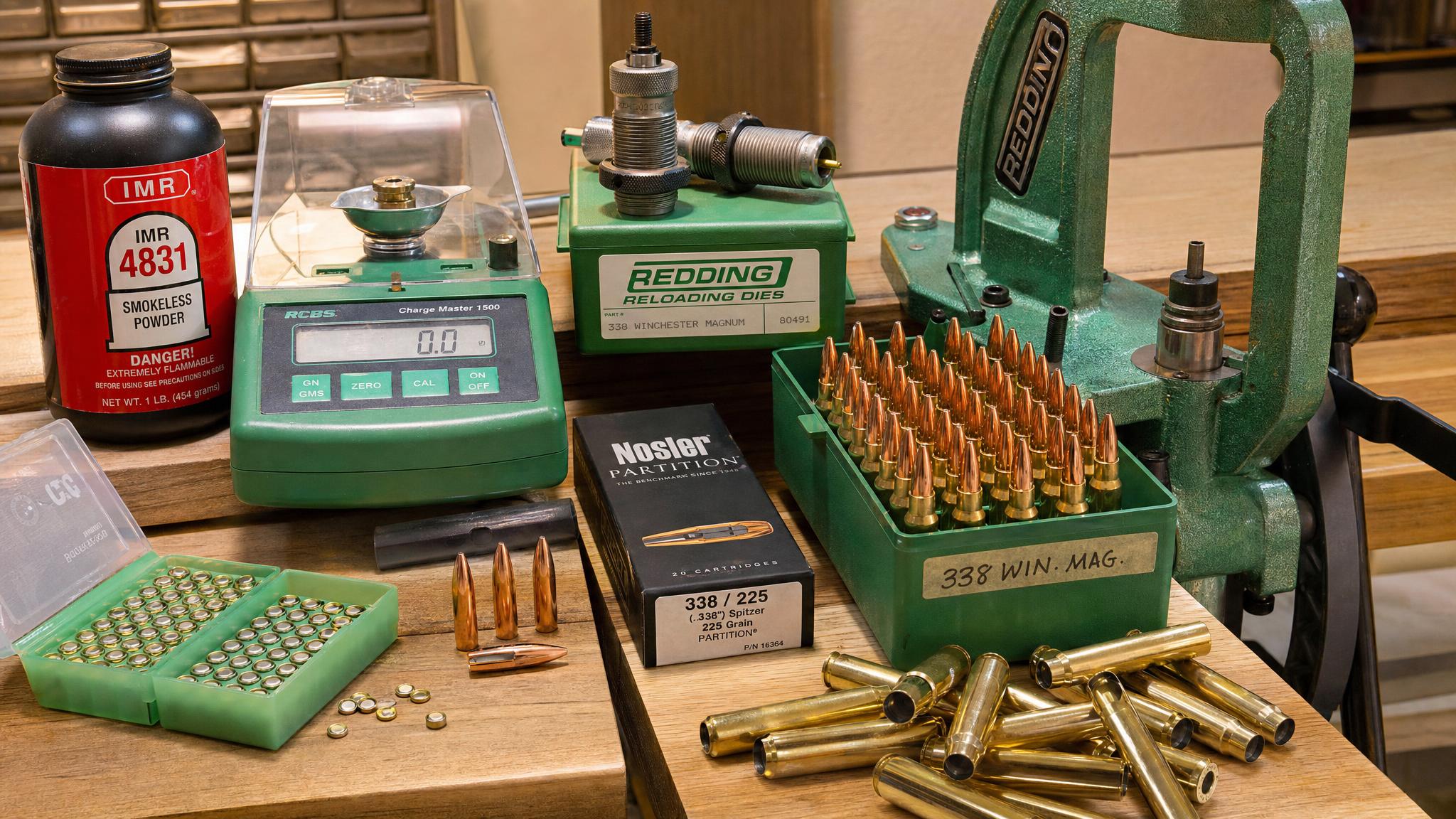
Winchester introduced the .338 Winchester Magnum in 1958 alongside the Model 70 Alaskan, and for Oregon's elk and bear country it remains one of the most well-balanced choices a handloader can work with. It drives 225- to 250-grain bullets at velocities that flatten trajectory enough for open-country shots while delivering the bone-breaking energy that Roosevelt elk in the Coast Range timber demand. If you're already loading and you hunt elk seriously, the .338 Win Mag deserves a spot on your bench.
Why the .338 Winchester Magnum for Oregon Big Game
Oregon elk hunters face a wide range of shot opportunities — from 50-yard timber shots in the Tillamook burn to 400-yard clearcut shots in the Cascades. The .338 Win Mag covers both ends of that spectrum. A 225-grain AccuBond at 2,900 fps carries 2,200 ft-lbs of energy past 400 yards, and at timber distances it simply doesn't give elk a chance to run far. For black bear over bait or in the Coast Range alder bottoms, the same load is overkill in the best possible way — exits are guaranteed, and blood trails are short.
Brass and Primer Selection
Start with quality brass. Winchester and Nosler offer the most consistent .338 Win Mag cases from a dimensional standpoint. Federal brass runs slightly thicker at the web but is also excellent. Buy 100 cases, full-length size them, trim to 2.490 inches (SAAMI spec max is 2.500), and anneal after the second or third firing to extend case life. Large rifle magnum primers are required — Federal GM215M and CCI 250 are both reliable with the slower powders this cartridge demands.
- Winchester WSM brass: Consistent, widely available, takes annealing well
- Nosler brass: Premium option, pre-prepped, minimal case prep needed out of the bag
- Federal GM215M primers: Best choice for temperature sensitivity with slower powders
- CCI 250: Excellent all-around large rifle magnum primer, consistent ignition
Powder Selection for the .338 Win Mag
The .338 Win Mag has a large case capacity (93 grains water) and performs best with medium-slow to slow extruded powders. The sweet spot for most hunting bullet weights falls in the IMR 4831, H4831SC, and Reloder 22 range.
Top Powders
- IMR 4831: The classic choice; metered well, fills the case nicely, accurate with 200-250 grain bullets. Start at 66 grains with a 225-grain bullet and work up to 70 grains watching for pressure signs
- H4831SC: Short-cut version meters better than standard H4831; excellent accuracy with 225-grain bullets. Start at 67 grains, max around 71 grains
- Reloder 22: Slightly slower than H4831SC; gives top velocities with 200- and 210-grain bullets. Start at 68 grains with a 225-grain bullet
- IMR 7828SSC: Excellent for the heaviest bullets (250-grain); good temperature stability for cold Oregon mountain mornings. Start at 66 grains
- Hodgdon H1000: Best for 250-grain bullets; slower burn rate fills the case and reduces pressure compared to faster powders at equivalent velocity
All load data is for reference only. Always start 10% below max and work up carefully. Consult a current reloading manual (Nosler, Hornady, Sierra, Lyman) for verified data specific to your components.
Bullet Selection for Oregon Hunting
The .338 bore gives you access to some of the best controlled-expansion hunting bullets made. For elk, you want penetration first — elk are big-bodied and thick-shouldered, and a bullet that mushrooms too aggressively at high velocity can fail to exit on quartering shots.
Best .338 Hunting Bullets for Oregon
- Nosler Partition 225-grain: The benchmark for elk — dual-core construction guarantees front expansion with rear-core retention; ideal for timber shots under 200 yards
- Nosler AccuBond 225-grain: Bonded construction with a polymer tip; flat-shooting with excellent long-range terminal performance out to 400 yards
- Swift A-Frame 225-grain: Bonded and tough; the choice for shoulder shots on big Roosevelt bulls in the brush
- Hornady ELD-X 225-grain: High-BC hunting bullet; excellent for open-country Cascade units where shots past 300 yards are common
- Sierra GameKing 250-grain BTSP: A proven elk bullet for decades; excellent sectional density (0.313) for deep penetration on raking shots
- Barnes TTSX 210-grain: Lead-free for California border hunts; all-copper construction retains near 100% weight
Working Up a Load: Step-by-Step
Start with a new or once-fired batch of brass, all trimmed to 2.488-2.490 inches. Full-length resize, prime with your chosen magnum primer, and load a five-shot ladder starting 10% below your manual's max charge. Increase in 0.5-grain increments. At the range, shoot from a cold barrel — one shot, let the barrel cool for 3 minutes, shoot again. Look for:
- Flattened or cratered primers (back off 0.5 grains immediately)
- Stiff bolt lift (pressure sign — stop there)
- Case head expansion beyond 0.001 inch over unfired brass (use a micrometer)
- Ejector marks on case heads
The .338 Win Mag in a factory Model 70 or Browning X-Bolt should deliver sub-MOA groups with a well-developed load. A 225-grain AccuBond over 69.5 grains of H4831SC chronographing at 2,880 fps from a 24-inch barrel is a realistic, accurate target.
Recoil Management and Practical Bench Notes
The .338 Win Mag generates 30-35 ft-lbs of recoil in a 9-pound rifle — that's real, and it matters at the bench. Use a quality recoil pad, shoot from a front and rear bag rest, and don't let flinch creep into your load development. For hunting use, a good muzzle brake cuts felt recoil by 40-50 percent. Just remember that a brake makes the rifle deafeningly loud — always wear ear protection afield if you run a brake.
The .338 Winchester Magnum rewards the handloader with a level of versatility and performance that factory ammunition can't fully deliver. With the right bullet, a well-developed load, and a few seasons of field experience, it's one of the most capable elk and bear cartridges a Pacific Northwest hunter can carry into the Oregon backcountry. Load it right, shoot it enough to be confident, and it won't let you down when a big Roosevelt bull steps out at last light.