The .358 Winchester was introduced in 1955, chambered in the Winchester Model 88 lever action, and should have taken over the hunting world. It didn't—mostly because marketing, not performance, drives cartridge adoption. What hunters in Oregon's dense timber have quietly known for decades is that the .358 Win delivers everything a big-bore brush cartridge should: a wide, heavy bullet at moderate velocity that hits hard, doesn't over-penetrate on close-range shots, and cycles smoothly in lever and bolt action platforms suited for the trees.
If you're hunting the Coast Range for Roosevelt elk or black bear in the Cascades and you're tired of bolt guns that feel oversized for 50-yard shots through Doug fir, the .358 Winchester is worth a serious look—and its handloading potential is excellent.
The Case for the .358 Winchester in Oregon Timber
Oregon's wet-side elk and black bear country is defined by short shot distances. The average Roosevelt elk encounter in the Coast Range or western Cascades happens inside 100 yards, often under 60. A cartridge optimized for 400-yard open-country performance is redundant in that environment. What matters is bullet diameter, terminal performance at close range, and reliable cycling in a fast-handling rifle.
The .358 Winchester throws .358-inch diameter bullets—the same bullets used in the .35 Whelen, .35 Remington, and .356 Winchester. At 200 to 250 grains, these are big, heavy projectiles that transfer energy efficiently and create wide wound channels. At 2,250–2,450 fps from a 22-inch barrel, you're not chasing flat-shooting velocity, but for the terrain and ranges involved, you don't need it.
Brass and Components
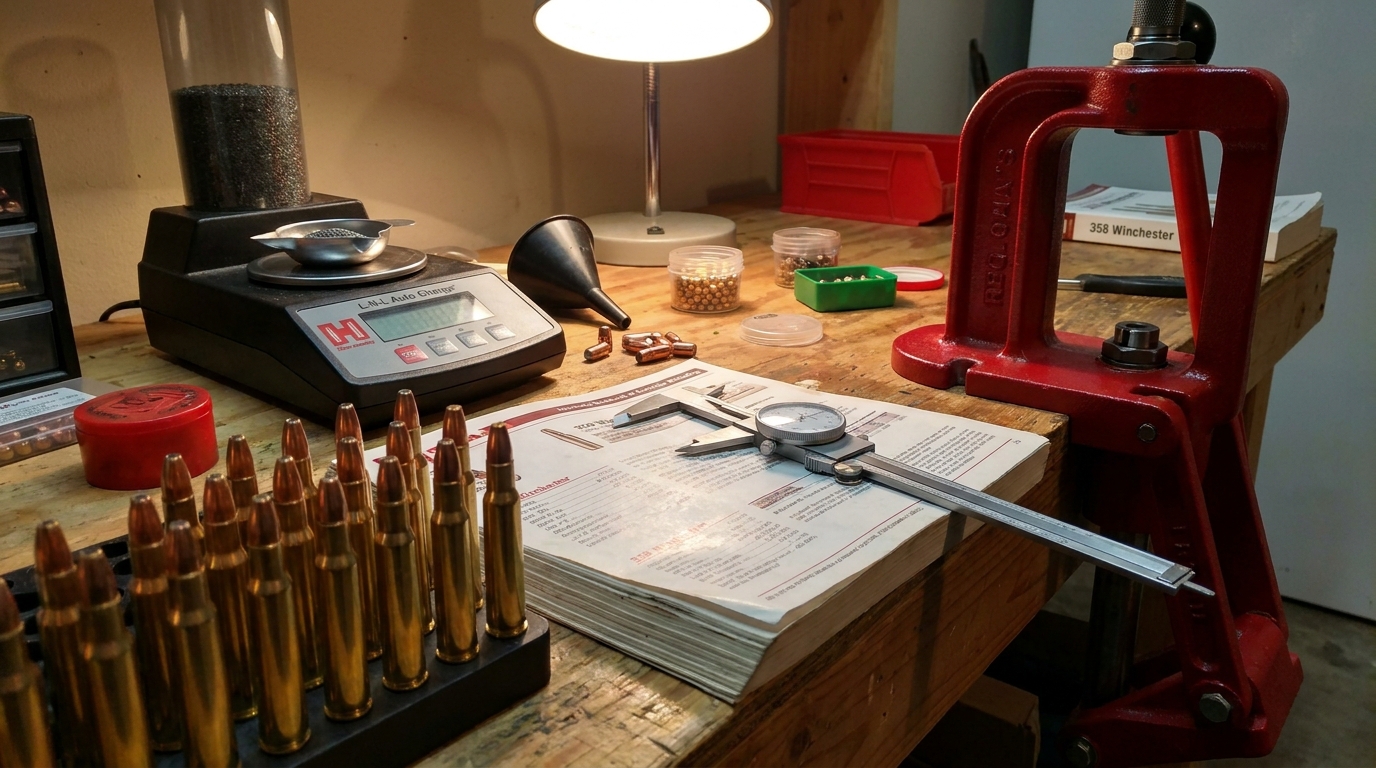
The .358 Winchester is based on the .308 Winchester case necked up to .358 caliber, which means .308 Win brass from Winchester or Lapua can be formed with a simple sizing die. Dedicated .358 Win brass is available from Hornady and Winchester, though in limited quantities. Buy what you can find and form the rest—the formed .308 cases work perfectly.
Bullet selection for hunting loads:
- Hornady 200 gr FTX (Flex Tip): Designed for lever-action magazine use, the FTX is the best choice for tubular-magazine lever guns. At .358 diameter, it feeds reliably and expands consistently even at reduced impact velocities from close-range shots.
- Sierra 200 gr Pro-Hunter: A classic flat-base spitzer for bolt-action use. Excellent accuracy at practical hunting ranges and proven terminal performance on deer and black bear.
- Nosler 225 gr Partition: The go-to for elk. The Partition's bonded construction handles close-range, high-velocity impacts without coming apart, and 225 grains at .358 diameter hits with serious authority.
- Woodleigh 250 gr Weldcore: Maximum penetration for large black bear at close range. Overkill for deer, appropriate for anything you'd encounter in Oregon's heavy timber.
Powder Selection
The .358 Winchester's case capacity sits between the .308 Win and the .30-06, and it prefers medium to medium-slow powders. The following are well-established performers:
- IMR 4064: The most consistently cited powder for the .358 Win. Produces excellent velocity and good accuracy with 200 and 220 grain bullets.
- Varget: Temperature-stable and widely available. Works well with lighter 200 gr bullets in bolt-action applications.
- IMR 4895: A bit faster than 4064, excellent with 200 gr bullets and well-suited for lever-action pressures.
- RL-15: A medium-slow option that gives excellent results with heavier 225–250 gr bullets in bolt-action platforms.
Starting Load Data (Always Verify with Current Reloading Manuals)
Note: Always cross-reference with current Hodgdon, Sierra, or Hornady reloading manuals. Start at minimum loads and work up. Maximum loads below are reference points, not starting points.
- 200 gr Hornady FTX / IMR 4064: Start at 40.0 gr (~2,300 fps), max near 43.5 gr (~2,470 fps). Check pressure signs carefully in lever-action platforms.
- 225 gr Nosler Partition / Varget: Start at 38.0 gr (~2,150 fps), work toward 41.5 gr (~2,310 fps). Excellent elk load with good accuracy.
- 250 gr Woodleigh / RL-15: Start at 37.0 gr, work toward 40.5 gr. Accuracy node typically shows at mid-range charges.
Practical Accuracy Expectations
The .358 Win in a quality bolt-action rifle—Ruger M77, Winchester Model 70, or a customized action—is capable of 1 MOA or better with developed handloads. For timber hunting, 2 MOA is more than adequate. Most lever-action platforms shoot 1.5–3 MOA, which is entirely sufficient for any shot you'll take in the Coast Range or Cascade understory.
Crimping is essential for tubular-magazine lever guns. Use a Lee Factory Crimp die or a standard roll crimp to prevent bullet setback under recoil from magazine spring pressure during rapid follow-up shots.
The Platforms
The Winchester Model 88 lever action is the classic .358 Win rifle, though they're collector pieces now. More practically, the Savage Model 99 (also lever action) was chambered in .358 Win and can be found used in good condition. For a new bolt-action option, many custom gunsmiths will chamber a Remington 700 or Ruger 77 action in .358 Win—typically a matter of a barrel swap.
For Oregon timber elk and black bear, the .358 Winchester is a cartridge that asks very little of the hunter in terms of technique and asks very little of the bullet in terms of terminal performance. It simply works.