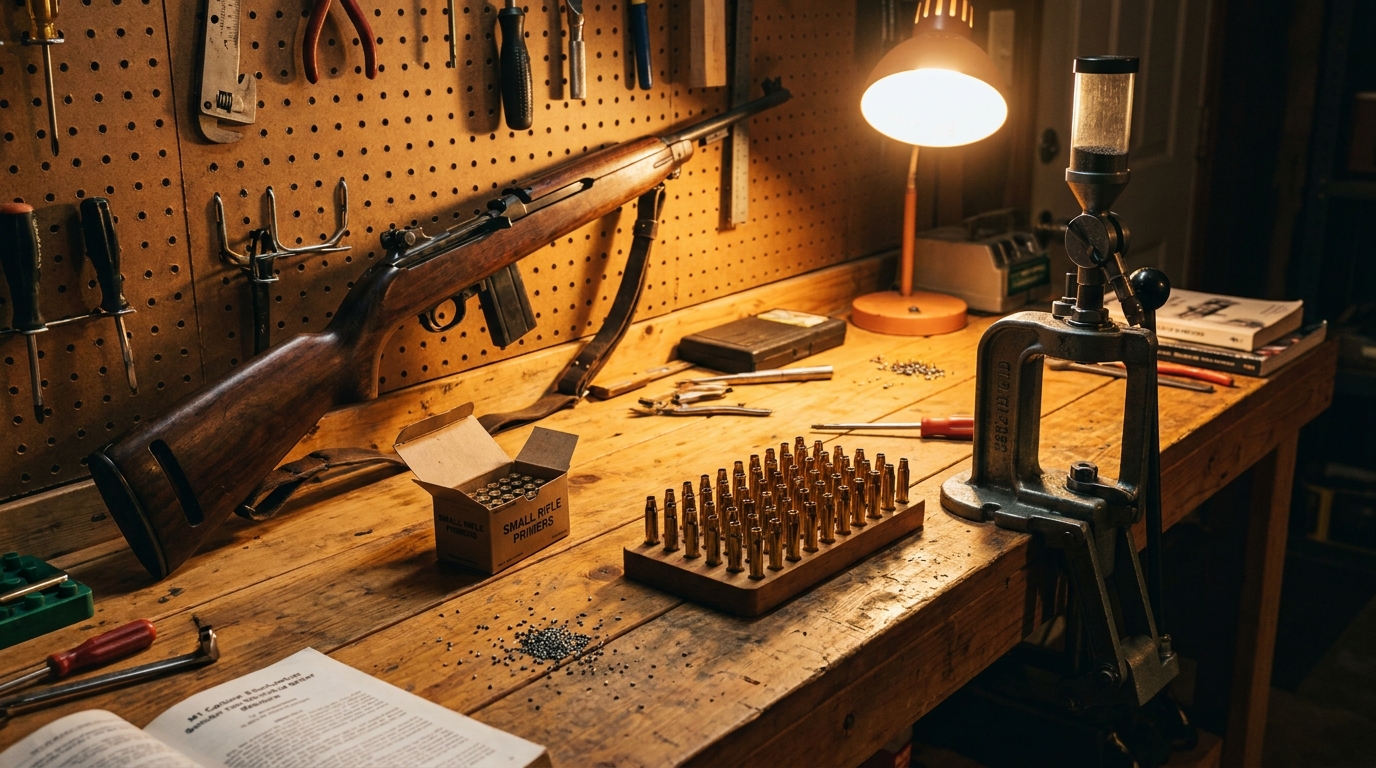
The .30 Carbine is one of America's most historically significant cartridges — it armed American soldiers from Normandy to Korea, and it remains one of the most fun, practical, and underloaded rounds in the handloader's library. If you own an M1 Carbine, a Ruger Blackhawk, or one of the various AR-style platforms chambered for this round, rolling your own ammunition opens up a world of options that factory loads don't touch.
A Brief Look at the Cartridge
Developed by Winchester in 1941, the .30 Carbine fires a .308-diameter, 110-grain round-nose bullet at approximately 1,990 fps from the 18-inch barrel of the M1 Carbine. It's a semi-rimmed, straight-walled pistol-class cartridge operating at relatively modest pressures (40,000 PSI max) — which makes it easy to reload, easy on brass, and gentle on dies. It is not a long-range rifle cartridge; it was designed as a light personal defense weapon for rear-echelon troops, and it excels in that role. Expecting magnum rifle performance from .30 Carbine is setting yourself up for disappointment.
What it is: a fast-handling, low-recoil, accurate-enough-for-100-yard-shooting cartridge with significant nostalgia value and real utility as a small-game and pest-control round in the timber country of the Pacific Northwest.
Brass Prep
GI surplus brass is everywhere and generally excellent — it's made to military specifications and is thick, uniform, and durable. Commercial brass from Starline is outstanding and the preferred choice for dedicated handloaders. Avoid mixing headstamps in your working loads, as case capacity can vary enough to affect velocity consistency.
- Full-length resize every time — the M1 Carbine's semi-auto action is hard on case shoulders, and factory-spec sizing ensures reliable feeding.
- Trim to 1.285" if cases are at or above 1.290" after sizing. The .30 Carbine is not especially prone to stretching, but check every 4–5 loadings.
- Small rifle primers only — this is a small rifle primer case, not small pistol. Using pistol primers in .30 Carbine has caused failures in semi-auto platforms. Use Winchester WSR, Federal 205, or CCI 400 exclusively.
Powder Selection
The .30 Carbine's small case and modest pressure ceiling make powder selection straightforward. You want a fast-to-medium burning rate powder that fills the case reasonably well without spiking pressure.
- Hodgdon H110 / Winchester 296: These are the go-to powders for .30 Carbine. They meter well, produce consistent velocities, and are proven in both the M1 Carbine and the Ruger Blackhawk. Do not reduce charges of H110/296 below published minimums — this powder needs to be run near maximum to burn consistently.
- Alliant 2400: A classic choice that runs slightly cooler and is more forgiving of minor charge weight variations. Excellent for the Ruger Blackhawk revolver.
- Hodgdon Lil'Gun: A newer option that produces excellent velocity with the 110-grain bullet and meters very consistently through a volumetric powder measure.
Bullet Options and Load Data
The 110-grain round-nose FMJ is the traditional projectile, and it's hard to improve on for the M1 Carbine's gas system and feed ramp geometry. Hornady, Sierra, and Speer all make quality .308-diameter 110-grain projectiles. For the Ruger Blackhawk, you have more flexibility — hollow points, soft points, and cast lead bullets all work well in the revolver.
Representative loads (always cross-reference with your current Lyman, Hodgdon, or Hornady manual):
- 110 gr FMJ / H110: 14.5–15.5 gr — approximately 1,950–2,010 fps (M1 Carbine, 18" barrel)
- 110 gr FMJ / Alliant 2400: 13.0–14.0 gr — approximately 1,850–1,940 fps
- 110 gr HP / Lil'Gun: 14.0–15.0 gr — approximately 1,960–2,020 fps
Seat bullets to an OAL of 1.650–1.680" for reliable feeding in the M1 Carbine. Crimp firmly using a Lee Factory Crimp Die — the semi-auto's feed cycle absolutely requires consistent crimping to prevent bullet setback.
Ruger Blackhawk Considerations
The Ruger Blackhawk in .30 Carbine is a niche but deeply satisfying handgun. With its 7.5-inch barrel, it produces velocities within 100–150 fps of the carbine, making it an effective small-game and pest-control sidearm. Cylinder gap losses are real — expect 150–200 fps less than from the 18-inch carbine barrel with the same load. The Blackhawk's superior case support also allows you to safely use full-power .30 Carbine handloads that you'd use in the carbine without modification.
One important note: the .30 Carbine generates enough blast and muzzle flash from the Blackhawk's cylinder gap to require ear protection even outdoors. This is not a quiet revolver.
Practical Applications
In Oregon and the Pacific Northwest, the .30 Carbine finds practical use for controlling feral cats and invasive species on agricultural land, dispatching predators at moderate range, small-game hunting (it's devastating on jackrabbits and ground squirrels), and as a lightweight camp rifle when backpacking into black bear country where something more than a .22 LR is desired but a full-sized hunting rifle is too heavy. It's not a deer cartridge — in Oregon, it does not meet the ethical threshold for big game at any real distance. Use it for what it is: a handy, fun, historically rich cartridge that's a pleasure to reload and shoot.