The .22 Hornet was developed in the early 1930s at Springfield Armory as a small-game and varmint cartridge, and it was quickly adopted by the shooting public once Winchester chambered the Model 54 for it in 1933. Nearly a century later, it remains in production, with rifles still being chambered for it regularly. For Oregon ground squirrel hunters, small predator shooters, and anyone who wants an extremely low-recoil, low-report varmint round they can work up themselves, the .22 Hornet is worth serious consideration.
It's also one of the most interesting — and occasionally humbling — cartridges a handloader can tackle. The case is small, the pressures are modest, and the margins for error are tighter than anything you'll encounter with a larger rifle cartridge. Get it right, and the Hornet rewards you with sub-MOA accuracy, minimal barrel wear, and very low per-round costs.
What the Hornet Does
The .22 Hornet propels a 35- to 55-grain bullet at velocities ranging from approximately 2,500 to 3,100 fps depending on bullet weight and powder charge. At 100 yards, it delivers terminal performance well suited for ground squirrels, prairie dogs, jackrabbits, and even coyotes at moderate ranges. Maximum effective range for varminting is generally considered around 150 yards — beyond that, the bullet's modest ballistic coefficient and velocity loss begin to compromise wind-bucking and accuracy.
For Oregon's high desert ground squirrel hunters shooting into the summer wind at Steens Mountain, Hart Mountain, or the Warner Valley flats, the Hornet's modest effective range is a real consideration. Where it excels is in timber country, agricultural edges, and anywhere the shots stay inside 125 yards. It's also a superb walk-around rifle cartridge: you'll barely hear it, you'll barely feel it, and the rifle stays chambered and ready for the next shot.
Case Characteristics and Reloading Challenges
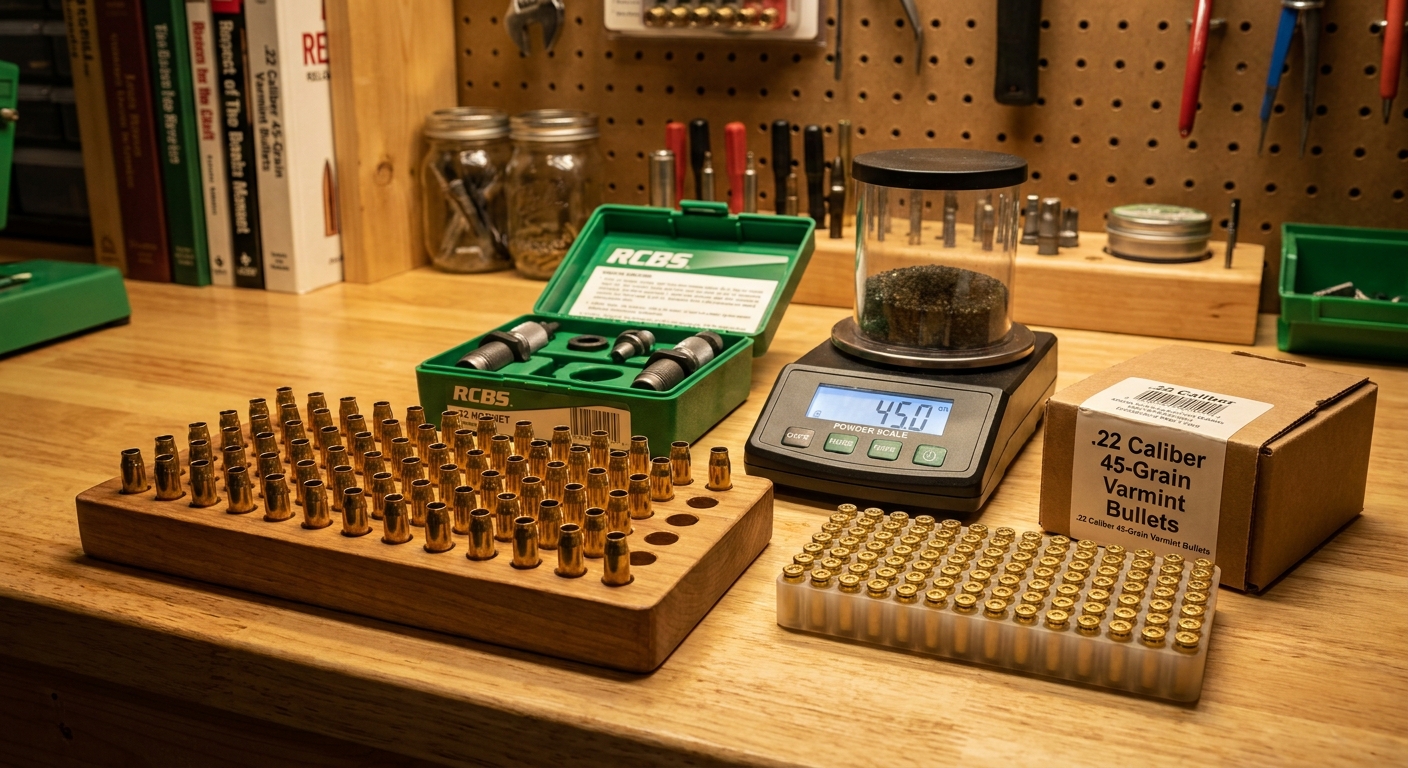
The .22 Hornet case holds approximately 10.8 to 11.5 grains of water depending on brand. That tiny capacity means powder charges are measured in single grains or fractions thereof — precision matters far more here than with a .308 or even a .223. A 0.3-grain variation in charge weight is a significant percentage of the total load. Use a quality beam or digital scale, and verify it with a reference weight before each session.
The Hornet case also headspaces on the rim, not the shoulder, and factory chambers can be somewhat generous. This can cause case stretching with full-length sizing. Many Hornet handloaders prefer to neck-size only for bolt-action rifles with consistent headspace, which improves brass life significantly.
Dies from RCBS, Redding, and Lee all work well. The Hornet's case mouth is not crimped — this is important. The thin-walled case and small diameter mean you should bell the case mouth minimally during priming and seat bullets with care. Crushing a Hornet case during bullet seating is easy if you're not paying attention.
Primers
The .22 Hornet uses small rifle primers, not small pistol primers. Standard small rifle primers (Federal 205, CCI 400, Winchester WSR, Remington 6½) all work well. Some handloaders prefer small rifle magnum primers (CCI 450, Federal 205M) for more consistent ignition with slower powders like Lil'Gun, but with most Hornet loads this isn't necessary.
Powder Selection
The small case volume limits powder selection considerably. Stick to fast-to-medium rifle powders. The following are well-proven in the Hornet:
- Hodgdon Lil'Gun: The top pick for many Hornet handloaders. Dense, spherical powder that meters consistently and delivers excellent velocity and accuracy. Works especially well with 40- and 45-grain bullets.
- IMR 4227: A longtime classic Hornet powder. A bit bulkier than Lil'Gun but very accurate. Good with 45- and 50-grain bullets.
- Hodgdon H110 / Winchester 296: Can work in the Hornet with light charges and appropriate bullets; requires careful load development.
- Accurate 1680: Another spherical option that meters well and produces good velocity in the Hornet case.
Do not exceed maximum charges published in a current reloading manual. The Hornet operates at relatively modest SAAMI max pressures (approximately 47,000 CUP), but the small case means it reaches those limits quickly with any powder.
Bullet Selection
The .22 Hornet has a groove diameter of .224" — the same as .223 Remington and .22-250, so you have a wide selection of 0.224" bullets available. However, the Hornet's modest velocity means you should stay in the lighter-to-mid weight range:
- 35-grain HP: Extremely high velocity (~3,100 fps), explosive on varmints, marginal at wind-bucking range
- 40-grain V-MAX / Nosler Ballistic Tip: The sweet spot for most Hornet rifles — fast, accurate, and produces dramatic terminal performance on ground squirrels
- 45-grain SP or HP: A slight velocity trade for more stability and better downrange performance; excellent all-around Hornet bullet weight
- 55-grain: Requires a faster twist barrel than some older Hornet rifles provide; check your rifle's twist rate (1:16 is common) before loading 55-grain bullets
Sample Load Data (Always Verify Against a Current Manual)
These are representative published loads — always cross-reference with Hodgdon, Sierra, or Lyman data before loading:
- 40-gr V-MAX / Lil'Gun: Start 9.0 gr, max ~10.5 gr — expect 2,800-3,050 fps
- 45-gr SP / IMR 4227: Start 9.5 gr, max ~11.0 gr — expect 2,600-2,900 fps
Always start 10% below published maximums and work up. Watch for pressure signs: sticky bolt lift, flattened primers, case head expansion.
Brass Life and Case Prep
Keep Hornet brass sorted by headstamp — mixing brands can cause inconsistent headspace fit. Trim cases to spec (1.395") after each firing if you full-length size. Neck-size only to extend case life. Deburr and chamfer the case mouth lightly before seating. Anneal case necks every 4 to 5 firings to maintain consistent neck tension.
The .22 Hornet won't replace your .22-250 for open-country shooting or your .223 for volume varminting. What it does is give you a quiet, efficient, pleasant-shooting small-bore that you can load precisely, shoot accurately, and carry anywhere without disturbing the neighbors or burning through powder. For a morning walk along an Eastern Oregon creek bank in July, it's hard to beat.