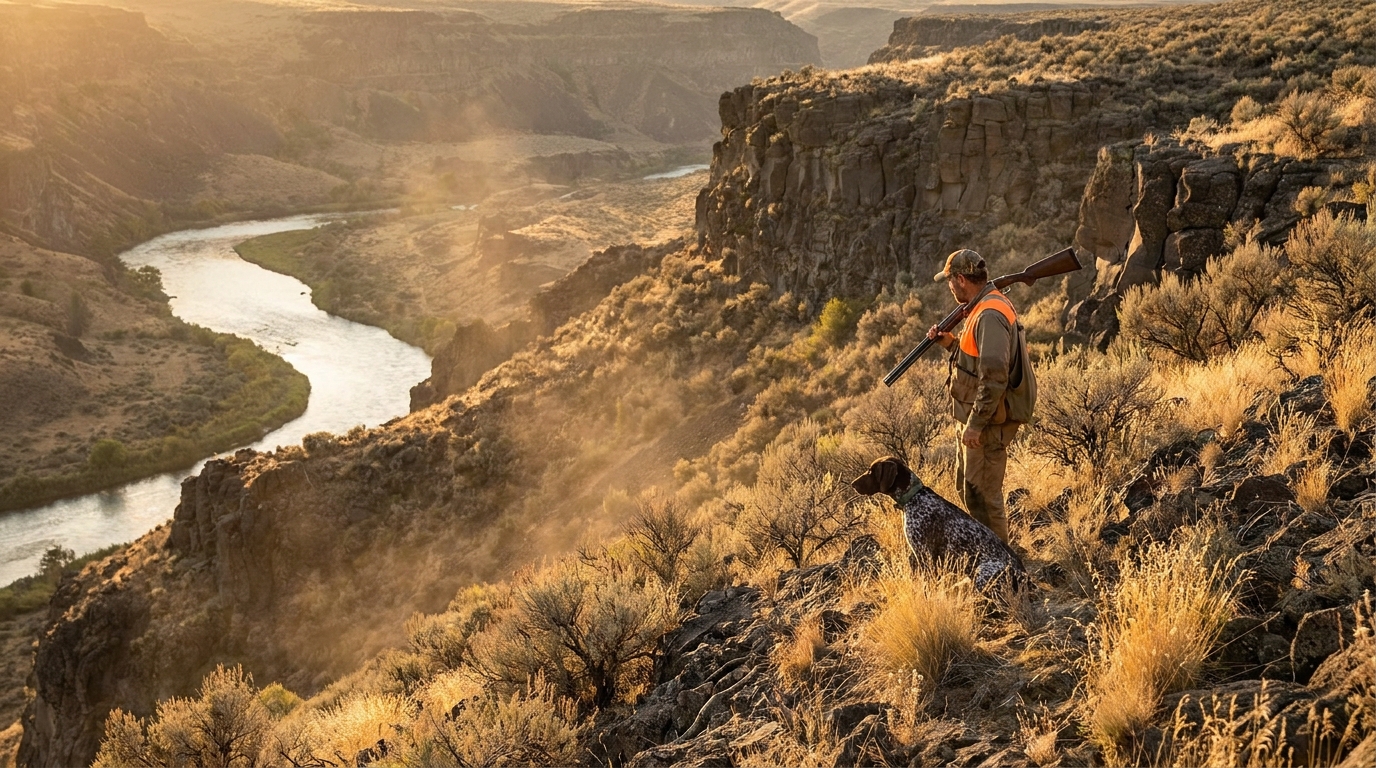
Ask any upland hunter who's done it where the hardest bird hunting in America is, and a good number of them will say the same thing without hesitation: chukar in the Snake River Canyon. These birds were built for terrain that breaks hunters. They live on near-vertical basalt rimrock faces, canyon walls that drop 2,000 feet to the river, and slopes where the angle feels closer to a ladder than a hillside. They run uphill, flush downhill, and cackle at you from cliffs you can't reach. And yet hunters come back year after year, beat up and grinning, because there's no upland hunting quite like it.
The Snake River Canyon as Chukar Habitat
The Snake River forms the border between Oregon and Idaho through Hells Canyon and the canyon country to the south, and the entire corridor is essentially one long chukar factory. The combination of rocky basalt rimrock, bunchgrass-covered slopes, cheatgrass, and sheltered south-facing canyon walls creates textbook chukar habitat. The Oregon side—particularly the Wallowa-Whitman National Forest and the Snake River Birds of Prey National Conservation Area—holds significant bird populations in good years.
Chukar are not native to Oregon. They were introduced from Asia and the Middle East in the early 20th century and thrived in the dry, rocky interior West in ways that surprised even the biologists who released them. The Snake River Canyon is one of their strongholds in North America—a place where wild chukars reproduce freely and hunting pressure, while growing, remains manageable compared to more accessible upland terrain.
Season and Regulations
Oregon's chukar season typically opens in early October and runs through late January. Check the current Oregon Upland Bird Regulations for exact dates and bag limits—the daily limit has historically been 6 birds with a 12-bird possession limit, but verify before your trip. A valid Oregon hunting license and upland bird validation are required. The Idaho side of the canyon has its own season and regulations—if you're hunting near the border, know which state you're in.
Where to Access the Canyon
Access to the Snake River Canyon on the Oregon side is limited but real. Key spots include:
- Hells Canyon National Recreation Area (HCNRA): The Imnaha River Road out of Joseph leads to Dug Bar and other access points into the canyon. This is remote country—plan accordingly.
- Brownlee Reservoir Area: The canyon country south of Hells Canyon proper, around Brownlee and Oxbow, offers more accessible terrain via roads off Highway 86 east of Richland.
- Succor Creek State Natural Area: On the southern end of the Snake River corridor, Succor Creek canyon holds birds in good numbers and offers somewhat less vertical terrain than Hells Canyon proper.
- Leslie Gulch: The Owyhee canyon country around Leslie Gulch and Three Fingers Gulch holds chukars in the rimrock, and the access road off Highway 95 near Jordan Valley is passable for most 4WD vehicles.
The Hunt: What to Expect
Chukar hunting in the canyon follows a predictable daily rhythm once you understand it. Morning birds are typically found higher—on ridgelines and upper canyon walls where they roosted overnight. As the day warms, they work downhill toward water sources and feed in the cheatgrass midslopes. Late afternoon, they begin moving back up toward roosting cover.
The most productive strategy is to gain elevation early and hunt your way down. This is counterintuitive for hunters used to walking flat or rolling upland—but hunting up into chukars means exhausting yourself on slopes where flushed birds simply glide downhill and land 300 yards below you. If you start high and work down, flushed birds have nowhere comfortable to go, and you're descending as the day goes on instead of grinding uphill at 2 PM.
Dogs are valuable but must be in excellent physical condition. Loose, rocky basalt is hard on paws—bring boots for your dog or at minimum check pads every hour. Brittanys, Vizslas, and German Shorthairs with canyon experience tend to outperform wider-ranging breeds. A close-working dog that handles rocky terrain is worth more than a big-running pointer on this country.
Shotgun and Load Selection
Chukar flush wild, fly fast, and are durable birds that require solid hits. Most canyon hunters carry an improved cylinder/modified choke combination and shoot 1 1/4 oz loads of #6 shot at 1,300 fps for close flushes, with some stepping up to #5 for longer shots on canyon birds flushing across 40-yard gaps. A 12-gauge with 28-inch barrels is the classic choice. Over-unders and semiautos both work well; leave your heavy pump at home—you'll feel every ounce by noon.
Gear and Survival Considerations
The Snake River Canyon is not a place to take lightly. Hunters die here every few years—from falls, from heat, from getting lost in canyon country after dark. Treat it like a backcountry hunt:
- Wear ankle-supporting boots with aggressive lugs—Danner Mountain 600 or Kenetrek Hardscrabble are popular canyon choices
- Carry at least 3 liters of water per person; the canyon is dry and deceptive
- Bring a paper map and compass in addition to your phone GPS—canyons eat cell signals
- Tell someone your access point, route, and expected return time
- Pack a headlamp even for day hunts—you will stay longer than planned
- Snake gaiters are smart from September through November when rattlesnakes are still active
The Reward
A limit of chukars in canyon country is one of the harder things to accomplish in Pacific Northwest upland hunting, and that's exactly why it matters. These birds earn their reputation. The terrain earns its reputation. And when you crest a rimrock ridge at dusk with a heavy game vest, legs like rubber, and a face full of canyon dust, you'll understand why hunters who've done it once can't stop going back.