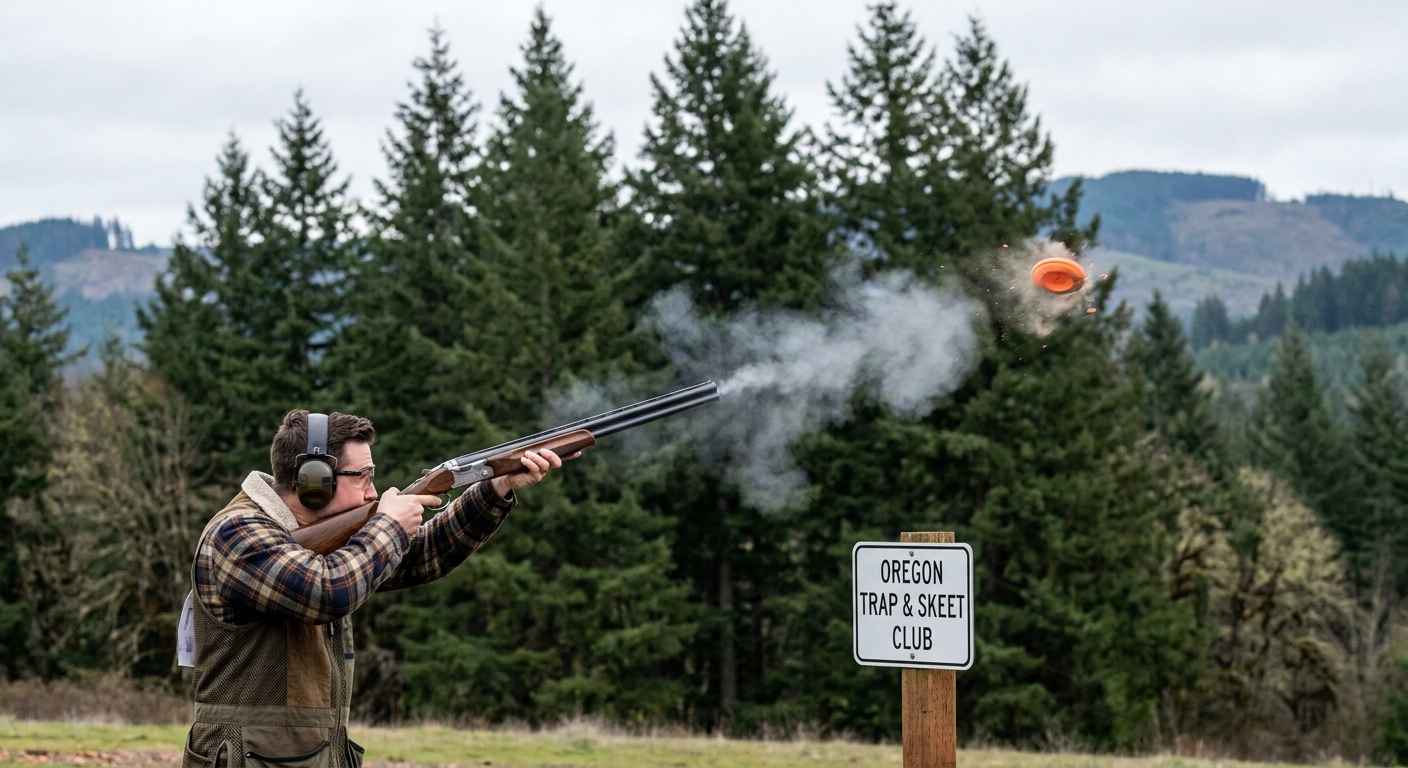
If you've ever blown a straightforward shot on a pheasant or fumbled a passing duck because your swing was slow, the answer isn't more time in the duck blind — it's more time breaking clays. Trap, skeet, and sporting clays are the shotgun sports that have trained more successful bird hunters than any other practice method. They're also genuinely addictive in their own right.
Oregon has a solid network of clay target facilities, from public ranges run by ODFW to private clubs with full trap, skeet, and sporting clays setups. Here's everything you need to know to get started.
The Three Clay Target Disciplines
Trap
Trap is the most common clay target sport in Oregon and the easiest for beginners to find. A single trap machine launches birds away from the shooter at varying horizontal angles — the bird always moves away from you, which is why trap is described as the most straightforward of the three disciplines.
In American Trap (the most common form), five shooters rotate through five stations arranged in a semicircle behind the trap house. Each shooter takes five shots from each station for 25 shots total — a "round" of trap. Birds are thrown at varying left-right angles, and the shooter doesn't know which angle is coming. Doubles trap throws two birds simultaneously.
Trap is excellent practice for:
- Flushing pheasant, chukar, and grouse shooting
- Pass shooting doves and pigeons
- General shotgun mount and swing mechanics
Skeet
Skeet is the most technically demanding of the entry-level clay sports and, arguably, the best all-around training for wing shooting. Two trap machines — a high house on the left and a low house on the right — throw birds on a fixed, known path. Shooters rotate through eight stations arranged in a semicircle between the two houses, taking shots at crossing, incoming, and outgoing birds from every angle.
Unlike trap, in skeet the bird's angle is fixed and predictable — the challenge is the wide variety of crossing and quartering shots that mimic real-world bird hunting scenarios. Stations 3, 4, and 5 (the middle of the semicircle) produce the most difficult crossing shots. Station 8, directly between the two houses at close range, is the closest shot in shooting sports — blink and you miss it.
Skeet is excellent practice for:
- Driven pheasant and chukar
- Decoying and crossing ducks and geese
- Building swing-through and lead fundamentals
Sporting Clays
Sporting clays is the most realistic simulation of actual field shooting. Sometimes called "golf with a shotgun," a sporting clays course consists of 10–15 stations spread over a course, each presenting a different target presentation — crossing birds, tower targets, ground-bouncing rabbits, incoming teals, looping chandelles, and more. Distances range from 10 to 60+ yards.
No two courses are identical, and even the same course changes presentations regularly. There's no way to pre-program your shot — you must read each target and react. For hunters, sporting clays is the most direct preparation for actual hunting because it recreates the uncertainty of real game birds.
Getting Started: What You Need
Shotgun
You don't need a dedicated clay target gun to get started. Any safe, functioning 12-gauge or 20-gauge shotgun will work for your first several sessions. That said, a few features make clay shooting easier:
- Longer barrel: 26–30 inch barrels are preferred over shorter hunting barrels — the longer sight plane and added weight aid swing consistency
- Interchangeable chokes: Improved Cylinder (IC) or Light Modified for close targets; Modified for longer presentations in sporting clays
- Comfortable stock fit: A stock that fits well (cheek to comb at eye height over the rib) is worth more than an expensive choke
Dedicated clay target guns — the Browning Citori, Beretta A400, or Krieghoff K-80 — are wonderful if you catch the bug, but start with what you have.
Ammunition
Standard 12-gauge target loads work for all three disciplines. Typical recommendation: 1 oz. or 1-1/8 oz. of 7.5 or 8 shot, at 1,100–1,200 fps. Avoid magnum or heavy game loads — they're harder on your shoulder and don't break more birds. Many ranges sell ammo on-site, often at a premium; buy in bulk at a big box store if you're shooting regularly.
Safety Equipment
Safety glasses and hearing protection are mandatory at all clay ranges — bring your own or borrow from the range. Foam ear plugs are the minimum; electronic muffs that amplify ambient sound while blocking shots are a worthwhile upgrade for comfort and safety situational awareness.
Oregon's Best Clay Target Ranges
Estacada Gun Club
Located in Estacada, 45 minutes southeast of Portland. Full trap and skeet fields, sporting clays course, and a strong ATA/NSSA registered shoot schedule. Excellent beginner-friendly environment with experienced members willing to coach newcomers.
Prineville Reservoir Shooting Range (ODFW)
ODFW operates a trap range at Prineville Reservoir State Park. Low cost, publicly accessible, and a great option for Central Oregon hunters who want to work on their upland game and waterfowl shooting between seasons.
Albany Gun Club
One of the most active clubs in the Willamette Valley. Trap, skeet, and occasional sporting clays events. Well-maintained facilities and active membership make it a strong choice for regular practice.
Southern Oregon Clay Target (Medford area)
Serves the Rogue Valley with trap and sporting clays. Popular with hunters preparing for the early dove season and the September teal opener.
Coos County Sportsmen's Club
Oregon Coast option with trap and skeet. Convenient for coastal waterfowl hunters who want off-season practice without a long drive inland.
Fundamental Technique: What to Know Before You Show Up
Clay target shooting rewards a few fundamental habits. Nail these before developing bad muscle memory:
- Mount to your face, not your shoulder. Your cheek should meet the stock comb first, creating the correct eye-over-rib alignment. Most misses are high or low because the head moves on the mount.
- Keep the gun moving. The most common miss in clay sports is stopping the swing at the point of pull. Maintain your lead through the shot and follow through.
- Call for the bird before you're ready, and you'll rush. Establish your gun hold point (where you'll be pointing when you call for the bird) and your focus point (where you want to first acquire the clay) before you say pull.
- Watch the bird, not the barrel. Focus intensely on the leading edge of the clay — your hands will put the gun where your eyes are pointing.
From the Range to the Field
The improvement transfer from clays to hunting is real and measurable. Experienced skeet and sporting clays shooters consistently outperform occasional hunters on driven birds and crossing waterfowl. A dozen rounds of skeet before your first duck hunt of the season is worth more than any new choke tube or pattern test.
More importantly, clay target sports are genuinely fun as standalone pursuits. The social element at a club on a Saturday morning — competing with friends, getting coached by better shooters, chasing that perfect 25 straight — has kept generations of Pacific Northwest sportsmen shooting year-round. Find your local range, sign up for a beginner clinic if one's available, and break some birds.