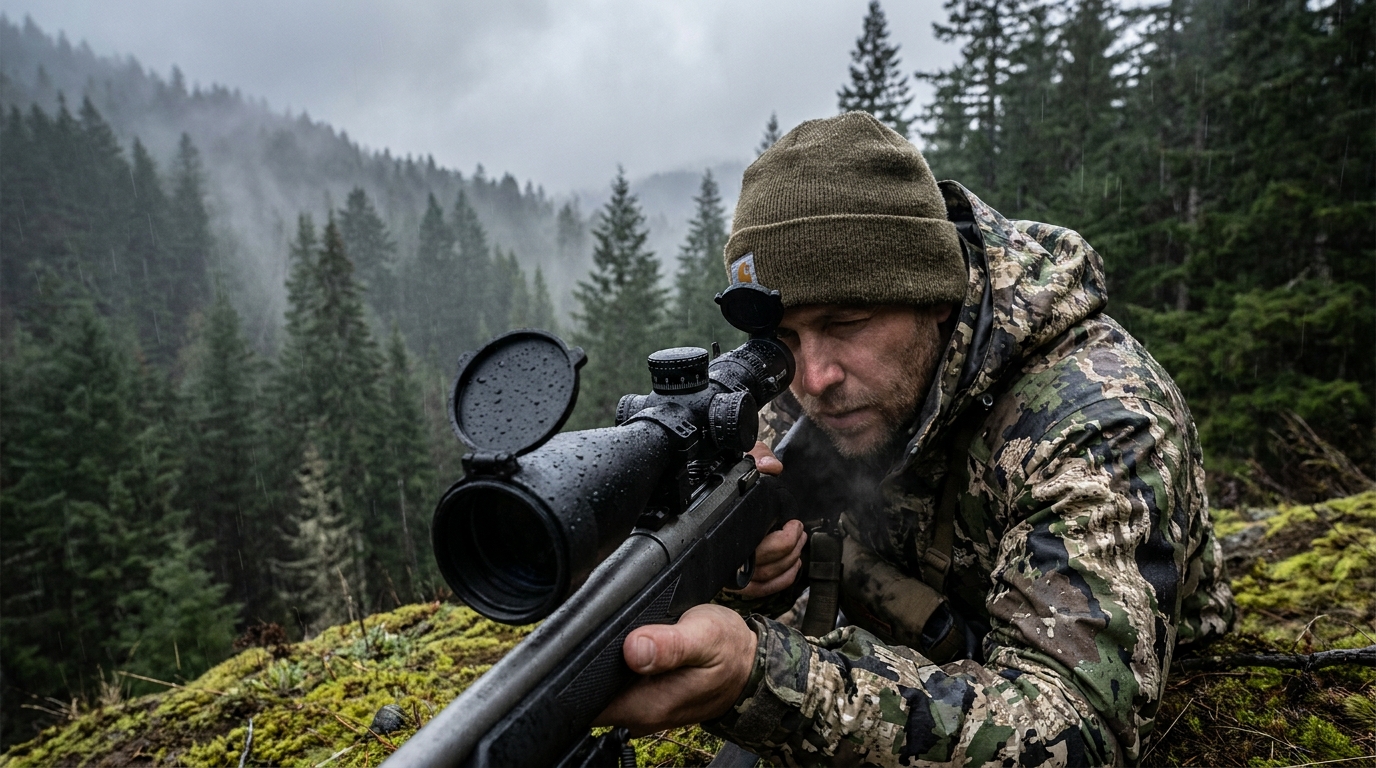
There is no crueler test of hunting optics than a November blacktail hunt in the Oregon Coast Range. You walk in at 6 AM when it’s 38°F and foggy, heat up on the climb, and end up with the outside of your scope fogged from body heat and the eyepiece fogged from your breath. By 8 AM the rain starts. By afternoon a slant of December light comes through the clouds just long enough to reveal a buck at 180 yards, and you need your glass to work—right now, without hesitation.
Pacific Northwest hunters face optics challenges that hunters in drier states never encounter. Understanding what makes glass fail in these conditions—and what makes it succeed—is as important as any other piece of your hunting kit.
Internal Fogging: The Real Enemy
External fogging is annoying. Internal fogging is a scope-killer. Quality riflescopes are sealed and filled with nitrogen or argon gas to prevent moisture intrusion and internal fogging. The issue is that “sealed” is a spectrum, not a binary condition. Budget scopes ($150–$400 range) often use O-ring seals that degrade with temperature cycling, physical impacts, and aggressive field use. After two or three seasons of real Pacific Northwest hunting, those O-rings may fail, allowing moisture into the tube.
The fix is prevention: buy quality glass with documented weatherproofing standards, and avoid creating the conditions that stress seals. Don’t submerge your rifle in creeks. Keep scope caps on when moving through dense brush. Store rifles in a dry environment rather than in a wet truck bed overnight.
Signs of Internal Moisture
- Fogging that appears inside the tube (between the lenses rather than on the exterior glass)
- A milky or hazy appearance that doesn’t wipe off
- Fogging that takes 20+ minutes to clear in warm conditions
- Visible water droplets or streaks inside the scope body
If you see any of these, the scope needs to go back to the manufacturer for regassing. Most major brands—Leupold, Vortex, Nightforce, Zeiss, Swarovski—offer lifetime warranties that cover this repair.
What to Look for When Buying for Pacific Northwest Use
O-Ring Quality and Gas Purging
Look for scopes advertised as nitrogen-purged or argon-purged with multiple O-ring seals. Better manufacturers publish their waterproofing depth ratings—Vortex, for example, rates many of their scopes to submersion depths of 1 meter or more. That’s overkill for most hunting, but it’s a useful indicator of overall seal quality.
Lens Coatings
Multi-coated or fully multi-coated optics shed water more effectively than single-coated glass. Hydrophobic exterior lens coatings—offered by Leupold (Xtended Twilight Lens System), Swarovski (SWARO COAT), and others—cause water to bead and roll off rather than sheeting across your field of view. In a driving Pacific Northwest rain, this is a meaningful functional difference, not just a marketing feature.
Eyepiece Design
Sunshades and objective bell protectors help keep rain off the glass when shouldering the rifle. A 3–4-inch sunshade on the objective lens prevents water droplets from landing directly on the front glass in light rain. They add weight and length but pay off on wet hunts.
Fast-focus eyepieces (diopter adjustment) allow you to quickly refocus on a cold morning when your eye takes a few minutes to fully accommodate. A fixed-focus eyepiece is one less thing to fumble with in the moment, but a quality fast-focus is worth the cost on a dedicated hunting scope.
Budget Recommendations by Use Case
Deer Rifles (Under $600 Scope Budget)
The Vortex Diamondback HD and Crossfire II lines offer genuine nitrogen purging and multi-coated glass at prices that don’t require a financing plan. The Diamondback HD 4-12x40mm is a workhorse scope that’s held up on Coast Range blacktail hunts in conditions that would destroy cheaper glass. The Vortex warranty is genuinely unlimited—no questions asked, no deductibles.
In the same price range, the Leupold VX-Freedom line is built in the USA and carries Leupold’s Full Lifetime Guarantee. The 3-9x40mm in CDS-ZL configuration gives you a custom-dialed elevation turret for a modest upgrade fee—useful if your hunting involves varying distances.
Elk and Long-Range Rifles ($600–1,500 Scope Budget)
The Leupold VX-3HD and Vortex Viper HS series are workhorses in this range. Both feature fully multi-coated lenses, robust O-ring systems, and sufficient optical quality to resolve elk at distance in low-light Pacific Northwest mornings. The Burris Signature HD is an underrated option that punches above its price point in edge clarity and low-light performance.
Premium Glass ($1,500+)
When money isn’t the primary constraint, Zeiss, Swarovski, and Nightforce are the benchmarks. The Swarovski Z5i 3.5-18x44mm is arguably the finest hunting scope for PNW conditions—its SWARO COAT repels water aggressively, the twilight performance is class-leading, and the illuminated reticle gives you a usable aiming point in the last legal shooting light of a December day. Nightforce’s SHV and NX8 series offer military-grade sealing in a hunting-weight package that will genuinely survive anything Oregon throws at it.
Field Maintenance for Wet Conditions
Even premium glass needs field care. Carry a microfiber cloth in a waterproof zip bag. Never wipe a wet lens dry—rinse with clean water first if possible, then blot dry with the microfiber. Wiping a wet lens with grit on it creates permanent scratches in lens coatings.
Bikini-style scope caps (Butler Creek, Leupold, Tenebraex) keep water off lenses when moving. Flip them open before you shoot—practice doing this quickly and quietly in the dark. Tenebraex flip caps are the best on the market for sealing water out while remaining fast to open one-handed.
When transitioning from cold to warm environments (truck to warm camp, cold morning to heated blind), allow your rifle to equilibrate slowly rather than bringing it from extreme cold directly into high heat. Rapid temperature changes stress O-ring seals and can cause temporary internal fogging as residual trapped gases expand.
Binoculars and Spotting Scopes in the Rain
The same principles apply to binoculars. For Coast Range and western Cascades hunting in wet conditions, phase-corrected roof prism binoculars with hydrophobic coatings and full nitrogen purging are the standard. The Vortex Diamondback HD and Maven B.2 series offer this at mid-price. For heavy users, the Swarovski EL or Leica Noctivid represents the ceiling of what’s achievable in consumer binoculars—both worth every penny for serious hunters who glass daily.
For spotting scopes used in Coast Range or Cascades hunting, a quality eyepiece cap is non-negotiable. A wet eyepiece in cold temperatures is nearly unusable without wiping every 30 seconds. Angled eyepieces shed rain better than straight models when the scope is tilted slightly downward on the tripod.
The Pacific Northwest tests gear like nowhere else. Buy right once, maintain what you have, and your glass will work the day it has to.