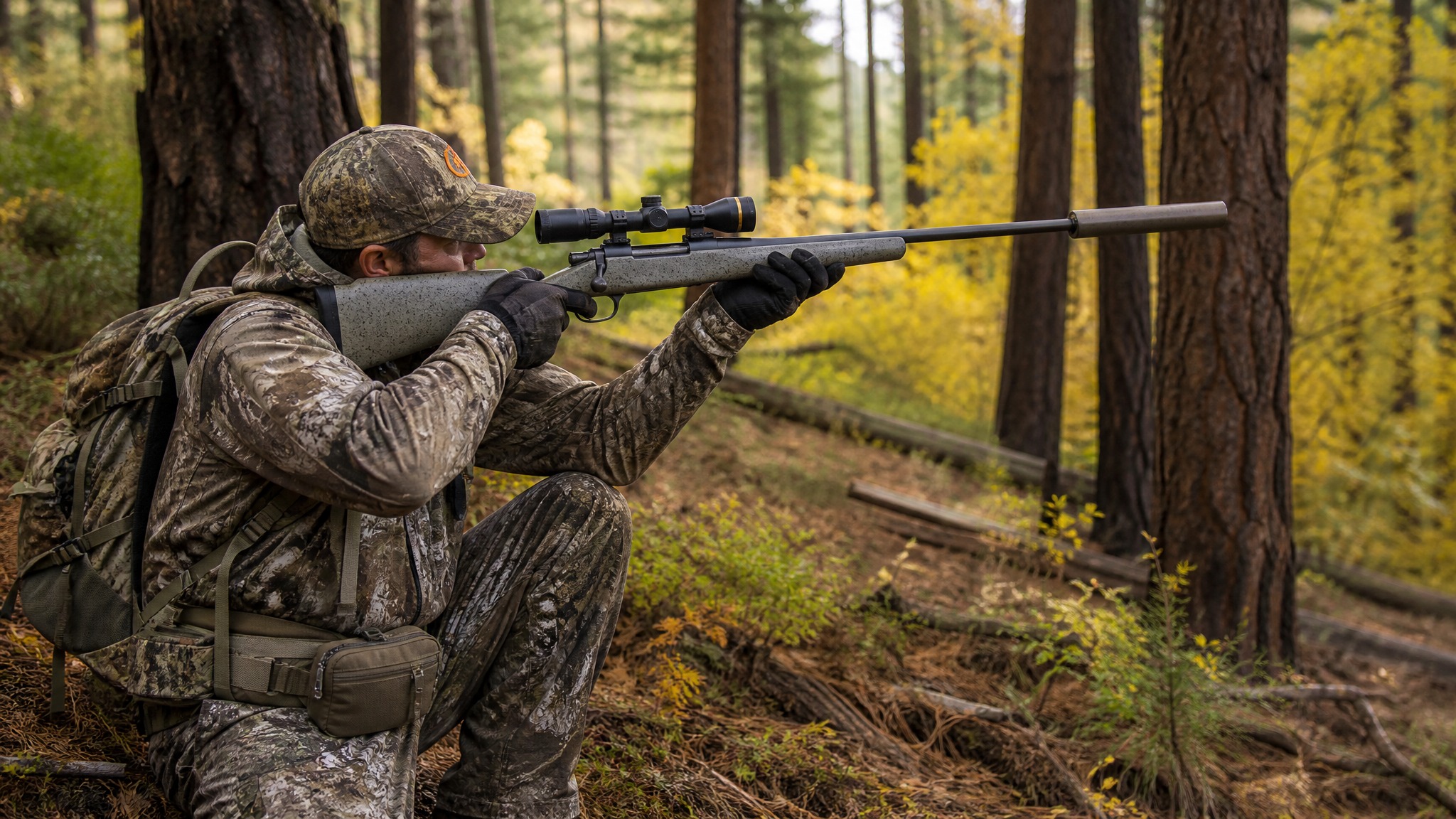
Walk into any gun shop in Bend, Medford, or Portland and you'll notice something that wasn't common a decade ago: suppressor display cases, right next to the hunting rifles. Suppressors — legally regulated as "silencers" under the National Firearms Act — have gone mainstream among Oregon hunters, and for good reason. They protect your hearing, reduce muzzle blast, and can make you a more effective shooter in the field. Here's what you need to know.
Are Suppressors Legal for Hunting in Oregon?
Yes — Oregon has allowed suppressor use for hunting since 2009. You can use a legally registered suppressor on any legal hunting firearm for any species, including deer, elk, bear, cougar, and migratory birds (with the appropriate licenses). There are no Oregon state restrictions beyond federal NFA compliance.
Federal law requires that any suppressor be registered with the ATF via a Form 4 (transfer to an individual) or Form 1 (make your own). You'll pay a one-time $200 tax stamp, submit fingerprints and a photo, pass a background check, and wait — currently 30 to 60 days for most e-File Form 4 submissions, though timelines vary. Once approved, the suppressor is yours to keep and use in any state that permits it, including Oregon, Washington, and Idaho.
Why Hunters Are Choosing Suppressors
Hearing Protection Is the Real Reason
Hollywood suppressors make guns whisper-quiet. Real suppressors reduce muzzle report by 20-35 decibels, bringing a .308 Winchester from roughly 165 dB (immediate hearing damage territory) down to around 130-138 dB — still loud, but far less damaging, and comparable to a car door slamming hard. Over a career of hunting, that reduction adds up to a meaningful difference in long-term hearing health.
More practically: you're not wearing foam plugs in the field. When an elk steps into a clearing at 80 yards and you have three seconds to shoot, you're not fumbling for earmuffs. A suppressor lets you take that shot without the concussive blast that can disorient you for a follow-up if needed.
Reduced Flinch and Better Accuracy
Recoil doesn't change meaningfully with a suppressor, but perceived recoil and muzzle rise often do — the suppressor adds weight forward of the action and briefly delays gas expansion. Many hunters who shoot suppressed during range practice report measurably better groups, simply because they're not anticipating the blast as much. That translates to calmer trigger pulls in the field.
Less Disturbance
In timber elk country — the Coast Range, the Cascades, the Blue Mountains — a missed shot or a quick follow-up used to guarantee that every animal within half a mile knew exactly where you were. A suppressed rifle still makes noise, but it significantly reduces the directional crack that spooks game. This isn't a magic stealth device, but experienced suppressed hunters consistently report better recovery rates after initial shots and less herd dispersal in multi-animal situations.
Choosing a Suppressor for Oregon Big Game
The suppressor market has matured significantly. Here are the most important specs for a hunting-focused suppressor:
- Full-auto rating not required: For hunting semi-auto or bolt-action rifles, you don't need a full-auto-rated can. A hunting-grade suppressor will be lighter and easier to carry.
- Direct thread vs. QD mount: Direct thread (screwing the can directly onto the muzzle threads) is simple and affordable. Quick-detach (QD) systems — like the Dead Air KeyMo or SilencerCo Bravo — let you swap the suppressor between host rifles in seconds. If you own multiple rifles, QD is worth the extra cost.
- Caliber rating: A suppressor rated for .30 caliber (7.62mm) will handle any standard Oregon deer and elk cartridge — .308, .30-06, .300 Win Mag, 6.5 Creedmoor (6.5mm bore, subsonic bleed through .30 cal bore), 7mm-08, and more. Confirm your specific calibers with the manufacturer.
Top Hunting Suppressor Options (2026)
- Dead Air Nomad-30: One of the most popular hunting cans on the market. Full-auto rated, 17.3 oz., rated for cartridges up to .300 Win Mag. Available in direct thread or with the KeyMo QD system. MSRP ~$850.
- SilencerCo Harvester EVO: Purpose-built for hunters — lightweight at 15.9 oz., titanium construction, rated up to .300 Win Mag. Excellent for mountain elk hunts where every ounce matters. MSRP ~$900.
- Rugged Suppressor Radiant 762: Budget-friendly at ~$600-700 MSRP, still full-auto rated and handles most common hunting calibers. A solid entry point for first-time suppressor buyers.
- OSS BPR: Uses a flow-through baffle design that eliminates first-round pop and reduces backpressure on gas-operated rifles — worth considering if your hunting rifle is a semi-auto.
The NFA Process Step by Step
- Find a licensed Class III dealer in Oregon (most gun shops that stock suppressors are SOT/Class III dealers).
- Choose your suppressor and pay for it — it stays at the dealer until your Form 4 is approved.
- Fill out ATF Form 4 (electronically through your dealer's software). Submit fingerprint cards or use a live-scan service.
- Pay the $200 tax stamp. Your dealer handles the submission.
- Wait for ATF approval. Current e-File times are 30-60 days for individual Form 4s as of 2026.
- Pick up your suppressor, take it home, and go hunting.
Note: You must have your approved tax stamp (the physical Form 4 with the ATF approval stamp) with you or accessible when hunting with your suppressor. Keep a photo on your phone and the original in a safe place.
What to Expect in the Field
A quality suppressor on a .308 or 6.5 Creedmoor is comfortable to shoot without hearing protection for most people — though if you're shooting a magnum cartridge like a .300 Win Mag in a short barrel, you may still want a single foam plug in the ear closest to the action. First-round pop (louder than subsequent rounds due to oxygen in the can) is real but manageable.
Suppressed hunting is genuinely enjoyable. You can communicate with your partner after a shot, hear your surroundings better immediately after the report, and approach the experience with less of the stress that comes from knowing a single shot is going to leave your ears ringing for hours. For Oregon hunters who spend weeks afield every fall, that quality-of-life difference is real.