Eastern Oregon's high desert is vast, open, and loaded with Belding's and Richardson's ground squirrels — and that combination makes it one of the premier varmint shooting destinations in the Pacific Northwest. From the rolling wheat hills of Harney County to the rimrock flats of Lake County, the opportunity to shoot hundreds of targets a day at distances from 50 to 400 yards is real. Here's how to do it right.
Know Your Quarry: Oregon's Ground Squirrels
Two species dominate Eastern Oregon's varmint shooting scene:
- Belding's ground squirrel (Urocitellus beldingi) — Found in meadow and irrigated agricultural areas from about 3,000 to 6,000 feet. Harney County's meadows around Burns, the Warner Valley, and Catlow Valley hold dense populations. These are your classic "picket pins" — they stand bolt-upright when alarmed, making them easy to spot and range.
- Richardson's ground squirrel (Urocitellus richardsonii) — Less common in Oregon proper, but the Umatilla County wheat country near the Idaho border sees these mixed in. Slightly larger than Belding's.
Ground squirrels in Oregon are classified as unprotected wildlife — no bag limit, no season. However, always confirm shooting access with landowners or check BLM and state land rules for the specific parcel you're hunting. Much of the best ground squirrel country is private agricultural land where a polite knock on the farmhouse door and an offer to show the landowner your cartridge brass goes a long way.
Best Areas in Eastern Oregon
Harney County (Burns Area)
The undisputed ground squirrel capital of Oregon. Irrigated meadows along the Silvies River, Dry Creek drainage, and the broad flats south of Burns toward Frenchglen hold staggering squirrel densities from late April through late September. Elevation keeps populations active later into fall than lower-country sites. The Malheur NWR vicinity has private agricultural ground neighboring the refuge where landowner permission opens up excellent shooting.
Lake County (Lakeview and Paisley)
The Warner Valley south of Paisley and the agricultural ground around Lakeview produce excellent Belding's squirrel shooting. Open terrain here allows shots to 400+ yards. The wide valley floors give you natural backstops and safe shooting lanes without the work of setting up formal shooting positions.
Malheur County (Vale and Ontario)
Irrigated farmland along the Snake River bottom produces good spring and early summer populations. Access here requires more landowner legwork, but the combination of open terrain and dense squirrel numbers makes the effort worthwhile.
Rimfire: The High-Volume Solution
For shots inside 150 yards, a quality rimfire rifle keeps costs down and allows truly high-volume shooting without the barrel heat issues of centerfire varmint rounds.
- .22 LR — The go-to for shots to 100 yards. CCI Velocitor, Federal AutoMatch, or CCI Mini-Mag in a Ruger 10/22, Savage Mark II, or CZ 457 will account for enormous numbers of squirrels. Keep shots within your ethical range — the .22 LR drops off quickly past 100 yards in wind.
- .17 HMR — Extends effective range to 175 yards with a laser-flat trajectory and explosive terminal performance. Ruger Precision Rimfire and CZ 455/457 in .17 HMR are the platform of choice. Federal V-Shok 17-grain TNT hollow points are a proven load.
- .22 WMR — Bridges the gap between .22 LR and centerfire. Useful in moderate wind to 150 yards. A good option if you already have a .22 Mag rifle.
Centerfire: Long-Range Precision Shooting
When you want to stretch your shooting legs to 300–500 yards across Eastern Oregon's wide-open terrain, centerfire varmint cartridges shine. These sessions double as exceptional long-range marksmanship practice ahead of deer and elk seasons.
- .223 Remington — The standard. Light recoil, cheap brass, and near-universal barrel availability make this the entry-level varmint centerfire. Pair with 50–55 grain Hornady V-MAX or Sierra BlitzKing bullets for explosive performance to 400 yards. Savage Axis II, Ruger American, and AR-15 platforms all work well.
- .204 Ruger — Flatter than .223 and devastatingly accurate. The 32-grain Hornady V-MAX at 4,225 fps is a laser to 400 yards in calm conditions. Under-appreciated in Oregon but excellent in the open terrain of Harney County.
- .22-250 Remington — The PNW varmint stalwart. A 55-grain V-MAX at 3,680 fps handles Oregon's afternoon winds better than .223. This is the cartridge when shots stretch past 300 yards and a breeze comes up off the Steens.
- 6mm Creedmoor / .243 Winchester — Overkill on squirrels, but if you're using the session as long-range practice for deer season, shooting your hunting rifle on live targets at unknown distances is the best possible preparation.
Gear That Makes the Day
Optics
Ground squirrels are small targets. A quality variable-power scope in the 4–16x or 6–20x range is the minimum for centerfire shooting. Vortex Viper HST, Leupold VX-3HD, and Nightforce ATACR all perform well in the Oregon summer heat. A rangefinder (Sig Kilo, Vortex Ranger) is essential for shots past 200 yards — even 25 yards of ranging error at 350 yards means a miss on a 4-inch target.
Shooting Support
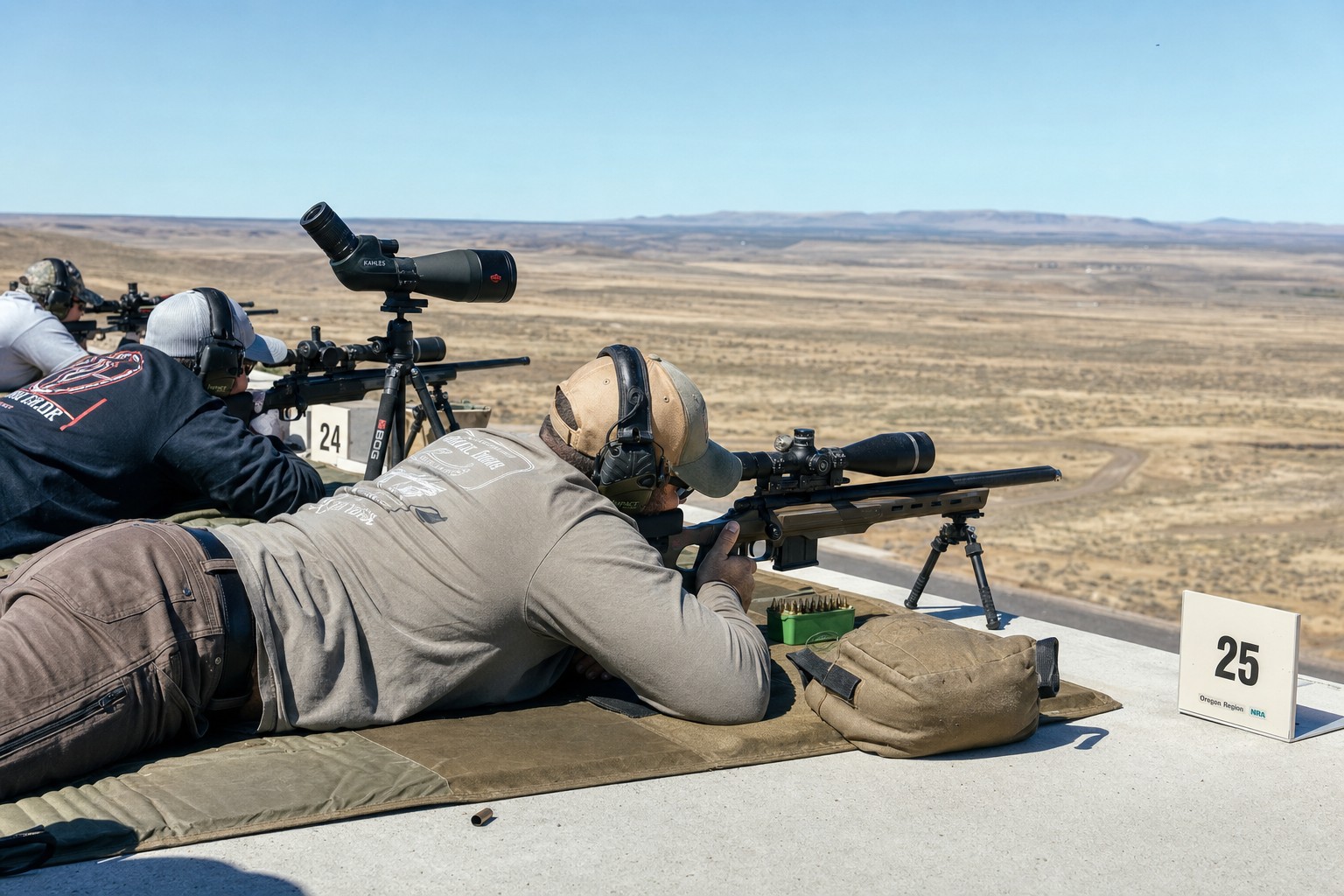
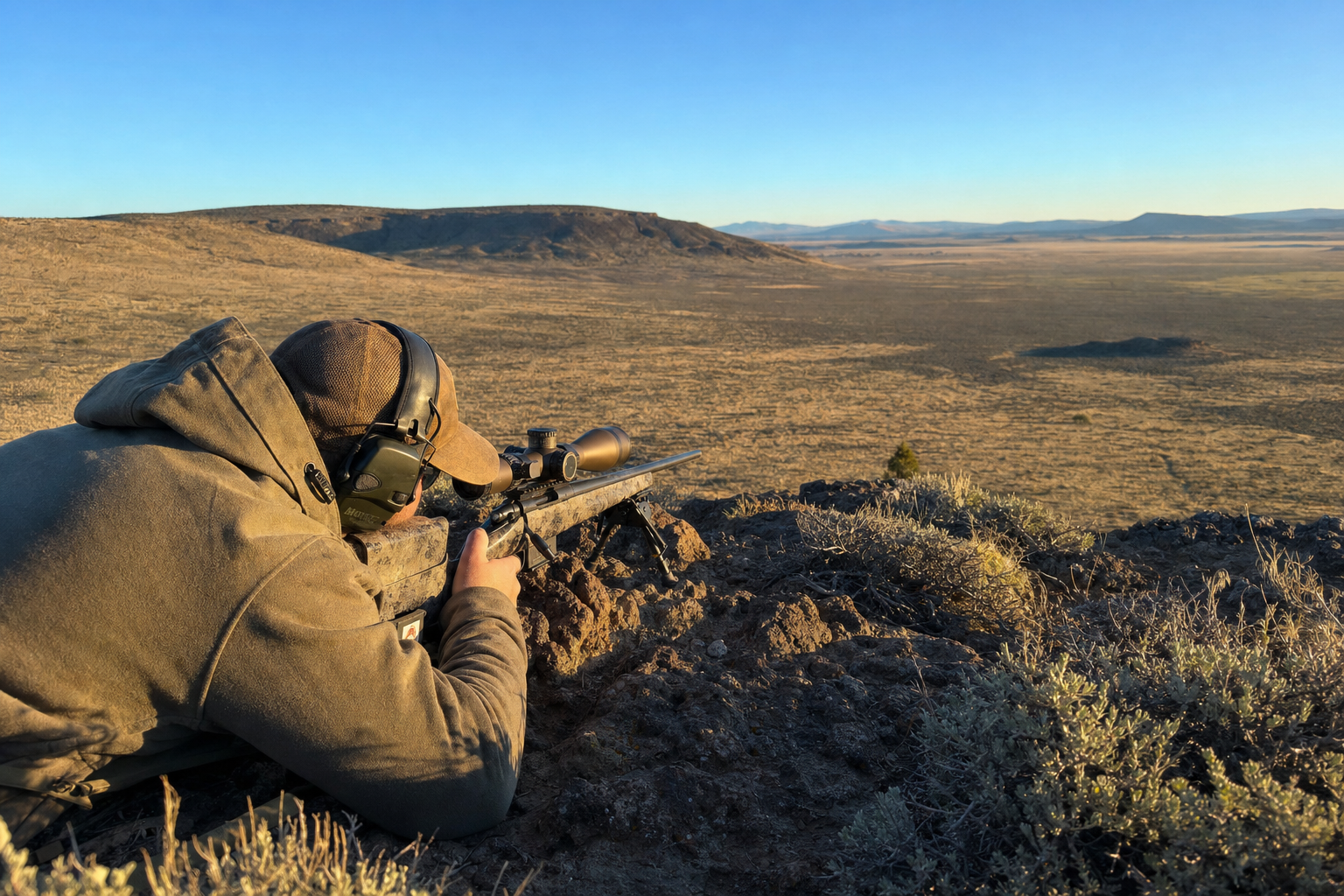
Prone with a bipod and rear bag is the most stable field position. Atlas and Harris bipods in the 9–13" or 13.5–27" range suit Eastern Oregon's uneven ground. A Kestrel wind meter pays for itself in saved shots on windy Harney County afternoons — and there are almost always windy afternoons.
Water and Sun Protection
This is desert country. Summer temps in Burns regularly hit 95°F. Bring at least a gallon of water per person, sunscreen, a wide-brim hat, and a quality shade canopy if you're planning a full-day session. A cooler with ice is not optional.
Ethics and Landowner Relations
The future of varmint shooting access in Eastern Oregon depends entirely on how well hunters represent themselves to agricultural landowners. Always:
- Ask permission before accessing private land — and ask every year, not just once
- Pick up your brass and target debris
- Close gates exactly as you found them
- Report any fence damage or equipment damage honestly
- Consider offering to share coyote or ground squirrel observations that benefit livestock operations
A landowner who trusts you is worth a hundred acres of BLM ground with public access. Build those relationships and protect them.
Plan Your Trip
Peak ground squirrel activity in Eastern Oregon runs May through September, with the squirrels most active in morning and late afternoon. October activity drops significantly as squirrels begin entering torpor. The Burns area is the closest major hub — the Harney County Chamber of Commerce can point you toward current agricultural contacts, and ODFW's Hines office can confirm current land status for nearby BLM parcels. Gas up in Burns before heading out — the distances between stations in Harney County are very real.