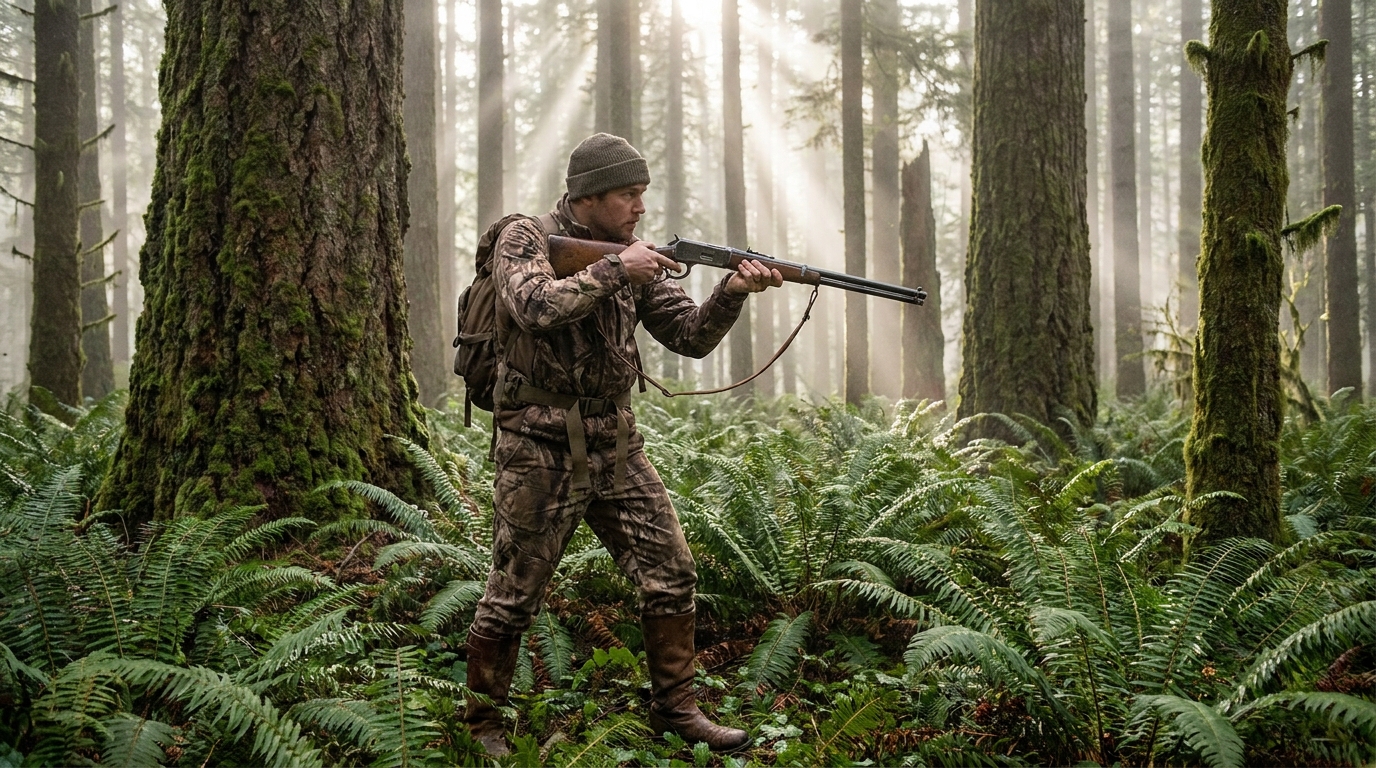
Walk into any coastal Oregon hunting camp in Roosevelt elk country and count the lever actions. There will be more than you expect from hunters who know what actually works in the timber. The lever action carbine has been written off by the modern precision rifle crowd, but in the Coast Range and the wet Cascades west of the crest, where 80% of elk encounters happen inside 100 yards and shots through alder and vine maple thickets are more common than clean lanes, a smooth, short lever gun is a genuinely practical choice—not a nostalgia piece.
Why Timber Country Favors the Lever Action
The argument for lever actions in Pacific Northwest timber isn't sentimental—it's environmental. Oregon's Roosevelt elk habitat, Cascade west-slope bear country, Columbia Blacktail timber zones, and Coast Range hunting areas all share similar characteristics: dense understory, short sight lines, wet weather, and frequent close-range encounters where fast follow-up shots matter more than long-range precision.
Lever action carbines excel in several practical ways:
- Compact and maneuverable: A 20-inch barrel lever gun handles through alders and past brush without flagging the muzzle on branches. Most configurations run 37–39 inches overall—several inches shorter than a standard bolt gun with the same barrel length.
- Fast follow-up shots: The lever action offers repeatable, fast cycling without breaking cheek weld or dramatically shifting the rifle's position. On moving elk at 40 yards in timber, this is a meaningful advantage.
- Weather resistance: Older lever actions with steel receivers and walnut stocks are as weather-hardy as anything you'll find. Modern synthetic-stocked variants from Henry and Marlin add to this. They don't need coddling in the rain.
- Short barrels remain legal: Oregon's general timber seasons don't require any barrel length above what federal law mandates. A 16.5-inch Marlin 336 is a genuinely effective deer and bear rifle.
Caliber Selection for Pacific Northwest Hunting
Lever action hunting isn't limited to cowboy-era chamberings. The modern options cover everything from deer to elk to black bear:
- .30-30 Winchester: Still viable for blacktail deer, Columbia blacktail, and coastal deer inside 150 yards. With modern Hornady LEVERevolution FTX ammunition, muzzle velocity and trajectory have improved significantly over old round-nose loads. Not an elk cartridge in most situations.
- .35 Remington: The big-bore lever cartridge of choice for many Pacific Northwest hunters. Heavy, slow, and destructive at close range. Excellent for Roosevelt elk inside 100 yards and a legitimate black bear cartridge. Primarily available in the Marlin 336 platform.
- .45-70 Government: The modern choice for maximum energy at close range. Henry and Marlin both offer quality .45-70 lever guns. With modern loads, the .45-70 exceeds 2,000 ft-lbs at the muzzle and is appropriate for any game in North America. Recoil is significant but manageable.
- .450 Marlin: A belted magnum version of the .45-70 concept, designed to prevent accidental loading of +P .45-70 loads in older rifles. Not as widely supported as the .45-70 but offers genuine performance in modern Marlin lever guns.
- .357 Magnum: In Henry or Marlin carbines, the .357 Magnum develops significantly higher velocity than handgun-barrel lengths—around 1,800 fps with 158 gr loads. A legitimate deer and blacktail carbine inside 100 yards, and handles the same ammunition as a .357 revolver for camp use.
Platform Comparison: Henry vs. Marlin vs. Winchester
Marlin 336: The workhorse of timber hunting. Side ejection makes optic mounting straightforward without offset rails. The 336 has earned its reputation over 70+ years of production. Post-Ruger acquisition (2022–present) quality control has improved significantly. Available in .30-30 and .35 Remington. The 1895 variant handles .45-70.
Henry All-Weather: The Henry rifles feature a brass receiver that won't rust and a chrome-lined barrel. Top ejection on the standard models complicates optic mounting, but the Henry X Model and Side Gate variants address this. Excellent build quality and made in the USA.
Winchester Model 94: The legend. Current production Model 94s are made by Miroku in Japan and are high-quality rifles. The Angle Eject models mount optics cleanly. In .30-30, the 94 is perhaps the quintessential deer rifle for timber country. The .450 Marlin variant is a modern elk-worthy option.
Optics: Keep It Simple
For timber hunting at close range, a 1-4x or 1-6x low-power variable optic is the practical choice. The 1x setting gives a both-eyes-open field of view for fast target acquisition at close range; the 4-6x setting allows precise shot placement to 200 yards. Leupold's VX-Freedom 1.5-4x is a popular choice for lever guns—compact, bright, and reliable in wet conditions.
Red dot sights are increasingly popular on lever carbines for close-range timber work. A Holosun or Leupold DeltaPoint Pro co-witnessing with iron sights covers every scenario you'll encounter in western Oregon.
Practical Accuracy in the Field
Lever action accuracy is often undersold. A Marlin 336 or Henry lever gun with a quality scope is typically capable of 2 MOA or better—1.5 MOA with good ammunition. At 100 yards in the timber, that's a 1.5-inch group: adequate for any ethical shot at deer, bear, or elk at practical timber ranges.
The practical accuracy ceiling for timber hunting is rarely the rifle; it's the hunter's ability to shoot from field positions under pressure and through cover. Train with your lever gun. Learn to shoot from a tree rest or sitting position. Practice the cycling action until it's automatic. That preparation is what turns a traditional platform into a genuinely effective modern hunting tool.
The Bottom Line
Oregon's timber country favors hunters who move well, shoot fast, and carry rifles that don't fight the environment. A lever action carbine in .35 Remington, .45-70, or .30-30 isn't a compromise—it's an honest match for the terrain and the game. Experienced Pacific Northwest hunters have known this for generations. The rifle on your shoulder doesn't need to be able to reach 800 yards if every shot you'll take is inside 80.