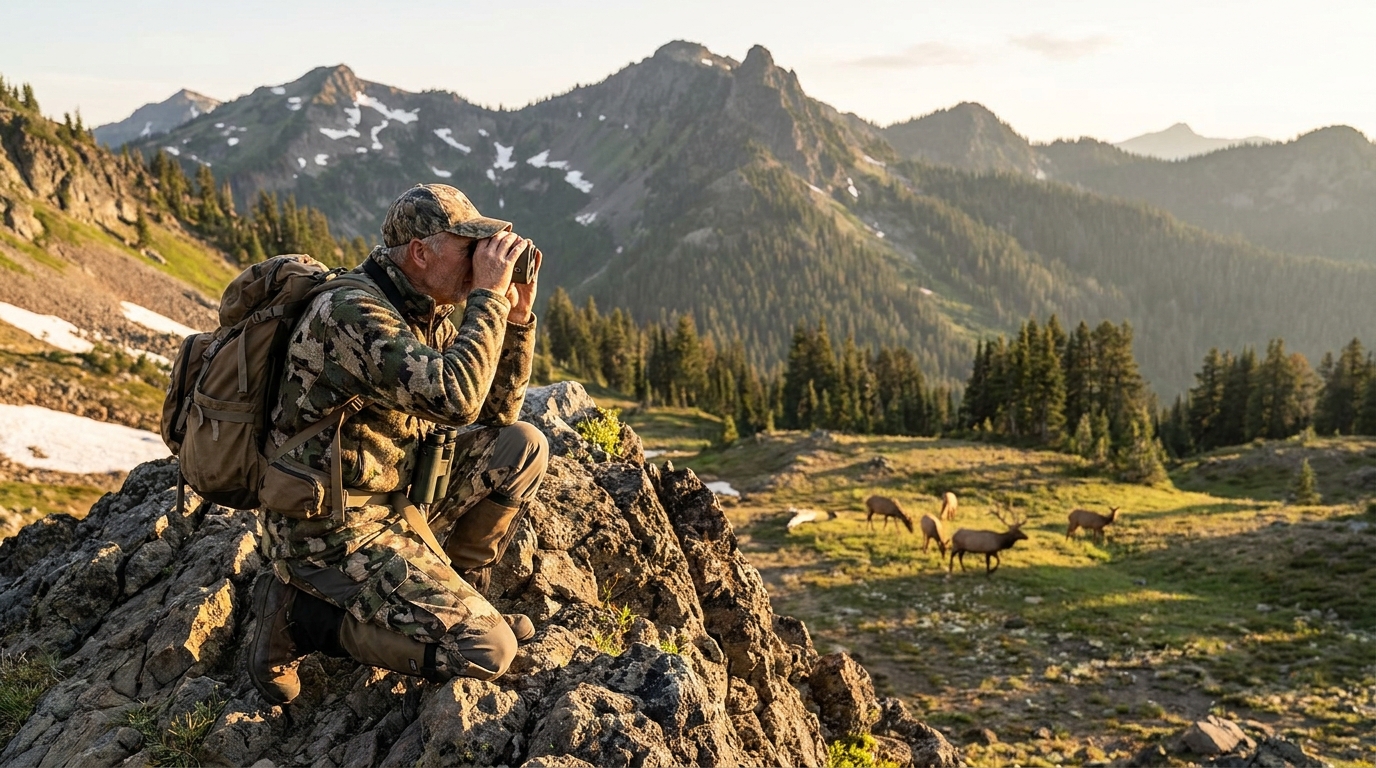
Twenty years ago, knowing the exact range to an animal meant you had good eyes and better judgment. Today, a laser rangefinder gives you that answer in a fraction of a second at ranges your grandfather would have considered impossible shooting distances. For western big game hunters — where 300-, 400-, even 500-yard shots are a part of the landscape — a quality rangefinder isn't optional equipment. It's as fundamental as your riflescope and your binoculars.
The problem isn't that hunters lack access to rangefinders. It's that most hunters use them wrong, buy more or less unit than they need, and don't understand the features that actually matter versus the marketing specs that don't. Let's fix that.
What the Specs Actually Mean
Maximum Range
Manufacturers advertise maximum range on reflective targets under ideal conditions. That 1,600-yard spec? That's a highway reflector on a fogless morning. On a mule deer in sage brush under overcast skies, the same unit might reliably range to 900 yards. On elk in timber, 600 yards. The reflectivity of the target surface matters enormously. A rule of thumb: cut the advertised max range in half for a realistic expectation on live game in field conditions.
First vs. Second Return
This matters more than most hunters realize. Some rangefinders return the distance to the first object the beam hits (first return) — useful when ranging through brush where you don't want to measure a branch 50 yards in front of the animal. Others return the last object (second return) — better for measuring across an opening to a distant hillside. Premium units give you both modes. Know which mode your unit defaults to and when to switch it.
Angle Compensation
This is the feature that earns its keep in Oregon's mountains. When you're ranging an elk 350 yards away on a 30-degree slope, the line-of-sight distance is 350 yards but the ballistic distance — the distance your bullet actually drops over — is around 305 yards. A rangefinder with angle compensation (also called HCD, LOS/HCD toggle, or ARC depending on the brand) calculates this for you and gives you the true hold distance. Without it, you'll shoot over animals consistently on steep terrain. This is non-negotiable for mountain hunting in the Pacific Northwest.
The Rangefinders Worth Owning
Under $300: Vortex Ranger 1800i
The best value play in hunting rangefinders. Reliably ranges elk to 900+ yards in real conditions, has solid angle compensation, and the Vortex VIP warranty covers it for life. Glass isn't exceptional but is more than adequate for ranging purposes. If budget is the primary constraint, start here.
$300–$600: Sig Sauer Kilo3000 BDX / Leupold RX-2800
This is the sweet spot for serious hunters. The Sig Kilo3000 BDX pairs with Sig BDX-capable riflescopes to automatically set a holdover dot in your scope — genuinely useful for backcountry situations. The Leupold RX-2800 offers outstanding optics quality for glassing and ranging from the same unit, reducing gear carried.
$600+: Gunwerks G7 BR2500 / Vortex Fury HD 5000
Premium units that justify their price for specific applications. The Vortex Fury HD 5000 is a 10x42 binocular-rangefinder combo — one piece of glass that does both jobs. For spot-and-stalk mule deer or glassing elk basins where you're constantly ranging at different distances, the combination bino-rangefinder eliminates the step of switching from binos to rangefinder and back. Worth every dollar if you can afford it.
Field Use: Making It Count
Range Before You Need It
The biggest mistake hunters make is ranging animals only when they're about to shoot. Range constantly as you move through country — that rock pile 380 yards out, the lone juniper at the edge of the flat, the saddle where elk crossed yesterday. Build a mental map of your surroundings before the moment of truth. When an animal appears, you may already know it's 340 yards to the tree it just walked past.
Multi-Range for Accuracy
Range the same object 3–5 times and average the readings. Single readings can be off by 5–15 yards in difficult ranging conditions (low reflectivity, heat mirage, light rain). Three consistent readings that agree within 5 yards give you confidence to hold the right point.
Ranging in Timber
In Oregon's Coast Range or Cascade elk country, dense timber makes ranging difficult. Range the largest opening you can find near the animal rather than trying to punch through brush. Then use your knowledge of the forest structure to estimate the animal's actual position relative to what you ranged. In timber under 200 yards, precise ranging matters less — know your 200-yard zero and aim accordingly.
Angle Compensation in Practice
Always engage angle compensation mode when hunting slope grades above 15 degrees. Flat-country hunters can usually ignore it, but Pacific Northwest hunters shooting into canyons, off ridges, or down from elevated stands will see meaningful differences. A 400-yard shot at 35 degrees downhill requires the same holdover as a 330-yard flat shot — miss that correction and you're shooting over the animal.
Integration with Your Ballistic System
A rangefinder is only as useful as the ballistic solution you pair it with. Know your rifle's verified drops at 100-yard increments out to your maximum ethical shooting distance. Build a laminated dope card and tape it to your stock. Better yet, use a ballistic app — Applied Ballistics, Hornady 4DOF, or the Sig BDX system — that takes your rangefinder output and gives you an immediate hold solution.
The combination of a quality rangefinder, confirmed dope from your personal rifle, and the discipline to practice at field distances before season opens is what separates clean kills from wounding loss at extended range. The rangefinder starts that chain — invest in a good one, learn it cold, and use it every time you're in the field.