Precision Rifle Series, 3-Gun, USPSA — practical shooting sports can look intimidating from the outside. Complex rules, expensive gear, experienced competitors who've been doing it for years. If you want to get into competitive shooting but don't know where to start, Steel Challenge is the answer. It's the most approachable competitive shooting sport going, and the Pacific Northwest has an active community of clubs running matches all year.
What Is Steel Challenge?
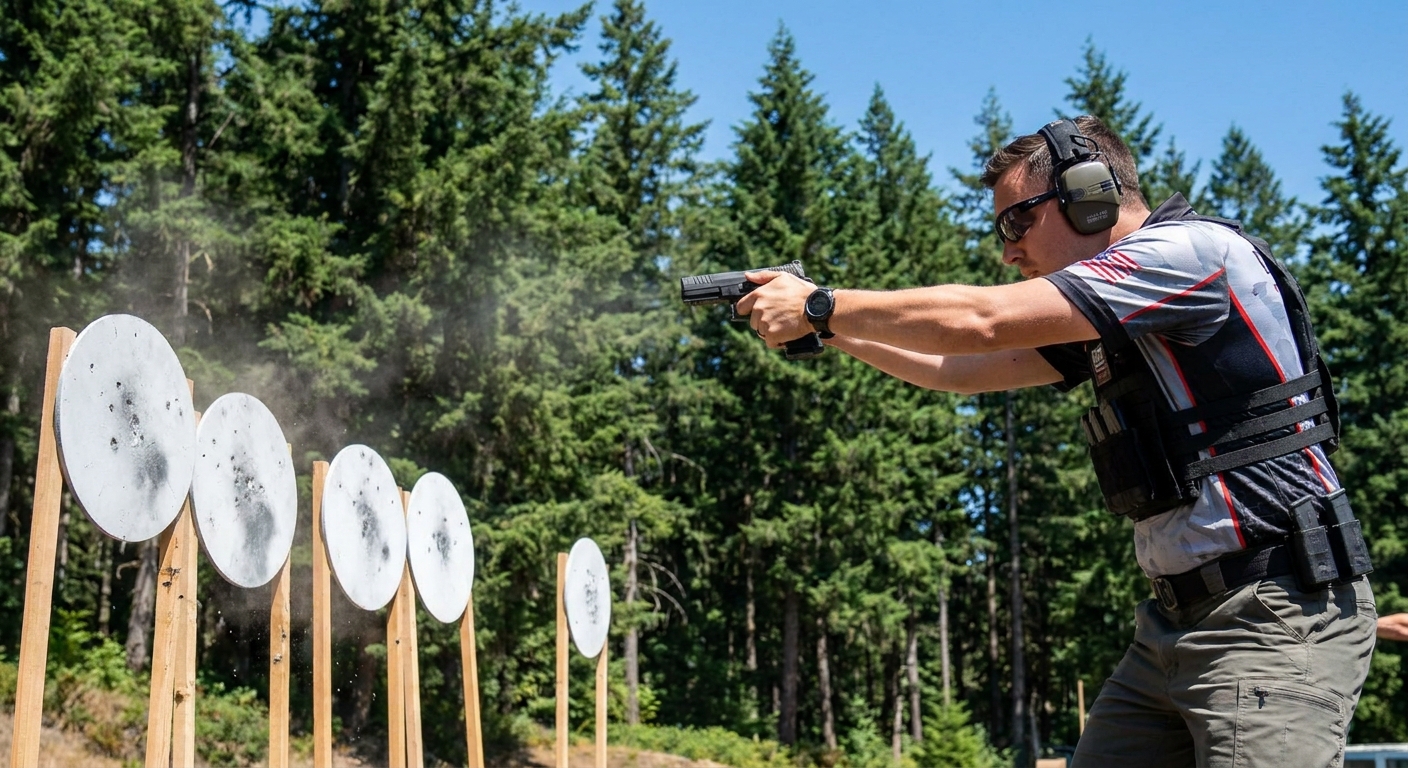
Steel Challenge Shooting Association (SCSA) competition is built around eight fixed stage designs. Each stage features five steel plate targets arranged in a specific geometric pattern. The shooter draws from the holster (or low-ready depending on division), engages all five plates, and stops the clock on a designated "stop plate" — always the large square plate. You shoot each stage five times; the slowest time is dropped and the other four are added for your stage score. Lowest cumulative time across all stages wins.
That's really it. No movement between positions. No reloads mid-stage. No decision-making about stage order. Just you, your gun, and the clock. Stage designs have names — Smoke and Hope, Five to Go, Roundabout, Accelerator, Outer Limits, Speed Option, Pendulum, and Showdown — and they vary from tight transitions to wide swings to the classic Pendulum stage that will humble even experienced shooters.
Why Hunters and Outdoorsmen Should Compete
Steel Challenge builds the fundamental skills that translate directly into the field: trigger control under pressure, smooth gun presentation, target acquisition, and consistent muzzle movement. Hunters who compete regularly notice that the trigger press that once felt mechanical becomes instinctive. The shot that used to require mental effort — lifting a defensive pistol accurately when adrenaline is flowing — becomes automatic.
Beyond the skill transfer, the community is genuinely welcoming to new shooters. Match officials run new shooter orientations at most clubs, and competitors at every skill level are typically happy to give advice and coaching. There's no shortage of experienced Pacific Northwest competitors willing to walk a new shooter through stage planning.
Divisions: What to Shoot
Steel Challenge has more divisions than any other shooting sport, which means you can almost certainly compete with what you already own. Key divisions include:
- Rimfire Pistol (RFP) and Rimfire Rifle (RFR): .22 LR semi-auto pistols and rifles with optics or iron sights. The cheapest way to compete — ammo costs are negligible and a Ruger 10/22 or Smith & Wesson M&P 22 Compact gets you started immediately.
- Centerfire Pistol Caliber Carbine (PCC): Semi-auto 9mm carbines like the AR-9. Very popular, fast divisions.
- Pistol Caliber (PC) and Open (OPN): Full-power centerfire pistols in iron sight and compensated/optic-equipped configurations.
- Single Stack (SS): 1911-pattern pistols in .45 ACP or 9mm.
If you're starting out, Rimfire Pistol with iron sights is the lowest-barrier entry point. A Ruger Mark IV, Browning Buck Mark, or S&W Victory, along with a brick of .22 LR, is all you need.
Pacific Northwest Clubs Running Steel Challenge
Several Pacific Northwest ranges run regular SCSA-affiliated Steel Challenge matches. Clubs to research include:
- Clark Rifles, Battle Ground, WA: Active practical shooting program with regular steel matches and a welcoming new-shooter environment
- Tri-County Gun Club, Sherwood, OR: One of Oregon's most active USPSA/Steel Challenge venues, with multiple bays and a consistent monthly match schedule
- Shooting Range Industries clubs throughout Western Oregon and SW Washington
- Bend Practical Shooters, Bend, OR: Serves Central Oregon's competitive shooting community with regular matches at the Prineville area range
Find current match schedules at practiscore.com — search for Steel Challenge matches in Oregon or Washington, register online, and show up with your gear and eye/ear protection.
What to Expect at Your First Match
Arrive early. Let the match director or a range officer know it's your first time. You'll receive a safety briefing covering the 180-degree rule, drawing from the holster protocol, safe gun handling, and stage procedures. You'll likely be squadded with a group that includes at least a few experienced competitors who can answer questions.
On each stage, the Range Officer will brief you on the stage description, call "Make Ready," and start the timer. Shoot the plates in any order you choose — most shooters develop an order based on efficient muzzle movement — and hit the stop plate last. Miss a plate? You'll see the steel didn't fall or the timer wasn't stopped — you'll get feedback immediately.
Gear Checklist for a First Match
- Pistol or rifle in a legal division, factory or competition legal
- Holster that covers the trigger guard (for pistol divisions) — Kydex OWB works fine
- At least three magazines or cylinders
- Minimum 150 rounds per match session; 200 to be safe
- Quality ear protection (electronic muffs let you hear range commands) and ANSI-rated eye protection
- A timer isn't required but helps with dry-fire practice at home
Dry Fire: The Free Training Tool
Steel Challenge rewards smooth, consistent technique over raw speed. The good news: almost all the skill development can happen at home through dry-fire practice with an unloaded, verified-safe firearm. Practice the draw stroke, the sight acquisition, and the trigger press. Run a par timer app on your phone to simulate stage pressure. The shooters at the top of the local leaderboard aren't shooting 500 rounds a week at the range — they're dry-firing 15 minutes a day in their living room.
If you shoot, hunt, or carry a firearm and you're not yet competing in Steel Challenge, you're leaving skill development on the table. Find a match near you, show up with your .22, and start the clock.