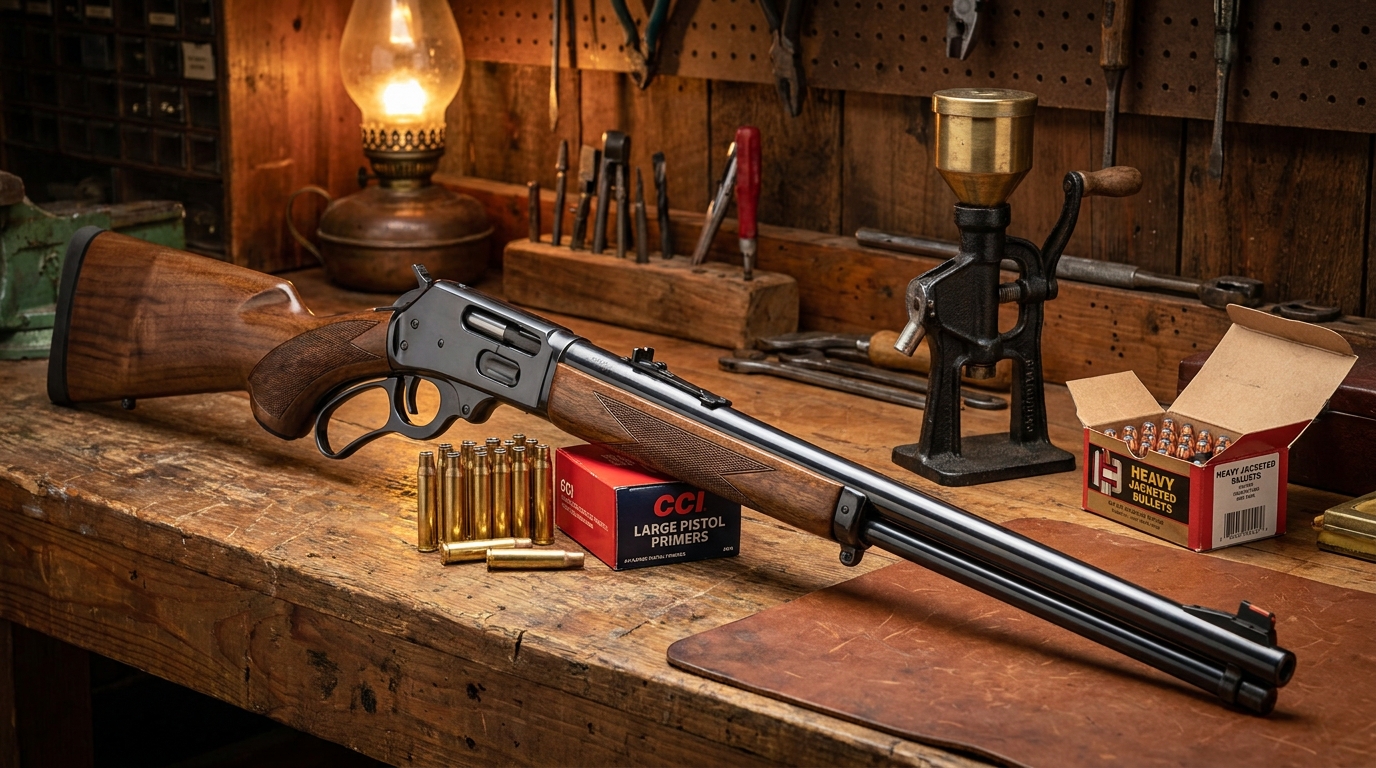
The .444 Marlin was introduced in 1964 as a joint venture between Marlin Firearms and Remington to produce a cartridge capable of taking large North American game at the ranges common to lever-action hunting — inside 200 yards, usually much closer. Built on a lengthened .44 Magnum case, the .444 fires .429-diameter bullets at velocities that produce nearly 3,000 ft-lbs of muzzle energy in full-power loads. In Oregon's dense Coast Range timber, the Cascade foothills, and the black bear country of southern Oregon, it is a serious and effective choice. And for handloaders, it's a cartridge that genuinely rewards attention to component selection and load development.
The .444 Marlin Case
The .444 Marlin operates at a relatively modest maximum average pressure of 44,000 CUP (approximately 60,200 PSI in current SAAMI specs), which is important context for choosing powders and understanding velocity potential. The case is rimmed, designed for the tubular magazine of the Marlin 444, and headspaces on the rim. This means consistent headspacing from the factory — a good thing for precision handloading.
Brass is available from Starline (the best option for volume reloaders), Remington, and Winchester. Starline .444 Marlin brass is excellent: consistent weight, good neck tension, and capable of many reloading cycles with proper annealing. Sort by weight before your first load development session and trim to 2.215 inches — the SAAMI spec trim-to length.
Primer selection is straightforward: large pistol primers are standard, though some handloaders use large rifle primers in compressed loads for more consistent ignition. CCI 350 Magnum Large Pistol, Federal 155, and Winchester WLP are all proven choices. For hunting loads with slower powders, the magnum primer is worth using.
Bullet Selection for Oregon Game
This is the most consequential decision you'll make when loading the .444 Marlin for hunting. The original chamber had a fast 1:38 twist that favored 240-grain bullets. Modern Marlin 444s have a 1:20 twist — a significant improvement that stabilizes heavy 300-grain and 325-grain projectiles effectively. Know your rifle's twist before committing to a bullet weight.
- Hornady FTX 265-grain: The spitzer-style FTX bullet opened up the .444 for modern performance at distance. In handloads, the 265-grain FTX is a versatile choice for deer, bear, and close-range elk. Sectional density is adequate for most Oregon game at lever-gun ranges. Velocity around 2,200 fps from a 22-inch barrel.
- Hornady XTP 300-grain: The XTP in .429 diameter is a proven deer and black bear bullet. Controlled expansion, good penetration. At .444 Marlin velocities this bullet performs extremely well on bear at woods distances. Load it to 2,000–2,100 fps for a classic big-bore load.
- Swift A-Frame 300-grain: For elk or situations where maximum penetration and weight retention matter, the A-Frame is the premium choice. The bonded core construction ensures the bullet holds together through shoulder bone and heavy muscle. Slightly expensive but worth it for once-a-year tag hunting.
- Cast bullets (Keith-style SWC, 300–320 grain): For practice, affordable shooting, and short-range bear over bait, hard-cast lead is appropriate in the .444. Keep velocity under 1,800 fps with cast to avoid excessive leading.
Powder Selection
The .444 Marlin works best with medium-burning rifle powders and slower pistol powders. The case capacity and operating pressure put it in an interesting middle zone — faster than most rifle cartridges, slower than most magnum pistol loads.
- Hodgdon H110 / Winchester 296: The classic choice for maximum velocity with 240–265 grain bullets. Produces consistent pressures and good ignition. Compressed charges are normal. Do not reduce H110/296 loads more than 3% below maximum — this powder requires a near-maximum charge for safe, consistent ignition.
- Alliant 2400: An older classic that works well with 240–300 grain bullets. Slightly more forgiving than H110 at reduced loads. Velocity is a touch lower than H110 at maximum charges but the difference is modest.
- IMR 4227 / Hodgdon H4227: Well-suited to 265–300 grain bullets. A bit slower than 2400 and gives excellent results across a wide bullet weight range. Popular for hunting loads where a wide window of safe charges is desirable.
- Lil' Gun: A spherical powder that meters well and produces excellent velocity with 240–265 grain jacketed bullets.
Practical Hunting Loads
These are starting points drawn from Hornady and Hodgdon published data. Always begin at the minimum charge and work up, watching for pressure signs — flattened primers, stiff extraction, ejector marks on the case head. Verify with your specific rifle.
- Hornady FTX 265 gr / H110 / 56.0 grains (start) to 59.0 grains (max): Approximately 2,200 fps from a 22-inch barrel. Excellent all-around hunting load for deer, bear, and close elk shots inside 150 yards.
- Hornady XTP 300 gr / H4227 / 46.0 grains (start) to 50.0 grains (max): Approximately 1,900–2,000 fps. Deep-penetrating bear and elk load. At 100 yards delivers over 2,500 ft-lbs — more than sufficient for any Oregon game animal.
- Cast 310 gr / Alliant 2400 / 36.0 grains (start) to 40.0 grains (max): Approximately 1,600–1,700 fps. Practice load that cycles the action smoothly and is easy on shoulders for offseason shooting.
Accuracy Expectations and Crimping
The Marlin 444 is a hunting rifle, not a benchrest gun. Expect 1.5–2.5 MOA groups from quality handloads the rifle prefers. At the ranges this cartridge is designed for — inside 150 yards in heavy timber — that accuracy is more than adequate.
Use a factory crimp die, not just the seating die's built-in crimp. The .444 Marlin recoils sufficiently that bullets can creep forward in the magazine under recoil. A positive Lee Factory Crimp Die or Redding Profile Crimp applied at the cannelure of jacketed hunting bullets solves this completely. This is one of the most important steps in loading any lever-action cartridge intended for a tubular magazine.
Oregon Applications
In Oregon's Coast Range black bear season — which runs spring and fall — the .444 Marlin is an outstanding choice for hunters working shot distances under 100 yards in dense second-growth timber. It hits hard, cycles quickly for a follow-up, and the Marlin 444 is lighter and shorter than many bolt-action elk rifles, making it a practical carry in the thick stuff. For coastal Roosevelt elk at close quarters, it's a legitimate option with a premium bonded bullet. Know your range limitations — this isn't a 300-yard rifle — and the .444 Marlin will serve you well in Oregon's most demanding close-cover hunting situations.