Oregon's archery deer season opens in mid-August, and elk follows in late August. That means July is the last month to sort out equipment problems before the season matters. Broadhead tuning is the step most bowhunters skip — or rush — and it's the one that determines whether your arrows fly true at 40 yards when a buck is standing in a September clearing. Field point accuracy means nothing if your broadheads don't match it. Here's how to tune your compound bow so broadheads and field points hit the same hole at hunting distances.
Why Broadheads Fly Differently Than Field Points
A field point is aerodynamically neutral — it adds minimal drag and doesn't affect arrow steering. A broadhead, especially a fixed-blade head, acts like a small wing. Any minor imperfection in your arrow's flight — a slight fishtail, a lean off the rest, a weak spine — that's invisible with field points becomes magnified with a broadhead. The larger the blade surface, the more pronounced the effect. A 100-grain mechanical with small vented blades is more forgiving than a 125-grain fixed three-blade; the fixed blade punishes poor tune ruthlessly.
The goal of broadhead tuning is to get your arrow flying perfectly straight at the broadhead — which means eliminating all steering influences so the head goes where the arrow is pointed, not where the blades want it to go.
Step 1: Confirm Your Foundation — Paper Tune First
Before you touch a broadhead, paper tune your bow with field points. Shoot through a single sheet of paper at 6–8 feet. The hole your arrow tears tells you what the arrow is doing in flight:
- Perfect bullet hole: Point and fletching enter together — you have a well-tuned arrow flight baseline
- High tear (nock high): Nocking point is too low, or your arrow rest is too high — raise the rest or lower the nocking point
- Low tear (nock low): Opposite — lower the rest or raise the nocking point
- Left tear: Arrow is kicking left at the rest — adjust rest to the right (for a right-handed shooter)
- Right tear: Arrow is kicking right — adjust rest to the left
Don't proceed to broadhead tuning until you're getting clean paper tears. Chasing broadhead inconsistency on top of a poorly tuned bow is a waste of time and arrows.
Step 2: Bare Shaft Tuning (Optional but Valuable)
For hunters who want maximum confidence, bare shaft tuning confirms your paper results without the masking effect of fletching. Shoot a fletched arrow and an unfletched (bare) shaft at the same target from 20 yards. The bare shaft should impact at or very near the fletched arrow. If it hits left or right, your rest position and/or center shot needs adjustment. If it hits high or low, your nocking point needs work. The bare shaft is a precision instrument — it doesn't forgive poor form or a poorly tuned bow.
Step 3: Walk-Back Tuning for Broadheads
Walk-back tuning is the most practical method for hunting-distance broadhead verification. Set up a vertical reference line — a piece of tape from top to bottom of your target works fine. Shoot a field point at 10 yards, centered on the line. Without moving the bow or sight, back up to 20 yards and shoot a broadhead. Then 30, then 40. Each arrow should impact on the vertical line — if broadheads drift left or right of field points as distance increases, your center shot is off.
- Broadheads drift left: Move rest to the left (for right-handed shooter)
- Broadheads drift right: Move rest to the right
- Consistent drift that doesn't worsen with distance: May be a nocking point issue rather than center shot
Make small adjustments — 1/16 inch at a time — and re-shoot. Walk-back tuning rewards patience.
Step 4: Matching Your Broadheads to Your Field Points at Distance
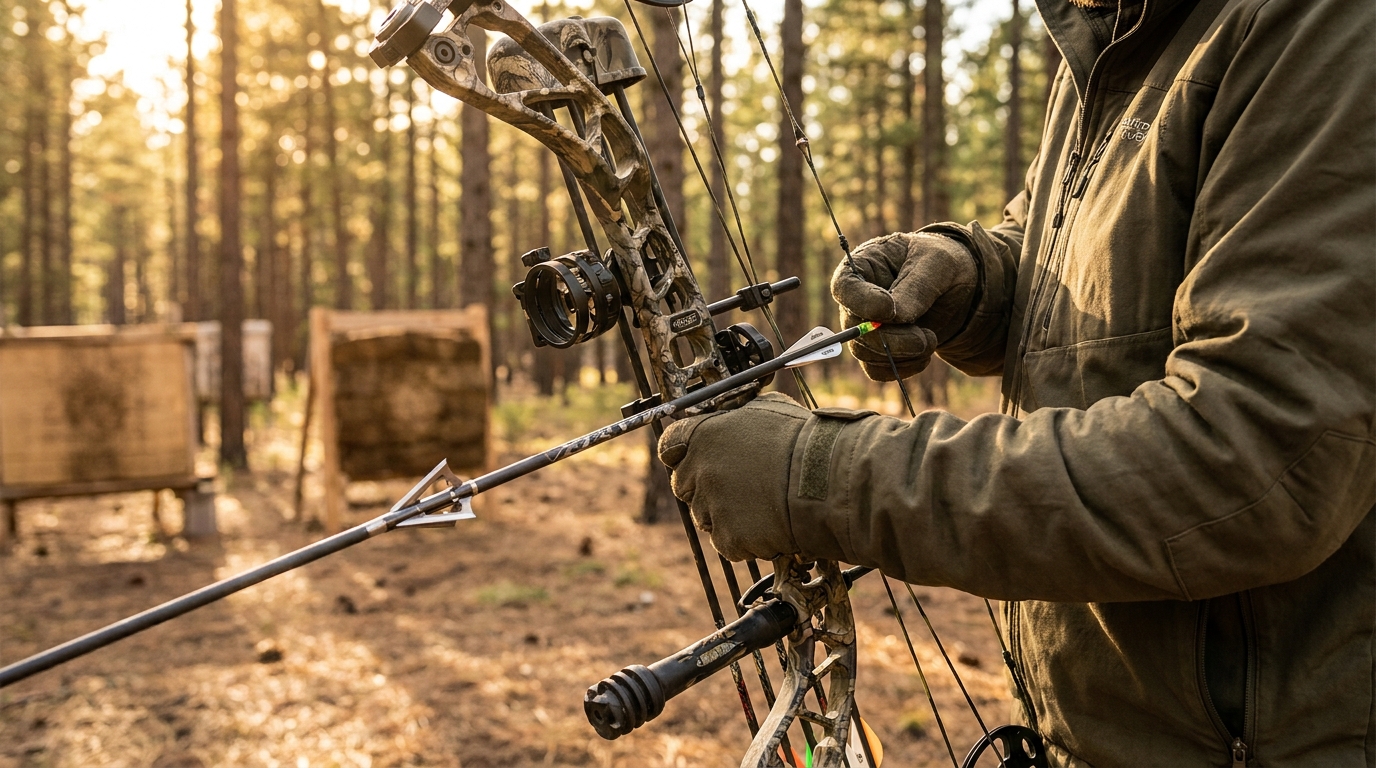
After walk-back tuning confirms your center shot, shoot groups at 30 and 40 yards with both field points and your hunting broadheads. They should impact within 2–3 inches of each other at 40 yards. If they're hitting the same hole, you're done. If broadheads are consistently high, low, left, or right of field points, you have options:
- Adjust your broadhead sight pins: If your bow is otherwise well tuned, a slight impact difference between field points and broadheads is normal, especially with fixed blades. Many hunters simply set a dedicated broadhead pin at 40 yards verified with actual broadheads.
- Check broadhead alignment: Spin-test every broadhead on a flat surface before shooting. A wobbling head is a bent insert, a poorly aligned ferrule, or a bad broadhead. Toss it.
- Check arrow spine: If broadheads are flying erratically and you can't tune them to match field points, your arrow spine may be too weak or too stiff for your draw weight and arrow length. A weak-spined arrow with fixed blades is the most common cause of broadhead inconsistency.
Mechanical vs. Fixed Blade: Tuning Considerations
Modern mechanicals — quality options like the Rage Hypodermic, Swhacker, or NAP Spitfire — are significantly more forgiving in tuning than fixed blades because the blades deploy after the arrow is in flight. If you're a beginning bowhunter or you're shooting a bow that's difficult to tune perfectly, a well-designed mechanical is a practical choice. Oregon's elk and deer are not going to survive a 2-inch wound channel from a mechanical at 35 yards — they're dead.
Fixed blades — Slick Trick, Muzzy, Montec, NAP Thunderhead — require a more precise tune but reward it with ultimate penetration and reliability. No deployment failure, no blade-not-opening on a quartering-to shot. If you're shooting fixed blades at elk, prioritize penetration and shoot a heavy, stiff-spined arrow with high FOC.
The July Timeline
July is the right month to work through this process because you have time to be methodical. Paper tune first. Walk-back tune with broadheads. Verify at 30 and 40 yards. Then spend August practicing from field positions with broadhead-tipped arrows at unknown distances. Don't save your broadheads for the season — shoot them. Know exactly how your hunting setup performs before you're standing in elk country with one chance.
A bow that's shooting broadheads into the same hole as field points at 40 yards is a bow you can trust. Do the work in July, and come August, your only job is to execute the shot.