Every bowhunter has been there: two weeks before the August opener, you notice the serving on your string has started unraveling at the nock point, or your peep sight is rotating every third shot, or your draw length suddenly feels half an inch short. You need a pro shop, except the two good shops near you have a three-week backlog in July because every other bowhunter in the county just pulled their bow out of the closet.
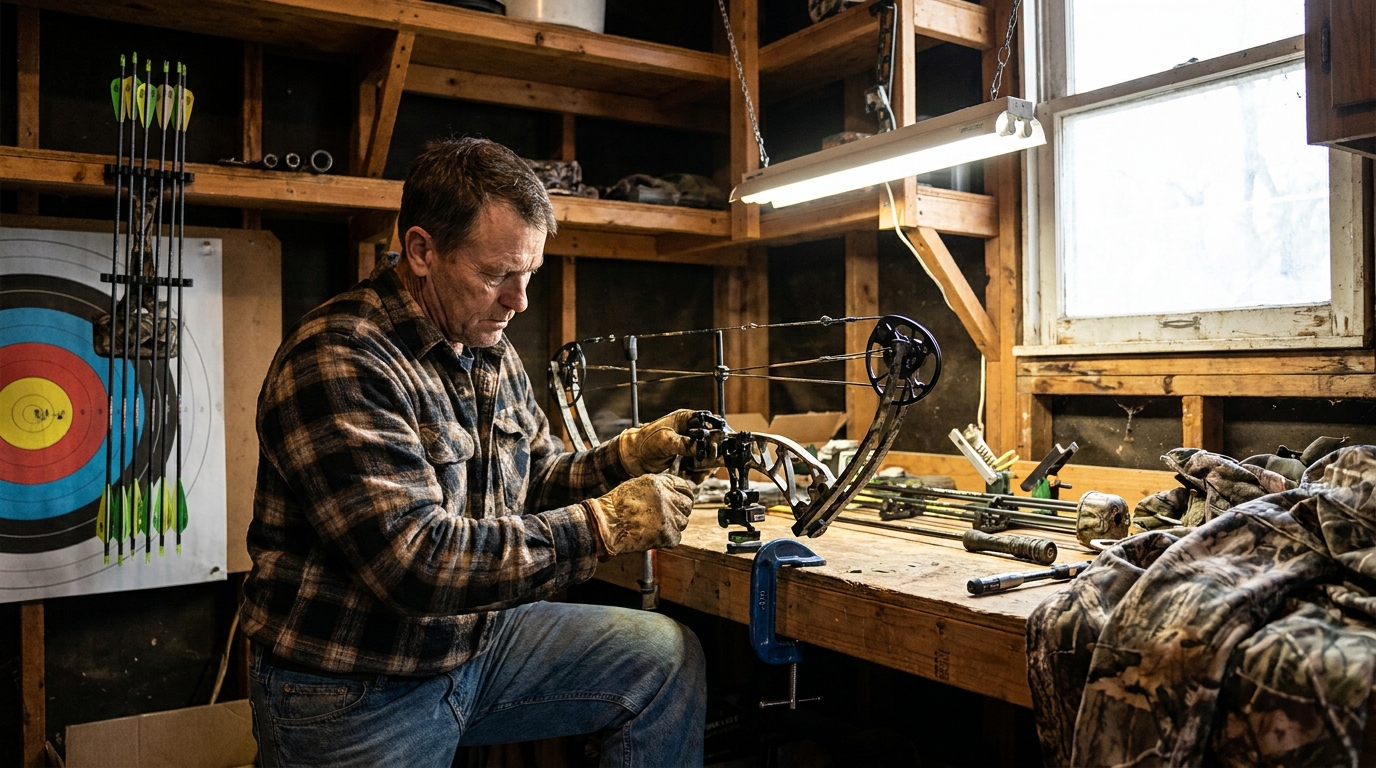
A portable bow press fixes most of that. It is the single most useful piece of archery maintenance equipment you can own, and learning to use one correctly opens up a range of DIY tasks that will save you time, money, and the panic of a last-minute equipment failure before season.
Which Bow Press Should You Buy?
Not all bow presses work on all bows. Before purchasing, confirm compatibility with your specific bow's cam system — single cam, binary cam, and hybrid cam bows each have slightly different press requirements.
- Last Chance Archery EZ Press: The most popular portable press on the market. Works on the vast majority of compound bows including short axle-to-axle models. Uses an external post system that mounts to the limb pockets. Retails around $170–$200. Highly recommended for home use.
- Apple Archery Products Pro Bow Vise: Bench-mounted design for more stable work. Better for full string replacements and extensive cam work. Around $300. Worth it if you maintain multiple bows.
- Portable Shop Presses (Work Sharp, Bowmaster): These use internal limb compression. Verify your bow's limb profile is compatible before buying — some shorter cam bows do not flex correctly in these designs.
Whatever press you choose, read the manual for your specific bow before applying any compression. Bow limbs store enormous energy. An improperly positioned press can crack a limb or slip and cause serious injury.
Safety Before You Press
A compound bow under compression is a stored energy system. Respect it:
- Always wear safety glasses when working with a pressed bow
- Never leave a bow fully compressed unattended
- Apply compression gradually and evenly — do not crank hard on one side
- Verify the press is fully engaged on both limb pockets before applying full compression
- If your bow limbs creak, pop, or feel abnormal under compression, release immediately and inspect for limb damage or delamination
Task 1: Peep Sight Alignment
A peep sight that rotates at full draw is the most common compound bow complaint, and it is almost always fixable at home with a bow press.
With the bow in the press and compression applied, the string goes slack and you can unserve or reposition the peep without fighting string tension. Rotate the peep to the correct orientation (it should align perfectly with your eye at full draw with no rotation required). The critical step is confirming which direction to rotate — draw the bow repeatedly without the peep served in and note the natural landing angle of the string. Serve the peep in at that angle, and it will not rotate under draw.
Re-serve with BCY 3D serving material or center serving cord, wrapping tightly for 1.5 to 2 inches above and below the peep. Once the serving is set, shoot 10 to 15 arrows and confirm the peep is stable before considering the job done.
Task 2: D-Loop Replacement
D-loops wear faster than most bowhunters expect, particularly with mechanical releases. A worn loop changes your draw length subtly and can crack under the tension of a heavy draw weight. Inspect your loop before each season.
D-loop material (BCY D-loop or equivalent) is inexpensive and the replacement process requires only a lighter, needle-nose pliers, and a D-loop tool or any narrow bar to apply pressure. No press required for a standard D-loop — the string does not need to go slack. Burn both ends of the new loop material to prevent fraying, tie secure knots above and below the nocking point, and burn the knot ends again after tightening.
Task 3: Draw Length Adjustment
Most modern compound bows use rotating modules on the cams to adjust draw length in 0.5-inch increments. The bow press is required to access these module screws because the limbs must be compressed to remove string tension from the cam.
With the bow pressed, locate the draw length module on the cam (usually marked with letters or numbers corresponding to draw length). Remove the module screw or screws with a hex key, rotate to the desired setting, and reinstall. Apply thread locker (blue Loctite) to the screw threads before reinstalling — module screws back out under shooting vibration and a lost module in the field is a ruined hunt.
After adjusting, recheck your draw length by drawing to anchor before shooting. Small changes feel significant — a 0.5-inch adjustment can meaningfully affect your anchor point and peep alignment.
Task 4: String and Cable Inspection
With the bow pressed and strings slack, inspect every inch of both the string and cables for:
- Frayed or broken strands (even 2–3 broken strands warrant string replacement)
- Worn center serving at the nocking point
- Separation between serving layers
- Unusual wear or glazing on the cables where they contact the cams
If you find broken strands, replace the string before hunting. A string failure at full draw is dangerous and can cause bow damage. Keep a spare string for your bow — any pro shop can build a replacement set for $80–$150 — and know how to install it.
Task 5: Cam Timing Check
For bows with dual or binary cam systems, cam timing — the simultaneous reaching of maximum draw by both cams — affects arrow flight and accuracy. A bow that is out of timing will kick at the shot and paper-tune poorly.
Check timing by drawing to full draw and watching the cam stops or timing marks (if your bow has them) reach their stops simultaneously. If one cam is slightly ahead of the other, adjust the yoke cables — the split cables that attach to the opposite limb tip — to shift timing. Twist the yoke on the side that needs to slow down (adding twists shortens effective cable length and pulls that cam slightly back in timing). This is advanced work — if you are unsure, a pro shop can do a timing check in 10 minutes.
Before the Oregon August Opener
Oregon's general archery deer season opens August 22 and archery elk opens August 29. That gives you roughly seven weeks from today to get your setup dialed in. Work through this checklist now while there is still time to fix problems without panic:
- Inspect string and cables — replace if in doubt
- Confirm peep alignment and re-serve if rotating
- Replace D-loop if worn
- Verify draw length feels correct and matches where it was last fall
- Paper tune at 6 feet and confirm bullet holes before moving to field points
- Shoot a minimum of 50 arrows per week until season
A bow press is a one-time investment that pays for itself the first time it saves you a trip to a packed pro shop in July. Own one, learn to use it correctly, and go into the September backcountry knowing your equipment is right.