Oregon's Canada goose hunting often gets overshadowed by duck hunting and the famous Klamath Basin, but for pure opportunity and season length, it's hard to beat the Columbia River corridor. Resident Canada geese — the giant subspecies that nests locally rather than migrating from Canada — are huntable from early September through January across much of the state. Add late-season migrant Cacklers and lesser Canadas pushing down the flyway in October and November, and you've got the makings of a genuine all-day, all-season obsession.
Understanding Oregon's Resident Flock
Giant Canada geese (Branta canadensis maxima) were almost extinct by the mid-20th century before a successful reintroduction program rebuilt populations across the Pacific Northwest. Today, they nest in parks, golf courses, farm ponds, and along virtually every river and reservoir in Oregon. The Columbia River basin holds some of the highest densities. These birds are homebodies — they use the same fields, roost sites, and loafing areas day after day — which makes pattern-scouting incredibly productive.
Unlike migratory geese that have seen every decoy spread on the continent by the time they reach Oregon, resident birds can be surprisingly relaxed and responsive to calls. That said, the same birds getting pressured every Saturday quickly wise up. Hunt fresh locations when you can.
Scouting First, Hunting Second
Pattern-scouting is the single most important thing you can do before season opens. Start glassing 3–4 weeks before opener:
- Find the roost: Geese sleep on open water — river sandbars, reservoirs, large ponds. Locate where birds are roosting, then find where they're flying to feed.
- Watch flight lines: Set up away from the roost and watch the direction birds travel at first light. Most will be heading to agricultural fields — grain corn, wheat stubble, and pasture grass are favorites along the Columbia corridor.
- Secure permission early: Farm fields along the Columbia are gold. Talk to landowners before the season. Offer to pick up shells, bring a bird or two as a gift, and be respectful of equipment and livestock.
Building a Field Blind Setup
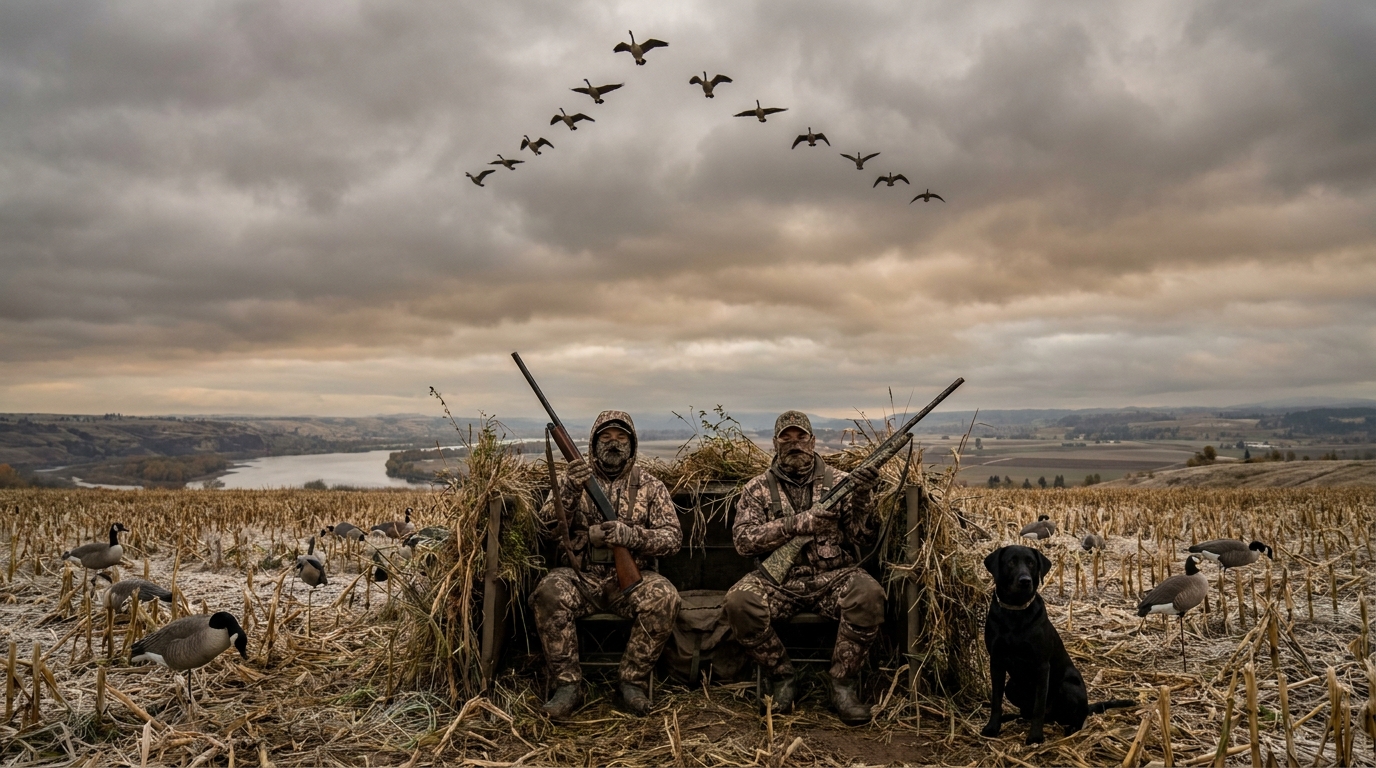
Full-body decoys, a layout blind, and a called-in shot at 15 yards is the quintessential Canada goose experience. Here's how to put it together:
Decoy Spread
For field hunting, full-body decoys outperform shells and silhouettes in most conditions. A starter spread of 18–24 full-bodies will pull birds. If you can run 36–48, even better. Key spread configurations:
- Landing zone spread: Two loose groups of 8–12 birds with a 15–20 yard gap between them. Leave the gap open facing into the wind — that's where birds will commit to land, putting them directly over your blinds.
- Family group spread: Smaller clusters of 4–6 birds scattered naturally. Avoid perfectly even rows — nothing screams "fake" like a parking lot of decoys at equal spacing.
- Motion: Add a couple of flapper decoys or a remote-controlled swimmer at the edge of the spread. Motion sells it when winds are calm.
Layout Blinds
The best field blind for solo or small-group hunting is a low-profile layout blind brushed with natural vegetation. Avery, Final Approach, and Tanglefree all make solid options. Key tips:
- Set blinds within the decoy spread, not behind it. Birds flare when they see hunters positioned behind decoys.
- Match surrounding vegetation — dried grass, corn stalks, thistle — and break up the rectangular outline of the blind.
- Face the blind opening slightly away from the direct sun to avoid glare off faces and gun metal.
Calling Canada Geese
Canada goose calling is both simpler and more nuanced than duck calling. Master these basic sequences:
- The greeting call / double-cluck: Short two-note honks, alternating. This is your standard "geese are comfortable here" sound.
- The comeback call: Aggressive, rapid series of clucks when birds start to drift away — "get back here" energy. Pull them back before they commit elsewhere.
- Murmuring and feeding calls: Low, soft, rolling sounds when birds are close and working. Too much loud calling on close birds is a common mistake.
Less is almost always more with resident geese. A passing flock that knows the country doesn't need a Broadway performance — just enough to confirm that yes, those are real birds down there.
Shotguns and Loads
Federal law requires non-toxic shot for all migratory bird hunting, including geese. Best performing options for Canadas:
- Steel: BB and BBB in 3" or 3.5" magnums. Go two sizes larger than you would with lead — a 12-gauge 3.5" BBB steel load is the workhorse for most field shooting.
- Bismuth and tungsten: Pricier but denser than steel, performs closer to lead. Bismuth is safe for older fixed-choke guns; tungsten blends require modern chokes rated for non-toxic.
- Choke tubes: Run a modified or improved-modified choke for 30–45 yard shots. Extended non-toxic chokes (Kicks, Carlson's, Patternmaster) consistently outperform standard chokes with steel.
Regulations at a Glance
Oregon's Canada goose seasons vary by zone. The Columbia Basin Zone typically opens in early September for resident birds and runs in segments through January. Daily bag limits are generally 5 Canada geese, with specific restrictions on cacklers and lesser Canadas in some zones. Always verify current ODFW regulations — they update annually and zone boundaries occasionally shift. A valid Oregon hunting license and a Federal Duck Stamp are required.
The Columbia River corridor is one of the most accessible goose hunting destinations in the Pacific Northwest. You don't need a guide, a fancy rig, or a lease. You need a scout mission, a landowner with a grain field, and a willingness to be flat on your back in a layout blind at 5:30 AM watching the dawn sky fill with birds. That's the whole deal — and it never gets old.