There's a particular satisfaction to varmint hunting that big game seasons can't quite replicate: the fast-paced shooting, the ethical responsibility of pest control, and the way it keeps your eye sharp and your trigger finger honest all the way from April through August. Ground squirrels — specifically Belding's ground squirrels and Columbian ground squirrels — are Oregon's most widely available varmint target, and the spring season coincides perfectly with the gap between winter seasons and summer scouting trips.
Know Your Target: Oregon Ground Squirrel Species
Oregon hosts two primary ground squirrel species worth pursuing:
- Belding's Ground Squirrel (Urocitellus beldingi) — Common throughout the high desert east of the Cascades. Brown-backed with a buffy belly. Highly colonial, living in dense burrow systems across irrigated pastures, hay fields, and native bunchgrass flats. They're active from March through August, then hibernate. Harney, Lake, Klamath, and Deschutes counties hold the heaviest populations.
- Columbian Ground Squirrel (Urocitellus columbianus) — Larger than Belding's, with mottled brown-gray coloration and reddish legs. Found in northeastern Oregon, particularly in Wallowa and Union counties. Common in mountain meadows and wet prairies.
Regulations: The Short Version
Ground squirrels in Oregon are classified as unprotected wildlife — there is no closed season, no bag limit, and no license required to hunt them on private land (though always confirm current regulations at myodfw.com). On public land managed by the BLM or USFS, you'll need a valid Oregon hunting license but generally face no other restrictions. Always get written landowner permission before hunting private ground, and be clear about where you're shooting relative to buildings, livestock, and neighboring properties.
Access: How to Find Good Ground
The single biggest factor in a productive ground squirrel hunt is access to infested property. Farmers and ranchers dealing with Belding's squirrels in alfalfa fields and pastures are generally eager for help — the rodents clip crops, create trip hazards for livestock, and draw eagles and hawks that complicate field operations. A polite phone call or knock on the door with a clear explanation of what you're doing opens a surprising number of gates.
Look for:
- Irrigated hay and alfalfa operations in Harney and Lake counties — the Burns area around Hines and south toward Frenchglen holds excellent populations in May and June
- The Klamath Basin around Klamath Falls — heavy squirrel populations in pastures surrounding Upper Klamath Lake
- Malheur County grain and feed operations near Ontario and Vale
- Wallowa Valley irrigated ground around Enterprise and Joseph for Columbian squirrels
Rifles and Cartridges
Most ground squirrel hunting happens inside 200 yards, with a significant portion of shots under 100. That said, big open fields sometimes push opportunities out to 300–400 yards, so a flat-shooting cartridge is worth the investment if you want to maximize your range.
- .22 LR — Best for close-range work under 75 yards. Quiet, cheap to shoot, and won't damage pelts if you're saving them. A CCI Minimag or Federal AutoMatch will handle anything at reasonable range.
- .22 WMR — Extends effective range to 125–150 yards. A solid middle ground if you're working both close and medium distances.
- .17 HMR — Flat-shooting and surprisingly wind-resistant for its size. Excellent to 200 yards on squirrels. Ammo is pricier than .22 LR but worthwhile for field distances.
- .22-250 or .223 Rem — When you're hunting big, open ground and taking shots beyond 200 yards, centerfire is the answer. The .22-250 is brutally effective and surprisingly economical to feed with bulk ammo. Hornady V-MAX bullets at 50–55 grains are a proven choice.
- .204 Ruger — A cult favorite among dedicated varmint hunters. Screaming flat trajectory, minimal wind drift, and devastating terminal performance on small targets.
Optics and Gear
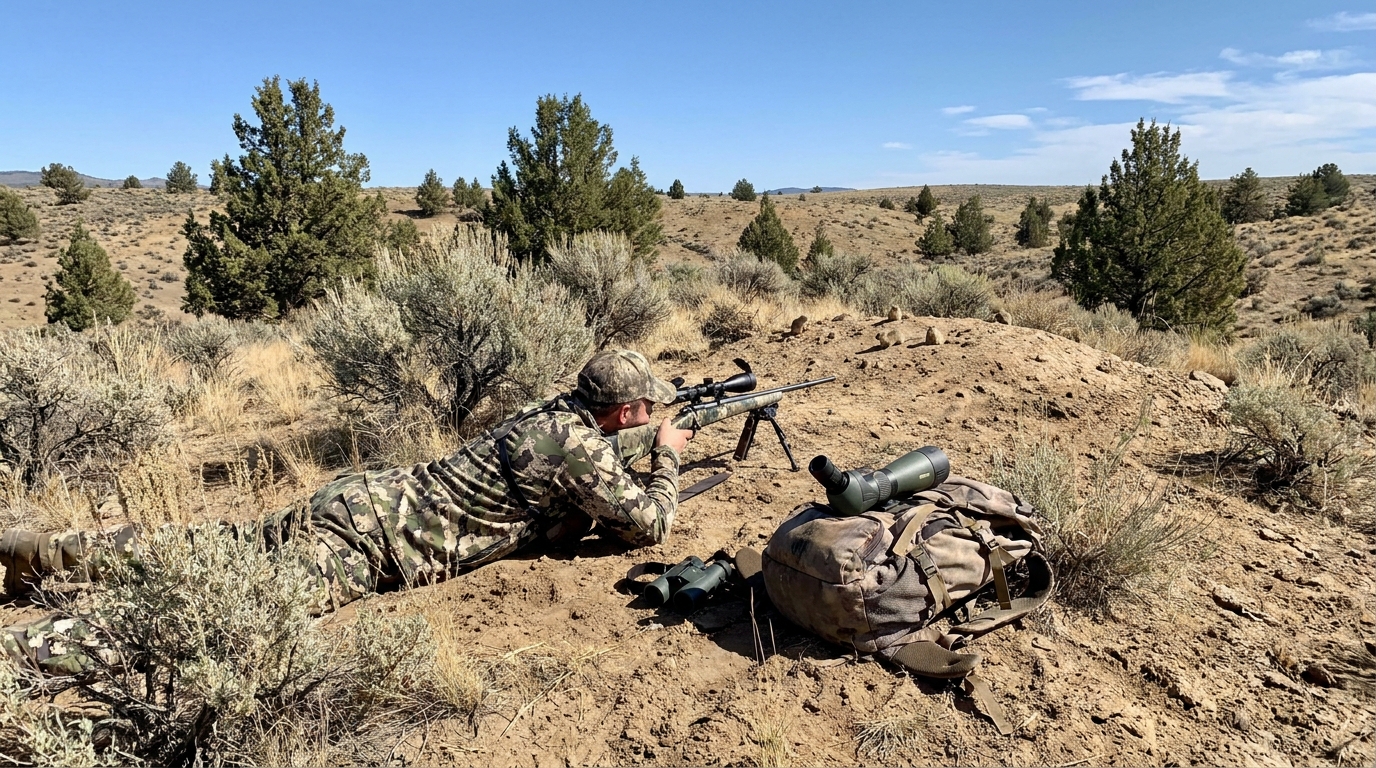
A quality variable-power scope — 4–16x or 6–24x — gives you the flexibility to shoot close shots quickly and stretch out to distance when conditions allow. A good set of shooting sticks or a bipod is worth more than any other single accessory on open-country hunts. Ground squirrels give small target areas; a solid rest makes all the difference.
Other gear worth carrying:
- Comfortable shooting mat — you'll be prone for hours
- Spotting scope for identifying distant colonies and calling shots
- Wide-brim hat and UV-rated sun protection — eastern Oregon high desert in May and June is brutal
- Plenty of water — this is not a wet-side hunt
- A cooler with cold drinks in the truck — you'll thank yourself at noon
Hunting Tactics
Ground squirrel hunting is fundamentally a patience game punctuated by fast shooting. Find an active colony, set up downwind with the sun at your back, and wait for squirrels to emerge from their burrows. Activity peaks in the first two hours after sunrise and again in late afternoon. Midday heat in June and July drives squirrels underground — use that time to find new fields or stay in the truck.
Work the edges of fields first. Squirrels on the periphery of a colony are warier than those in the center, and taking them quietly lets you work deeper into the population without blowing up the whole field. A shooting session that drops 30–40 squirrels in a morning is realistic on a good field. High-volume days on infested ground can push 100+ rounds fired.
The Bigger Picture
Beyond the fun and the trigger time, ground squirrel hunting provides real value to Oregon's agricultural community. A single colony can contain hundreds of animals, and their burrow systems compromise soil stability, irrigation systems, and forage quality. Hunters who do the work and leave gates as they found them tend to earn open invitations for years to come — which also means access for deer and bird hunting down the road. Build those relationships, and a spring varmint trip pays dividends in every season.