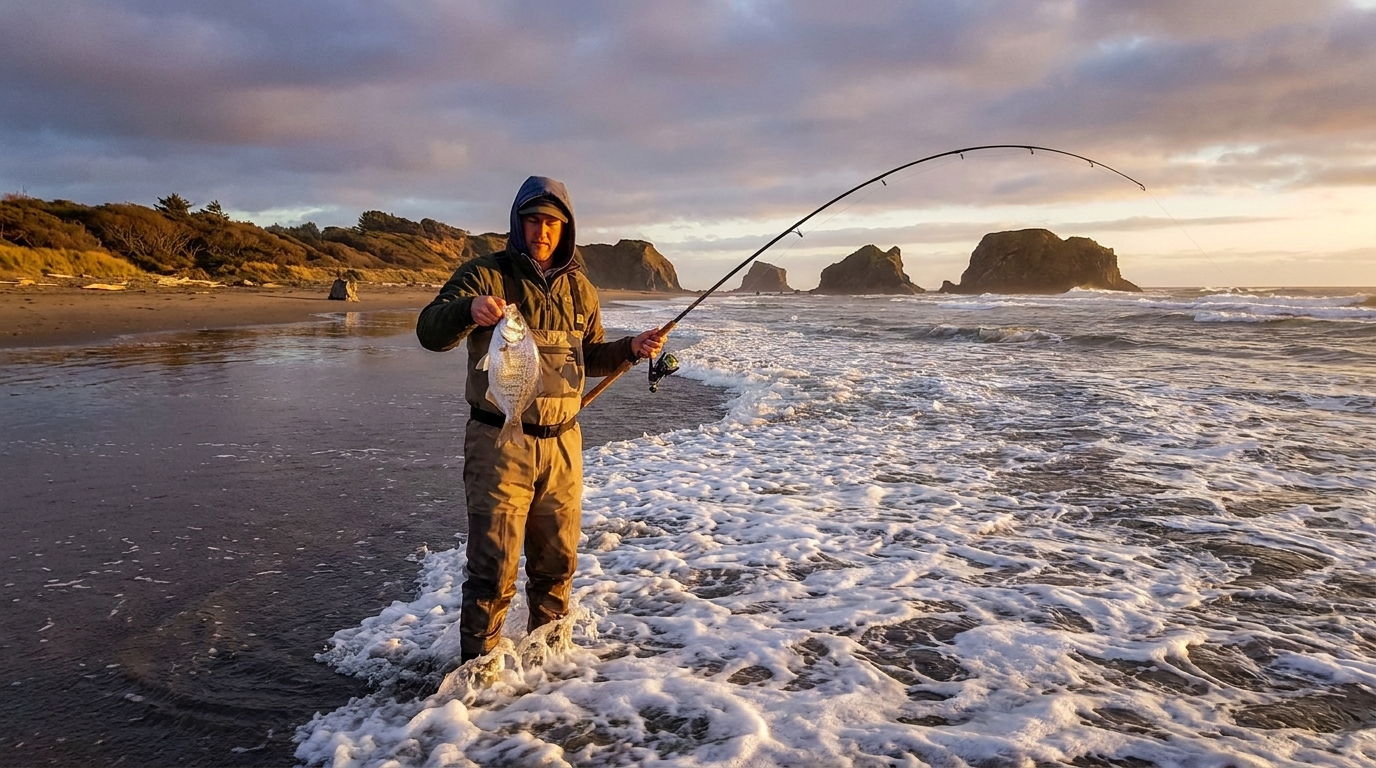
Surf perch don't get the headlines that Chinook salmon or coastal steelhead do, but for sheer accessibility and consistent action, they're hard to beat. No boat, no guided trip, no expensive gear — just a rod, a bucket of sand crabs, and a stretch of Oregon beach. From Seaside to Brookings, surf perch are available virtually year-round, with peak fishing running from late February through June when fish move into the surf zone to give birth to live young.
Species You'll Encounter
Oregon hosts several surf perch species, but three dominate the beach fishery:
- Redtail Surfperch — The most common beach species. Bright orange-red tail fins make them easy to identify. They run 10–14 inches on average, with occasional fish pushing 16 inches and nearly 3 pounds.
- Barred Surfperch — Found mainly on sandy beaches south of Coos Bay. Slightly more selective than redtails but highly catchable on sand crabs.
- Striped Seaperch — Common around jetties and rocky structure. Smaller on average but scrappy fighters and great eating.
Reading the Beach: Where to Fish
Surf perch hold in the troughs — those darker-colored depressions in the surf zone where waves break and wash back. Learning to read these from the dune line before you walk down is the single biggest skill you can develop. Look for:
- Longshore troughs: Parallel depressions running along the beach, usually 20–60 yards offshore. Perch stack here during incoming tides.
- Rip channels: Cuts in the sand where water drains back. These concentrate baitfish and invertebrates — and the perch that eat them.
- Jetty edges: The sand-rock interface at any Oregon jetty — Tillamook Bay, Depoe Bay, Winchester Bay — holds striped seaperch year-round. Cast tight to the rocks.
Tide matters enormously. The two hours on either side of high tide are generally the most productive window. Perch push into shallow water as the tide comes in and feed aggressively before pulling back on the ebb.
Gear Setup
You don't need fancy equipment, but a few specifics will put more fish in the bucket:
- Rod: A 9–11 foot medium-light spinning rod gives you the casting distance to reach outer troughs and the sensitivity to feel bites in the surge.
- Reel: Any quality 3000–4000 size spinning reel with a smooth drag. Saltwater-rated is worth the investment.
- Line: 20–30 lb braided mainline with a 15–20 lb fluorocarbon leader. Braid gives you casting distance; fluoro disappears in the green coastal water.
- Terminal tackle: A sliding sinker rig works well in most conditions. Use a 1–3 oz pyramid sinker above a swivel, then 18–24 inches of leader to a size 4–6 octopus hook. In calm conditions, a high-low rig with two hooks doubles your chances.
Best Baits
Mole crabs (sand crabs) are the gold standard for surf perch on the Oregon coast. Dig them from the swash zone — the area where waves wash up and drain back — using a wire mesh rake or your hands. Target the V-shaped ripples left in wet sand as waves recede. Thread one or two onto your hook, leaving the tail exposed.
When sand crabs are scarce early or late in the season, switch to:
- Bloodworms or nightcrawlers (especially effective from jetties)
- Small grubs and soft plastics in white or chartreuse (good when perch are actively chasing baitfish)
- Clam necks — underused but deadly in some areas
Top Oregon Surf Perch Beaches
Nearly any sandy Oregon beach holds perch, but a few consistently produce bigger fish and higher numbers:
- Gearhart and Seaside beaches — Long, gently sloping beaches with well-defined troughs. Easy access and often less pressure than you'd expect.
- Lincoln City area (D River, Roads End) — Natural funnel created by Siletz Bay pushes baitfish into the nearshore, keeping perch in tight.
- Otter Rock and Beverly Beach — Rocky headland transitions create excellent holding structure.
- Sunset Bay and Bastendorff Beach near Coos Bay — Both beaches produce redtails and barred surf perch through late spring. Bastendorff is particularly good in March and April.
- Pistol River and Gold Beach area — Southernmost Oregon beaches run warmer water earlier in the year, often producing good perch action in February when northern beaches are still cold.
Regulations and Limits
Oregon surf perch have no closed season and a generous bag limit — currently 15 fish per day of any combination of surf perch species. No license surcharge beyond your basic Oregon angling license. Always verify current regulations at myodfw.com before heading out, as rules can change.
Table Fare
Surf perch are excellent eating when handled properly. Bleed them immediately by cutting the gills, keep them on ice, and cook within a day or two. Small to medium fish are best fried whole or filleted for fish tacos. Larger redtails hold up well to baking and grilling. The flesh is mild, white, and finely flaked — closer to halibut than to typical panfish.
Next time you're sitting out a poor weather window or just want guaranteed action without a reservation, load up the surf rod. Oregon's coast perch fishery is one of the true sleepers of Pacific Northwest angling.