Walk into any gun shop or scroll through any shooting forum, and you'll eventually hit the MOA vs. MRAD debate. It's one of those topics that generates more heat than light, mostly because people make it more complicated than it needs to be. The truth: both systems work. Both are accurate. The choice comes down to what units you're already comfortable thinking in, and — more practically — what system your rangefinder and ballistic calculator use. Here's a clear breakdown so you can make the right call and get back to shooting.
What Is MOA?
MOA stands for Minute of Angle — a unit of angular measurement. One full degree of arc contains 60 minutes; one minute of arc (1 MOA) therefore equals 1/60th of a degree. In practical terms for shooters, 1 MOA equals approximately 1.047 inches at 100 yards. For field use, most hunters round this to 1 inch per 100 yards, which introduces only a 4.7% error — inconsequential for hunting distances.
Scope adjustments in MOA systems are typically expressed in 1/4 MOA per click, meaning each click on your elevation or windage turret moves your point of impact approximately 0.25 inches at 100 yards, 0.5 inches at 200 yards, 1 inch at 400 yards, and so on. Some scopes use 1/2 MOA clicks or even 1/8 MOA for extremely fine adjustments.
Quick MOA math: If your shot is 2 inches low at 200 yards, you need to come up 4 clicks on a 1/4 MOA scope (2 inches ÷ 0.5 inch per click at 200 yards = 4 clicks).
What Is MRAD?
MRAD stands for Milliradian — another unit of angular measurement derived from the radian, which is the SI unit for angles. One radian equals approximately 57.3 degrees; there are 1,000 milliradians in one radian. In practical terms: 1 MRAD equals exactly 10 centimeters at 100 meters, or approximately 3.6 inches at 100 yards.
MRAD scopes typically adjust in 0.1 MRAD per click (also written as 0.1 mil). At 100 yards, one click moves your point of impact about 0.36 inches. At 500 yards, that becomes 1.8 inches per click.
Quick MRAD math: If your shot is 7 cm low at 100 meters, you need 7 clicks on a 0.1 MRAD scope (7 cm ÷ 1 cm per click = 7 clicks).
The Critical Distinction: System Consistency
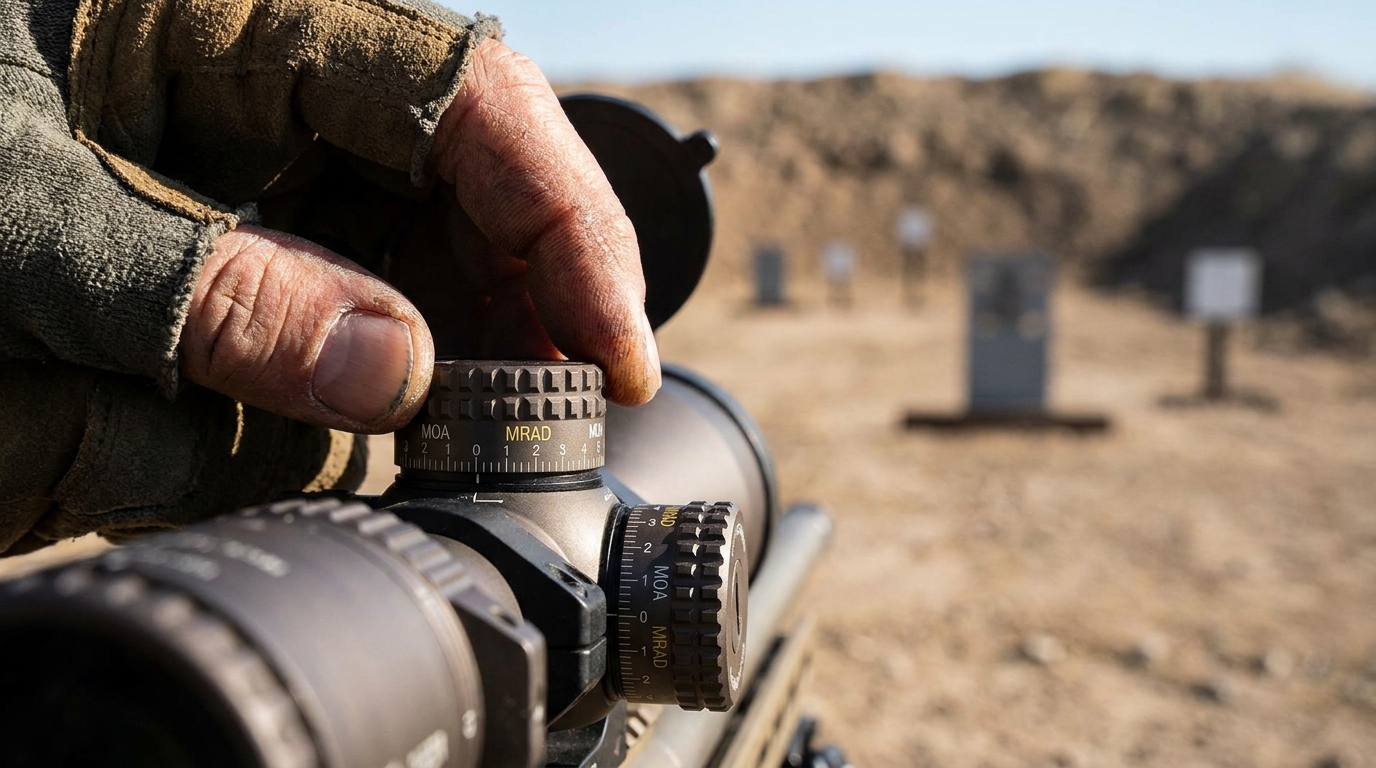
Here's where most hunters go wrong: they mix systems. If your scope reticle is in MRAD but your turrets adjust in MOA, or vice versa, every correction requires a conversion — and conversions under field conditions lead to misses on animals. The most important rule in scope selection is simple: reticle and turrets must be in the same system. Reputable scope manufacturers build this correctly; just double-check before you buy.
The same principle applies to your entire shooting system. If you range in yards and think in inches, MOA is the more intuitive system. If you range in meters and run a metric ballistic calculator, MRAD is cleaner math. The shooters who run into trouble are those who try to convert between systems on the fly.
MOA vs. MRAD: Practical Comparison
Resolution and Precision
A standard 0.1 MRAD click (0.36 inches at 100 yards) is coarser than a standard 1/4 MOA click (0.25 inches at 100 yards). For most hunting applications — where shots happen at unpredictable angles, in varying light, on moving animals — this difference is meaningless. In competition shooting or extreme long-range work (700+ yards), finer adjustment may matter; many PRS shooters prefer 1/4 MOA or even 1/8 MOA for that reason.
Math Simplicity
This is the MRAD system's strongest argument. The metric relationship between milliradians and meters is inherently clean:
- 1 MRAD = 10 cm at 100 m = 1 cm at 10 m
- 3 MRAD = 30 cm at 100 m = 90 cm at 300 m
- Corrections scale linearly without rounding
MOA math, while not hard, introduces the 1.047 constant that must be rounded. In a field dope book, MRAD numbers are generally cleaner to write and calculate.
Reticle Ranging
Both systems allow you to estimate range using your reticle when you know the size of the target. The formula is simple: target size (in your unit's base measurement) divided by reticle measurement = range. MRAD is more intuitive here because the metric system makes target size estimates (a deer's chest depth ≈ 45 cm) easier to work with than inches. That said, most hunters in 2026 are carrying a laser rangefinder and this advantage is largely academic.
Which System Should You Choose?
For Oregon and Pacific Northwest hunters, here's an honest recommendation:
- Choose MOA if: You think in yards and inches. You're primarily a hunting shooter (not a competition shooter). You want maximum click resolution on a standard turret. You already own MOA-calibrated tools.
- Choose MRAD if: You run a metric ballistic app (Applied Ballistics, Hornady 4DOF). You shoot with a spotter who calls corrections. You're interested in precision rifle competition where mil-based reticles are more common. You're buying your first long-range setup and want to build good habits from the start.
Either system, mastered, will put you on target at any hunting distance in North America. The worst choice is owning a scope you don't fully understand — buy the system you'll actually practice with and commit to learning it cold.
Building a Dope Card
Regardless of system, every long-range hunter should carry a field dope card — a laminated or notebook reference showing the elevation and windage corrections for their specific load at distances from 100 to 600+ yards. Build yours at the range, verify it in real conditions, and tape it to your stock. When a buck appears at an unknown distance and you've already ranged him at 380 yards, you want to be looking at a number on a card — not doing conversion math in your head.
Your ballistic calculator (Hornady's app is free and excellent; Applied Ballistics is the premium choice) will generate that card for you if you input your load data correctly. Verify the predictions at actual distance with real shots before trusting them in the field.
The Bottom Line
MOA and MRAD are both valid, both accurate, and both used by serious hunters and competitors. The debate matters far less than the fundamentals: consistent system use, a quality optic with reliable, repeatable adjustments, and enough range time to know exactly what your rifle will do at the distances you intend to shoot. Pick your system, learn it completely, and spend the rest of your time putting rounds downrange.