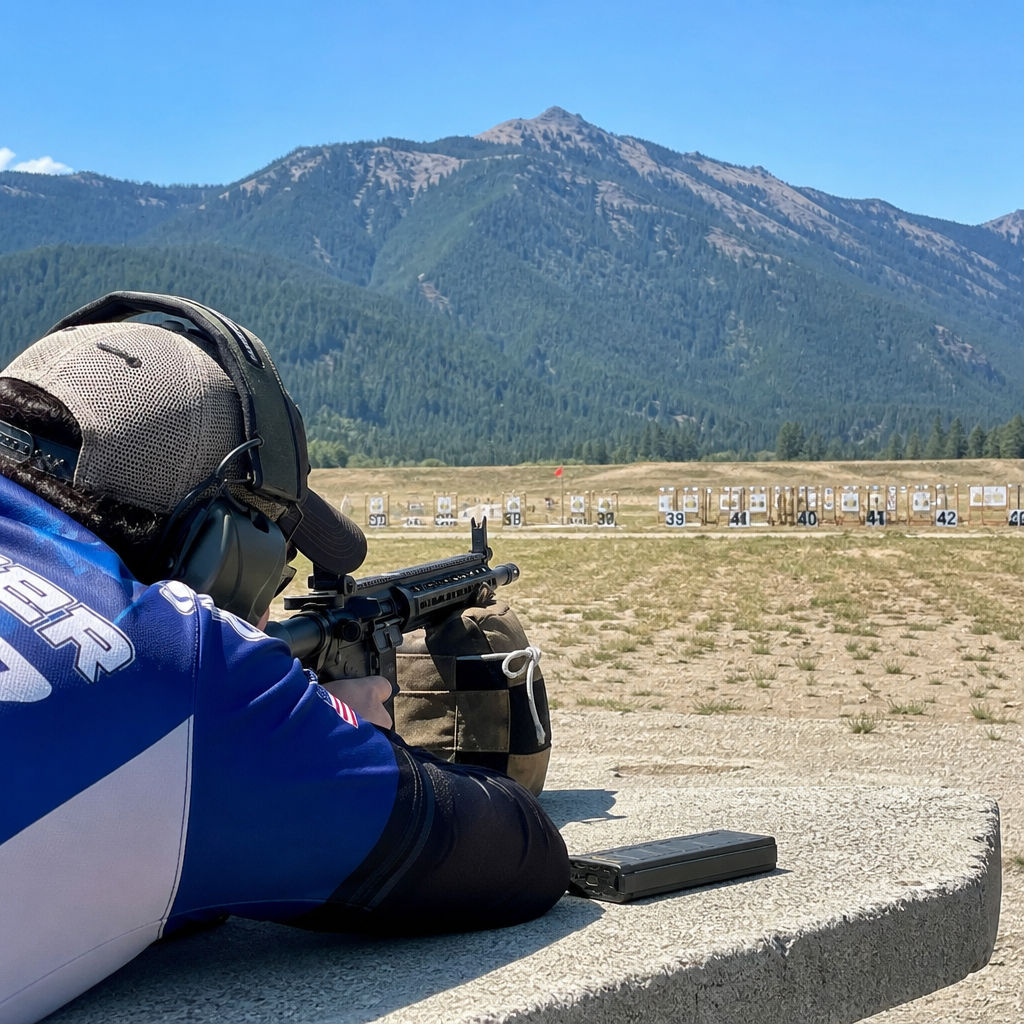
Most rifle shooters in Oregon know PRS, NRL Hunter, and 3-Gun. Far fewer know about High Power Service Rifle — the granddaddy of American rifle competition, run under CMP (Civilian Marksmanship Program) and NRA rules, requiring competitors to hit 10-inch and 12-inch targets at 200, 300, and 600 yards from standing, seated rapid-fire, and prone positions. If you want to get genuinely good with a rifle from field shooting positions, nothing else comes close.
What Is High Power Service Rifle?
High Power is a rifle accuracy sport with roots in military marksmanship training. The original service rifle was the M1 Garand; today it's the AR-15 in most matches. A standard High Power match consists of four stages:
- 200-yard standing slow fire (sighters + 10 rounds for record)
- 200-yard seated rapid fire (10 rounds in 60 seconds from a standing start)
- 300-yard prone rapid fire (10 rounds in 70 seconds from a standing start)
- 600-yard prone slow fire (20 rounds for record)
Scores are out of 500-10X (500 points possible, with X-ring hits counting as tiebreakers). Top competitors shoot 490s and 495s. A new shooter completing their first match with a 400 is doing well and learning a tremendous amount.
The Service Rifle AR-15
Unlike PRS with its precision chassis rifles and high-magnification scopes, High Power Service Rifle is shot with iron sights on a rifle that falls within strict equipment rules. The legal Service Rifle must:
- Be a semi-automatic rifle chambered in 5.56/.223 or .308
- Use standard military-pattern iron sights (no optical or electronic sights in the Service Rifle category)
- Have a maximum 4.5-pound trigger pull weight
- Use magazine-fed ammunition (10-round magazines for rapids, single-loaded for slow fire)
Most competitors shoot a 20-inch AR-15 with a National Match front sight post and an adjustable rear aperture — either a standard A2 upper or an NM-spec upper with a heavier barrel. The 20-inch barrel is standard because it provides a longer sight radius and generally better accuracy than 16-inch barrels at 600 yards.
A Starter Service Rifle Setup
- Rifle: Colt LE6920, Smith & Wesson M&P15, or an NM-spec build on a quality lower
- Sights: A2 rear with 1/2-MOA click adjustments; National Match front post
- Trigger: Geissele SSA or JP Enterprises two-stage, set between 4 and 4.5 lbs
- Sling: A military-style loop sling (Turner Saddlery or Brownells) — essential for position shooting
The Positions: What You're Actually Learning
High Power teaches position shooting skills that transfer directly to field hunting. The prone position used at 300 and 600 yards incorporates a loop sling — a technique that eliminates nearly all muscle support and lets bone and sling carry the rifle, reducing wobble and fatigue. Once you've shot 20 rounds prone at 600 with a loop sling, your field-position game is transformed.
Prone with Loop Sling
The loop sling wraps around the support arm just above the bicep, creating a rigid triangle between your arm, the sling, and the rifle stock. When done correctly, the rifle stays aligned on target without muscle effort — the sling holds it there. This takes about 20 minutes to learn and a full season to master.
Seated Rapid Fire
The seated position is the most physically demanding in the game. Competitors drop from standing to sitting, load a second 10-round magazine, and fire 10 shots within 60 seconds. Developing a consistent drop-to-position routine under the clock is one of the sport's great skills — and deeply humbling the first dozen times you try it.
Ammunition for High Power Competition
At 600 yards, ammunition quality matters. Service Rifle competitors typically use:
- Federal Gold Medal Match 69 gr Sierra MatchKing: The factory standard for Service Rifle. Consistent, accurate, and reliable through a wide range of AR-15 configurations.
- Handloads with 77 gr Sierra MatchKing (1:8 or faster twist required): The preferred handload for serious competitors. At 600 yards, the extra BC of the 77-grain bullet is measurable — a full wind call at 600 can be 1–2 MOA different between a 55-grain and a 77-grain bullet in a 10 mph crosswind.
- Surplus 5.56 for practice: Cheap brass-cased 5.56 is fine for learning positions at 200 yards, but don't expect to shoot respectable 600-yard scores with M193 ball.
Where to Shoot High Power in Oregon
Oregon has an active High Power shooting community, primarily through the following venues and clubs:
- Tri-County Gun Club (Sherwood): Hosts CMP and NRA sanctioned High Power matches on their 600-yard range. One of the most active clubs in the state for this discipline.
- Coos County Rod & Gun Club (Coos Bay): South Coast High Power matches.
- Oregon Rifle and Pistol Association (ORPA): Statewide sanctioning body for NRA-affiliated rifle matches in Oregon. Their website lists active clubs and match schedules.
- Camp Rilea (Warrenton): The Oregon National Guard facility occasionally hosts CMP matches open to civilians.
The CMP's website (thecmp.org) lists sanctioned matches and provides the rulebook as a free download. Attending as a guest scorer before your first match is strongly recommended — the stage procedures, firing line commands, and pit operation are not intuitive until you've seen them once in person.
Why Every Serious Shooter Should Try It
High Power teaches rifle fundamentals that no amount of bench rest shooting can replicate: natural point of aim, trigger control under time pressure, position stability, and wind reading at real distance. The 600-yard prone stage alone will expose every mechanical flaw in your shooting technique and every inconsistency in your load. Shooters who complete a full season of High Power come back to the hunting field or PRS stage with fundamentally better skills.
It's not glamorous. You'll lay in the dirt. You'll read the wind wrong. You'll drop a rapid-fire string because your sling slipped. But when it clicks — when a 10-shot slow-fire string at 600 goes X-10-10-10-X-10-X-10-10-10 — there's no other feeling in the shooting sports quite like it.