Every reloading manual says the same thing somewhere in the first chapter: buying a bullet mold and casting your own lead bullets is the most economical way to produce large quantities of ammunition. Most handloaders read that line, nod, and turn the page. A smaller number actually set up a casting station, melt some lead, and discover that bullet casting is a genuinely satisfying craft that can slash the cost of high-volume pistol shooting and plinking ammunition to a fraction of commercial prices.
If you've been reloading jacketed bullets and wondering whether casting is worth the additional setup, here's what you actually need to know to get started.
Why Cast Bullets?
The economics are straightforward. A box of 100 jacketed 9mm bullets costs $15-25 depending on brand and current market conditions. Lead alloy — a combination of lead, tin, and antimony, typically purchased as wheel weights or from a casting supplier — costs roughly $1.00-1.50 per pound. A pound of alloy yields approximately 70-75 cast 9mm bullets. At scale, you're producing bullets for 2-3 cents each vs. 15-25 cents for jacketed — a 5-to-10x cost reduction.
Cast bullets also produce less barrel wear than jacketed bullets at appropriate velocities, and many competition shooters find that well-sized and lubricated cast bullets produce exceptional accuracy in pistol calibers. The trade-off is velocity limitation: cast bullets driven above their design velocity generate leading (lead deposits in the rifling). For most pistol calibers and many rifle applications, this is not a practical constraint.
The Basic Equipment List
Lead Melting Furnace
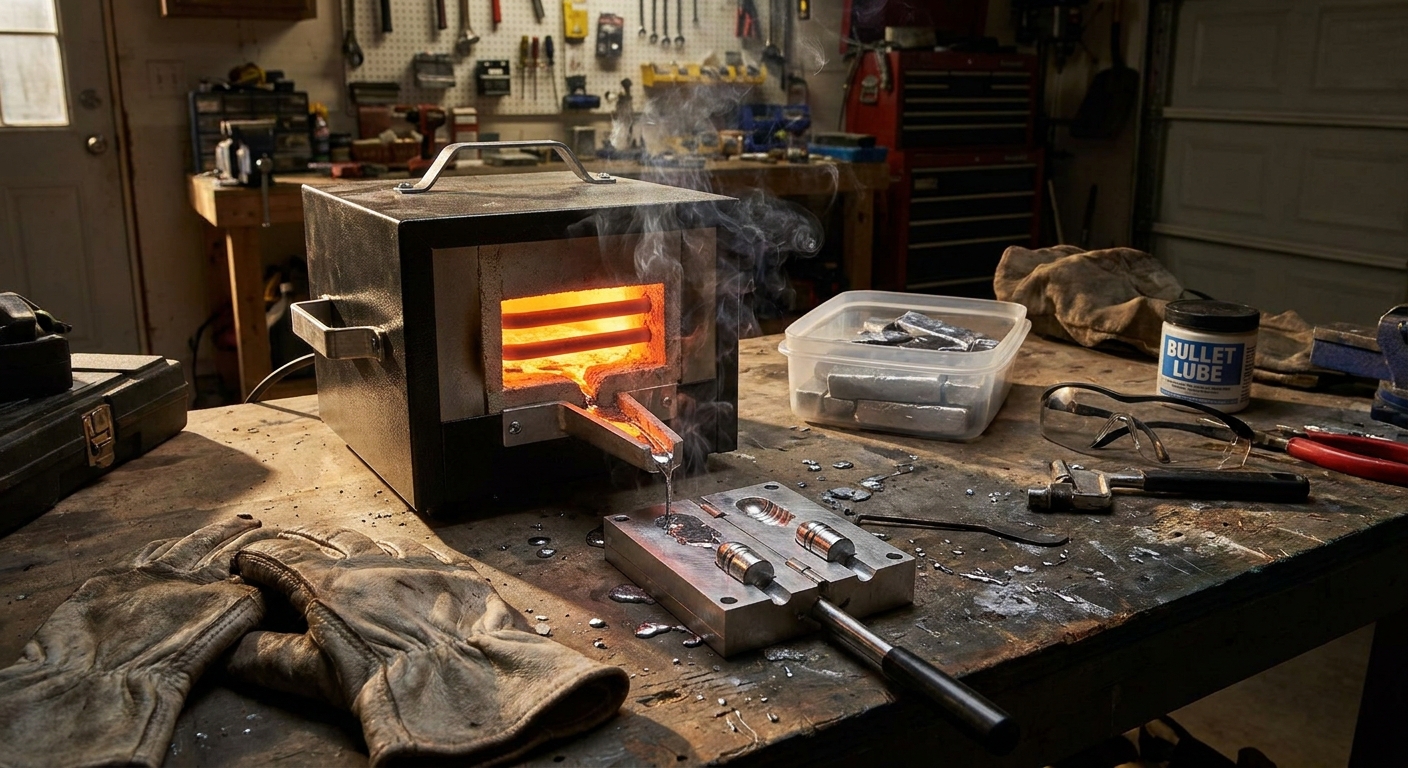
A bottom-pour electric furnace is the standard starting point. The Lee Production Pot IV ($60-80) and the RCBS Pro-Melt 2 ($150) represent the budget and mid-range options. A bottom-pour spout allows you to fill molds quickly without ladling. Temperature control is critical — most alloys pour best at 700-750°F. A thermometer probe is worth the $15 investment if your furnace doesn't have a built-in readout.
Bullet Molds
Start with a single mold for the caliber you shoot most. Lee Precision makes aluminum molds for $25-35 that are functional and accurate. Lyman and RCBS make iron molds ($60-120) that hold heat better and produce more consistent results once warmed up. Choose a bullet weight and design appropriate for your intended use — a 230gr round nose for .45 ACP target shooting, a 125gr semi-wadcutter for .38 Special competition, or a 147gr flat-nose for 9mm USPSA minor loads.
Bullet Sizer and Lubricator
Cast bullets must be sized to precise diameter and lubricated before loading. The Lyman 4500 Lubri-Sizer (~$130) and the RCBS Lube-A-Matic are the traditional tools. Lee offers a push-through sizing die that works with a standard press for around $20 per caliber — adequate for starting out. Bullet lube (Alox, white label, or hard lube depending on velocity) fills the lube groove and prevents leading.
Safety Equipment
- Respirator: An N95 at minimum; a half-face respirator with P100 filters is better. Lead fumes are a genuine health risk — ventilate your casting area thoroughly.
- Heat-resistant gloves: For handling molds and dealing with spills
- Safety glasses: Molten lead spatter is rare but not impossible
- Dedicated clothing: Lead contamination transfers; don't cast in clothing you'll wear around children
Alloy Basics
Pure lead is too soft for most bullet casting applications — it deforms under rifling pressure and leads badly. The standard casting alloys combine lead with tin (improves flow and fill-out) and antimony (hardens the alloy). Common sources:
- Clip-on wheel weights (COWW): The traditional free or cheap source from tire shops. Harder than pure lead (typically 10-12 BHN). Most shops now use stick-on zinc weights that are useless for casting — ask specifically for clip-on weights and sort carefully.
- Linotype: Very hard alloy (22-24 BHN), excellent for high-velocity applications. Available from printing salvage or specialty casting suppliers.
- Commercial alloys: Suppliers like Rotometals sell pre-blended alloys by hardness rating. Predictable composition simplifies load development considerably.
The Casting Process
Heat your furnace to target temperature (700-750°F). Flux the melt with a small amount of sawdust, beeswax, or commercial flux, stir thoroughly, and skim dross. Warm your mold with a few pours before keeping bullets — cold molds produce wrinkled, incomplete bullets that should be recycled. Once the mold is hot, the rhythm becomes automatic: fill, wait 3-5 seconds, cut the sprue, open and drop, repeat. A warmed-up iron mold can produce 100-150 bullets per hour.
Inspect your bullets for wrinkles, voids, or incomplete fill-out. Defective bullets go back in the pot immediately. Clean, well-formed bullets get sized, lubricated, and stored. Load them as you would jacketed bullets, reducing powder charge by 10% initially and working up while watching for accuracy and leading.
Best Starting Calibers for Oregon Shooters
- 9mm Luger: High volume, low-velocity target loads benefit enormously from cast bullets. A 125gr or 147gr round-nose flat-point at 850-950 fps makes a soft-shooting practice load for USPSA or general range use.
- .38 Special / .357 Magnum: Classic cast bullet territory. The Keith-style semi-wadcutter in 158gr is the historic standard — it shoots accurately and cleans lead deposits effectively.
- .44 Magnum / .44 Special: Excellent candidates for cast hunting bullets at reduced velocities. Keith's original designs were developed for this bore diameter.
- .45 ACP: The 230gr round nose in cast lead is the archetypal high-volume practice load. Easy to size, feeds reliably in most 1911s and Glocks.
Getting Started
The total investment to start casting for a single pistol caliber — furnace, one mold, sizing die, lube, and safety gear — runs $200-300. That investment pays for itself quickly if you shoot more than 500 rounds per month. For high-volume Pacific Northwest USPSA competitors, Steel Challenge shooters, or anyone who burns through multiple cans of powder annually, casting is worth every dollar of setup cost and every hour of the learning curve. The first perfect pot of bullets is genuinely satisfying. The 50th pot is just routine economy.