The 12-gauge pump shotgun has defended American homes for over a century, and for good reason: at close quarters, it delivers an energy transfer that handguns simply cannot match, the manual of arms is straightforward enough for most users to learn quickly, and the ammunition variety allows the user to tailor the platform to their specific environment. But "just point and shoot" is a dangerous oversimplification that leads to bad choices about load selection, poor understanding of actual patterns, and undertrained operators who freeze under stress.
This guide covers what you actually need to know: how to pattern your shotgun properly, how to choose a load for your home, and how to build the basic manual of arms into reliable muscle memory.
Why Patterning Matters Indoors
Here's what most defensive shotgun owners don't understand: at typical hallway distances of 10–20 feet, buckshot loads often pattern smaller than a fist. A full-choke or improved-modified shotgun at 15 feet is essentially a single large projectile for practical purposes — the shot column hasn't had room to spread significantly. This has two implications: first, you still need to aim a defensive shotgun; second, overpenetration of the shot charge is a real concern in a home with occupied rooms on the other side of walls.
At 25 yards, the same load might spread to 18–24 inches — now you're accountable for all nine of those 00 pellets and where each one goes. At defensive distances inside a structure, the pattern is almost always tighter than people assume.
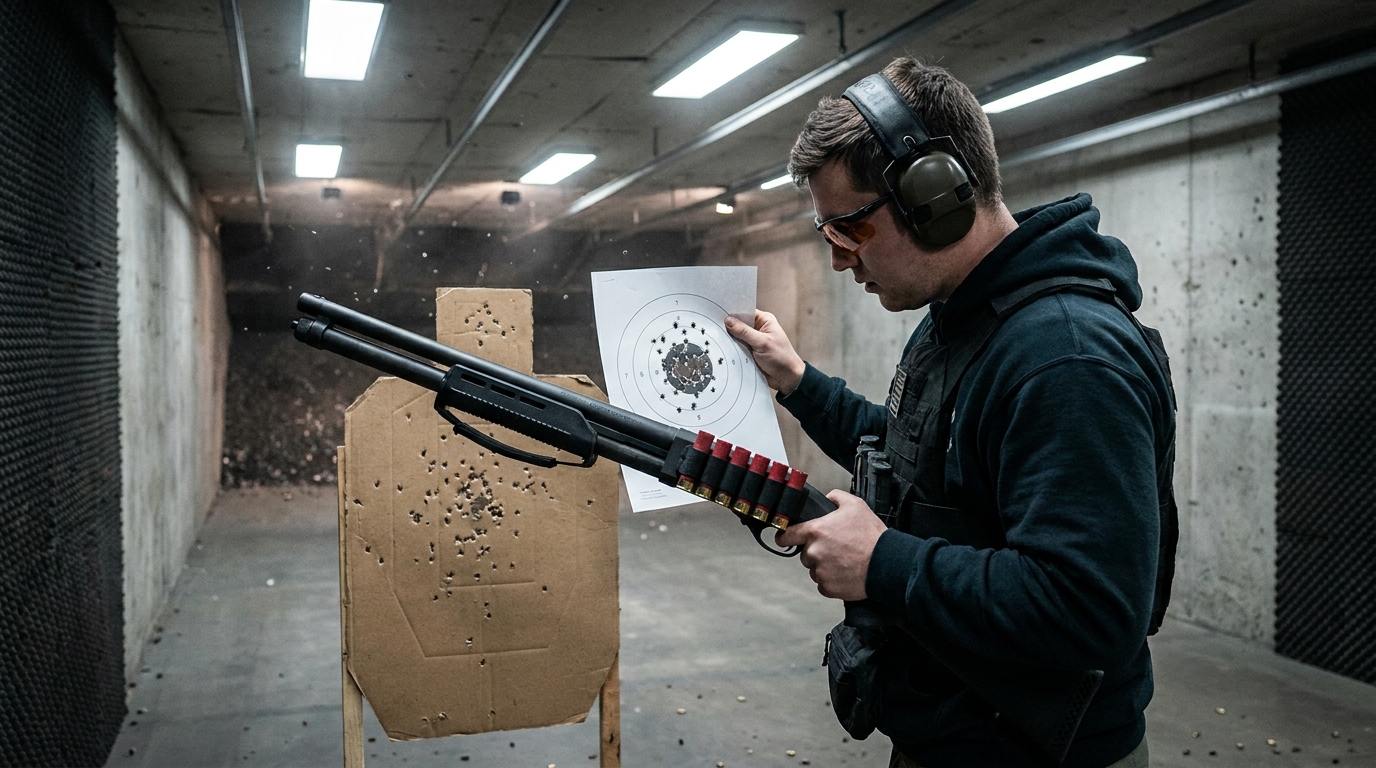
How to Pattern Your Shotgun
You need a few targets, a measuring tape, and a box of your chosen load. Most indoor defensive ranges have a maximum distance of 25 yards; run your patterning at 5, 10, 15, and 25 yards so you understand exactly what you're working with.
- Set up a paper target at least 24 inches square (newsprint works well)
- Fire one shot per target at each distance from a stable position
- Count pellet holes and measure the total pattern spread
- Note where the pattern centers relative to your point of aim
A properly fitted and aimed shotgun should put the center of its pattern at or very near your aiming point. If your pattern consistently shoots left or right of point of aim, your stock fit may be off or you may be canting the gun. If the pattern is centered but you're missing the target, that's a marksmanship issue requiring more training — not a load or equipment issue.
Buckshot Load Selection
Standard 00 Buckshot — The Default
Standard 2¾-inch 00 buckshot loads contain 8–9 pellets of .330-inch lead shot, each roughly equivalent to a .32 ACP bullet in diameter. At 1,200–1,325 fps, it's devastatingly effective on human targets at defensive distances and has been used by military and law enforcement for generations. The downside: 00 buck penetrates deeply through interior walls and can travel 50+ feet through standard drywall construction.
Reduced Recoil 00 Buckshot — The Smart Choice for Most
Federal FliteControl and Hornady Critical Defense reduced-recoil loads run at approximately 1,150–1,200 fps and deliver meaningfully tighter patterns than standard velocity loads — particularly the Federal FliteControl, which uses a wad design that holds the shot column together longer for exceptional pattern density at 15–25 yards. Recoil is more manageable, follow-up shots are faster, and pattern efficiency is better. This is the author's first recommendation for defensive home use.
The Federal Tactical 00 with FliteControl wad in 2¾-inch configuration is the go-to choice for many serious defensive shotgunners. At 15 yards it patterns into 4–6 inches consistently, making precise shot placement far more achievable than with standard loading.
#1 Buckshot — Underrated
The FBI once considered #1 buckshot the optimal defensive load, and the argument has merit. Standard 2¾-inch #1 buck loads contain 16 pellets of .30-inch shot — more projectiles than 00, adequate penetration for terminal effectiveness, and slightly reduced wall penetration compared to the larger pellets. If you live in a home with densely occupied adjacent rooms, #1 buck is worth serious consideration.
Birdshot — Only in the Smallest Structures
There is an ongoing internet debate about whether birdshot (7½, 8, or 9 shot) is adequate for defensive use. At contact to three yards, it's extremely damaging. Beyond five yards, the pattern spreads so rapidly that you may not deliver a disabling hit, and the individual pellets lack the mass and velocity to penetrate to vital structures reliably. Birdshot has a role in very small apartments where overpenetration of any wall is a severe hazard, but for most situations, a proper buckshot load is the better choice.
Choke Selection
Most defensive shotguns come with an improved cylinder or cylinder choke, and that's the right choice for defensive use. Tighter chokes (modified, improved modified, full) are designed for bird hunting at range and do not meaningfully improve close-range buckshot patterns — and they can cause pressure issues with some solid projectiles like Foster slugs. Leave the cylinder or improved cylinder choke in your defensive shotgun and spend your money on training instead.
The Manual of Arms
A defensive shotgun is only useful if you can operate it under extreme stress. The fundamentals:
- Loading the magazine tube: Practice loading rounds smoothly from a kneeling or standing position until it's automatic. Load shell carrier or side-saddle rounds in a consistent orientation to avoid fumbling.
- Pumping under stress: Short-stroking a pump shotgun — not fully cycling the action — is one of the most common malfunctions in defensive situations. Practice full, deliberate pump strokes until it's reflexive.
- Reloading on the fly: The "top off" technique — pushing individual rounds into the magazine tube during a pause in fire — is a critical skill. Practice it with snap caps first, then with live ammunition at the range.
- Managing misfires: A failure to fire in a pump gun: keep the muzzle downrange, wait two seconds, then run the action to eject the dud. This drill should be automatic.
Training Recommendations
Dry fire practice with an unloaded and verified-clear shotgun is productive: practice mounting the gun from low ready, acquiring a sight picture, and running the pump. Aim for 100+ dry repetitions before your first live-fire defensive session.
At the range, run drills that combine movement with shooting — stepping to a barrier, presenting the shotgun, firing, and repositioning. The Gunsite 250 shotgun curriculum and Mas Ayoob's MAG-40 both include excellent shotgun defensive modules if you want structured instruction from credentialed instructors.
Finally: pattern your ammunition, learn your gun, and train with the load you carry. The defensive shotgun is a capable tool in prepared hands — and just a heavy awkward object in unprepared ones.