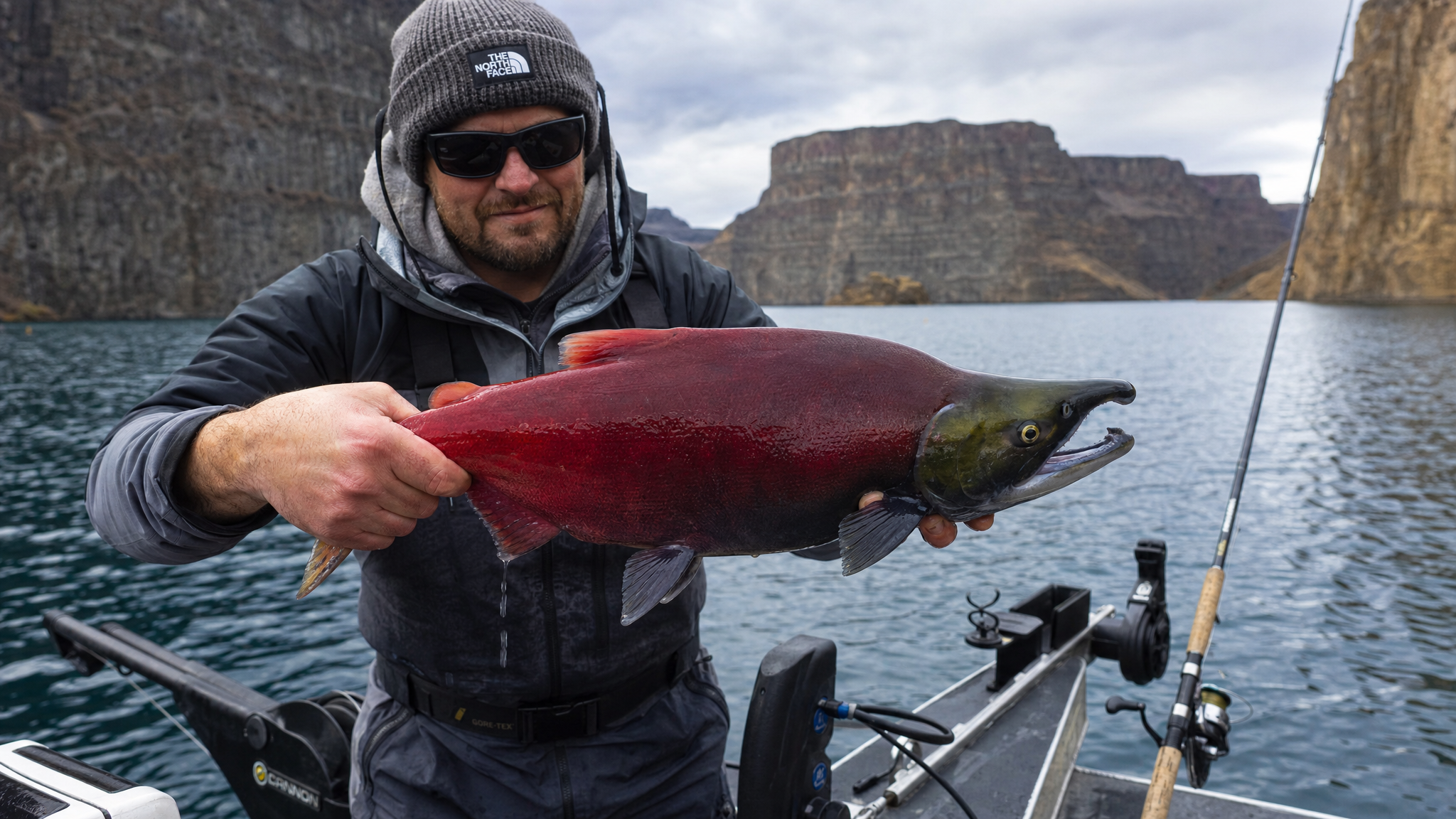
Lake Billy Chinook doesn't get the December attention it deserves. While most Oregon anglers are chasing steelhead in coastal rivers or waiting for ice on eastern reservoir perch fisheries, the kokanee at this central Oregon impoundment are wrapping up their fall spawn cycle and transitioning into prime winter feeding mode. For trollers willing to brave cold canyon winds, December offers a sleeper window of quality kokanee action on some of the most striking water in the state.
Lake Billy Chinook in December: What You're Dealing With
Lake Billy Chinook sits at the confluence of the Crooked, Metolius, and Deschutes rivers, backed up behind Round Butte Dam at an elevation of roughly 2,000 feet. The reservoir reaches depths exceeding 400 feet in its main arms, creating a thermally stratified environment that kokanee use differently depending on the season.
By December, the kokanee that survived the fall spawn are recovering and spreading back through the reservoir. Water temperatures drop into the low 40s and upper 30s, pushing the fish into predictable depth bands. Post-spawn fish typically suspend in the 25–60 foot range on the main lake arms, following the thermocline remnant and chasing small baitfish and zooplankton. This is a different fish than the summer kokanee — deeper, more lethargic in cold water, but still catchable with the right presentation and patience.
Tackle and Presentation for Cold-Water Kokanee
December kokanee call for a different approach than the aggressive summer troll. Here's what works:
Downriggers Are Essential
Surface presentations produce almost nothing in December. You need downriggers to put lures precisely in the 25–60 foot zone where the fish are holding. Set your downrigger ball at 30 feet to start and adjust based on your sonar readings. If you're marking fish at 45 feet, work from 40 to 50 feet until you find the active depth.
Lure Selection
- Wedding rings with corn: The classic kokanee setup still works. Tie a size 8 or 10 wedding ring spinner on 18 inches of 6 lb fluorocarbon leader behind a small dodger. Add two or three kernels of white shoepeg canned corn on the treble hook. The corn adds visual flash and scent that cold-water kokanee key on.
- Small spoons: Kastmaster spoons in silver/pink or chrome/blue in the 1/8 to 1/4 oz range work well. At slow troll speeds, their action stays lively even in cold water.
- Hootchie squids: Pink, red, and chartreuse hootchies in size 1.5–2 behind a 7-inch kokanee dodger produce throughout the winter months. Scale down from summer setups — smaller is better in cold, clear December water.
Troll Speed
Slow way down. Summer kokanee are aggressive and chase lures trolled at 1.8–2.2 mph. December fish want something that barely moves — 1.0 to 1.4 mph is a better starting point. Use your GPS speed-over-ground, not your engine RPM. Cold water and calm conditions often mean you're moving faster than you think.
Dodger Setups
In December, run a smaller dodger — a 7-inch model rather than a full 11-inch. Attach your wedding ring or hootchie 14–18 inches behind the dodger on fluorocarbon. The reduced action of a smaller dodger matches the lethargic feeding behavior of cold-water fish.
Finding Fish at Lake Billy Chinook in December
Lake Billy Chinook has three main arms — the Deschutes, Metolius, and Crooked River arms — each with slightly different character in December.
- Metolius Arm: Fed by some of the clearest, coldest water in Oregon from the Metolius River springs, this arm stays cold and clear throughout winter. Focus the lower 2 miles of the arm in 30–55 feet of water. The canyon walls create deep water close to shore, making downrigger work straightforward.
- Deschutes Arm: The longest and widest arm, with more variation in depth and structure. Work the mid-arm sections (between the Canyon View Campground area and the confluence) where the main channel drops to 80–100 feet — fish suspend well above the bottom, so target the 30–50 foot zone.
- Crooked River Arm: Shallower and warmer than the other arms in summer, but can be productive in December as kokanee push into shallower structure. Troll the edges of the main channel in 20–40 feet.
Access and Launch Points
The primary boat launch at Lake Billy Chinook is at the Cove Palisades State Park off Highway 97 between Madras and Redmond. A second launch is available at Deschutes Campground at the lower end of the Deschutes arm. Both launches typically remain accessible through December, though early morning ice on the launch ramp is a reality — bring sand or traction mats.
Cove Palisades charges a day-use fee, and park access hours are limited in winter. Check current Oregon State Parks hours at oregonstateparks.org before you go. A current Oregon fishing license with Combined Angling Tag is required for kokanee at Lake Billy Chinook — there is no separate salmon stamp required since kokanee are landlocked sockeye and classified as trout in Oregon regulations.
December Conditions: Be Prepared
Lake Billy Chinook sits in a high desert canyon that channels wind. December can bring calm mornings that turn brutal by afternoon as thermal winds funnel down the canyon arms. Here's how to handle it:
- Go early: Morning is typically calmer. Plan to be on the water by first light and off by early afternoon if winds pick up.
- Dress in layers: Canyon shade makes the water feel 10 degrees colder than the air temperature. Wool or synthetic base layers, a mid layer, and a waterproof shell are baseline. Bring extra warm layers.
- Watch the weather: Central Oregon can get snow in December. Check the forecast at Madras (the closest town) and have an exit plan if conditions deteriorate.
- Life jackets: Cold water immersion is serious at Lake Billy Chinook in December. Wear your PFD — a capsize in 40°F water leaves you minutes to get back in the boat.
Bag Limits and Size
Oregon's kokanee regulations at Lake Billy Chinook allow 10 fish per day with no minimum size. In December, expect fish in the 10–14 inch range from the general population, with some larger post-spawn holdovers pushing 15–17 inches. These fish are past their spawning peak and in recovery, so they don't fight with the same intensity as summer fish — but they're still excellent table fare, with firm pink flesh that cures beautifully.
December at Lake Billy Chinook isn't for everyone — the cold, the wind, and the reduced activity level mean you need to be patient and precise. But for the angler willing to put in the work in Oregon's high desert canyon country, there are kokanee to be found, stunning scenery that belongs to almost nobody else, and a kind of winter fishing solitude that's increasingly hard to find anywhere in the Pacific Northwest.