Oregon's fall black bear season is one of the state's most overlooked big-game opportunities. With a generous bag limit, a long season running through December in most zones, and a healthy statewide bear population estimated at over 25,000 animals, Oregon offers rifle hunters a legitimate shot at a quality black bear every season. The key is understanding where bears concentrate in October and November as they enter hyperphagia — the pre-denning feeding frenzy that makes fall the most productive time of year to punch a tag.
Oregon's Fall Bear Season — The Basics
Oregon's general bear season runs concurrently with deer and elk seasons in most units, and bear can be taken incidentally while hunting other species or pursued specifically. A bear tag is included with your deer or elk license in most units, though hunters should verify current ODFW regulations, as some units may require a separate bear license. The season in most western Oregon units runs from August 1 through December 31 — a remarkably long window that rewards persistence.
Hunters may take up to two bears per year in Oregon under current regulations. However, it is unlawful to take a female bear with cubs, or to use bait, dogs (in most general units — hound hunting has specific regulations), or electronic calling devices. Always check the 2026–2027 ODFW Big Game Regulations Synopsis before the season.
Where to Find Bears in October and November
Clear-Cuts and Regenerating Timber Units (Coast Range and Western Cascades)
If you hunt one habitat type for fall bears in Oregon, hunt 3–10-year-old clear-cuts on private timber company land or adjacent BLM ground. These regenerating units are bear magnets in October. The combination of emerging alder, vine maple, and berry species — huckleberry, blackberry, salal — alongside residual slash piles harboring insects draws bears from miles around. Focus on units in Tillamook, Lincoln, and Lane counties on the Coast Range side, and the western Cascade foothills in Marion, Linn, and Douglas counties.
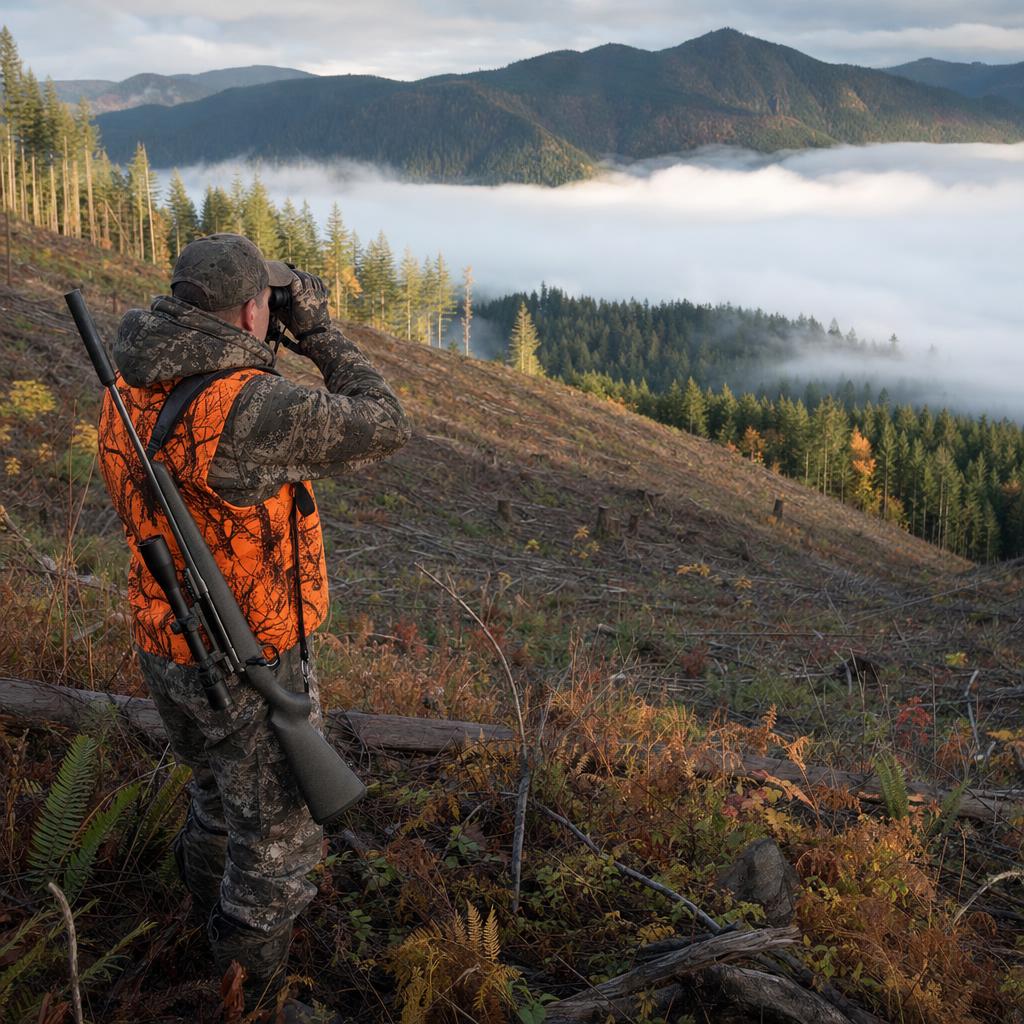
Bears are creatures of edge habitat — work the transition zones where clear-cut meets standing timber. They feed out of the timber in early morning and evening, retreating back to cover midday. Set up on a high point with good glass and cover as much ground as possible before committing to a stalk.
Mast and Berry Areas — Higher Elevation Cascades
Above 3,000 feet in the Cascades, huckleberry fields are the October draw. Units in the Mount Hood, Willamette, and Umpqua National Forests hold good bear populations, and bears key heavily on blue and red huckleberries through October until hard frost collapses the berry crop. After the berries are gone, bears transition to gut piles left by elk hunters — a legitimate and effective scouting technique is to locate elk-hunting camps and glass the surrounding timber margins for bears moving in to feed on gut piles.
Coastal Units
The Oregon Coast Range — particularly units around the Tillamook State Forest, Siuslaw National Forest, and the Elliott State Forest — supports some of the densest bear populations in the state. Black-phase bears dominate here, with occasional brown-phase animals. Access is often via logging roads, and the country is thick — shots under 100 yards are the norm. A shorter, lighter rifle setup is worth considering for this terrain.
Glassing, Scouting, and Spot-and-Stalk
Spot-and-stalk is the most effective strategy for rifle hunters. The standard approach:
- Park at the top of a ridge road or clear-cut overlook at first light
- Set up a quality spotting scope (Vortex Razor HD or similar) and glass systematically across the clear-cut in a grid pattern
- Look for black shapes moving through berry patches or feeding along timber edges — bears often "pop" in the binoculars once you know what movement pattern to look for
- Once a bear is spotted, plan a wind-favorable stalk keeping in mind that bears have exceptional noses. Get the wind right first; everything else is secondary
- Close to within 150 yards or less before shooting — body shots on bears can be deceptive; shot placement matters more than bullet size
Rifle and Cartridge Selection
Bears are tough animals but not difficult to kill with proper shot placement. A well-placed shot from a .243 Winchester will kill a bear cleanly; an inch off on a poorly placed shot from a .338 Winchester Magnum will result in a bad tracking job. Shot placement first, caliber second.
That said, practical recommendations for Oregon black bear:
- .308 Winchester / .30-06 Springfield: The standard — enough power, manageable recoil, widely available ammunition. 150–180 grain controlled-expansion bullets (Nosler Partition, Federal Trophy Bonded Tip, Hornady InterBond) are ideal.
- .270 Winchester: Flat-shooting and effective; 130–140 grain bonded bullets handle bears cleanly
- 6.5 Creedmoor: Excellent choice for the longer shots across clear-cuts; 140 grain bonded bullets provide adequate penetration
- .300 Winchester Magnum: More than enough for any Oregon bear; best reserved for hunters also carrying it for elk
For the thick Coast Range timber where shots are under 75 yards, lever-actions in .30-30 Winchester, .45-70 Government, or .357 Magnum are classic, effective choices that shine in heavy cover.
After the Shot — Recovery and Meat Care
Bear hunting requires mandatory reporting — in Oregon, you must present your harvested bear to an ODFW check station or report it through the MyODFW online system within 10 days. A required pre-molar tooth must be submitted for biological sampling.
Bear meat is excellent table fare when handled properly. Cool the carcass quickly — bear fat insulates well and can cause spoilage if the animal isn't broken down fast. Skin the bear promptly, remove the hindquarters, backstraps, and front shoulders, and get the meat into a cooler or refrigerator within a few hours of the kill, especially in the warmer early October temperatures common in western Oregon. Bear fat renders beautifully for cooking lard. The backstraps make outstanding steaks.
Key Units to Target This Fall
- Tillamook Unit: Coast Range classic — dense timber, high bear density, good road access via Tillamook State Forest roads
- Alsea Unit: Southern Coast Range, underutilized by bear hunters — excellent clear-cut opportunity on BLM ground
- Santiam Unit: Western Cascade foothills — combines well with a deer/elk tag, excellent huckleberry country above 3,500 feet
- Dixon Unit: Upper Rogue drainage — Douglas County's premier bear unit with strong late-season populations
- Klamath Falls Unit: Transition zone bears with good access via Winema National Forest roads
Oregon black bear hunting doesn't require a draw — it's over-the-counter and available to any licensed hunter. If you have a deer or elk tag in western Oregon this fall and haven't been glassing for bears, you're leaving one of the state's most exciting big-game opportunities on the table.