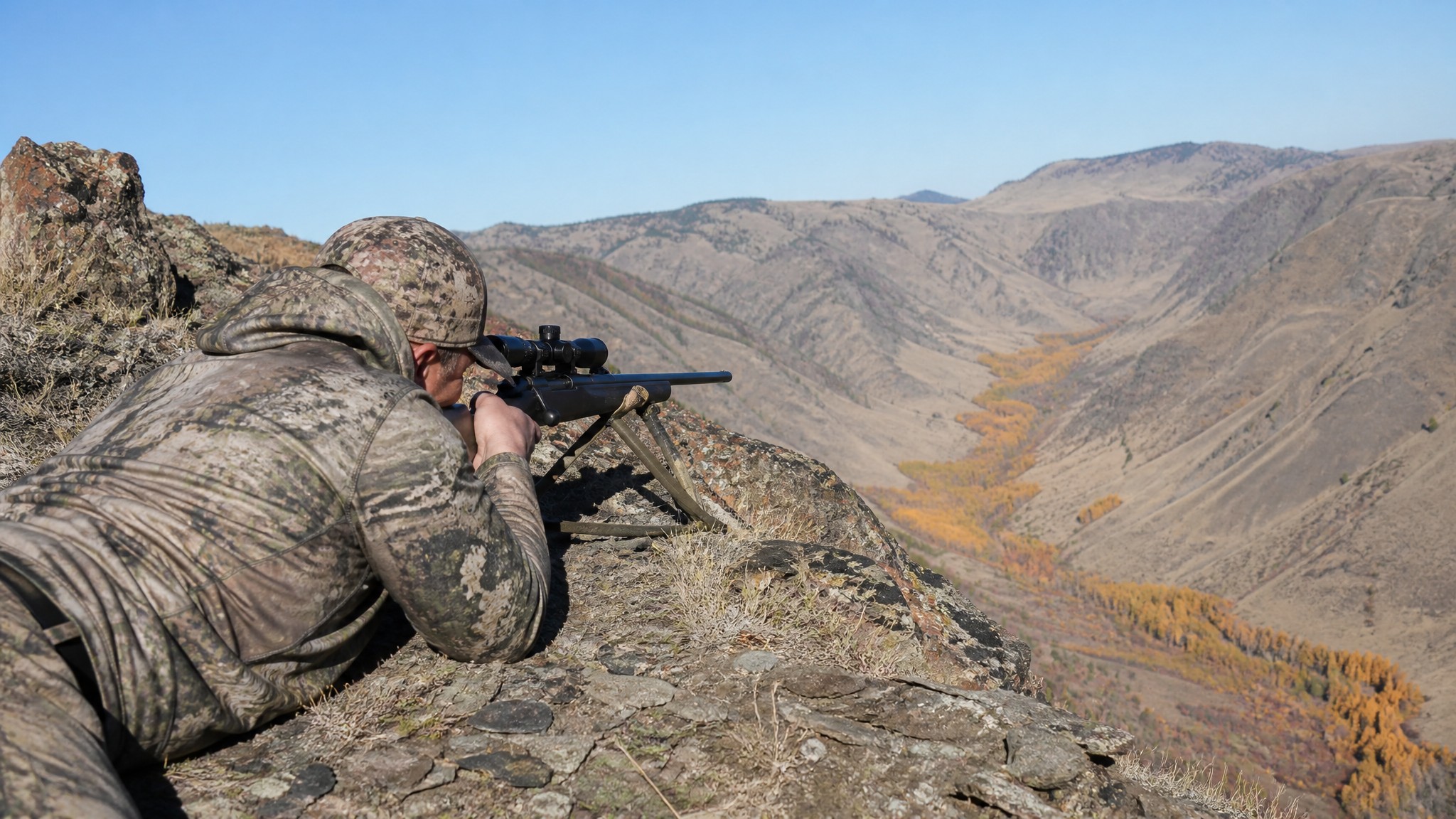
Oregon is steep country. Whether you're hunting mule deer in the Owyhee canyonlands, elk in the Blue Mountains, or blacktail in the Cascades, you will eventually face a shot at a significant angle — either downhill from a ridge, or uphill from a canyon bottom. Miss the physics, and you'll shoot over your animal. It's one of the most consistent, repeatable mistakes hunters make in vertical terrain, and it has a straightforward solution.
Why Angled Shots Hit High
The key concept is this: gravity acts on a bullet based on the horizontal distance to the target, not the line-of-sight distance. When you shoot at a steep angle — whether up or down — the horizontal distance to your target is shorter than what your rangefinder reads. Your rifle is zeroed for a bullet path that accounts for a certain amount of gravitational drop over a given horizontal distance. Shoot steeply uphill or downhill at the same line-of-sight range, and the bullet drops less than expected because it's traveling a shorter horizontal distance. Result: you hit high.
This isn't intuitive. Hunters instinctively feel like uphill shots should hit differently than downhill shots, but the physics are the same — both cause you to overshoot relative to your flat-ground zero.
The Rifleman's Rule
The Rifleman's Rule (also called the cosine rule) gives you a simple field correction. The rule states:
Hold for the horizontal distance, not the line-of-sight distance.
In practice, you multiply your line-of-sight rangefinder distance by the cosine of your shooting angle to get the adjusted distance to hold for. A 400-yard line-of-sight shot at 30 degrees — cosine of 30° is 0.866 — becomes a 346-yard hold. At 45 degrees, a 400-yard shot becomes a 283-yard hold. These are not trivial differences at hunting distances.
Using an Angle-Compensating Rangefinder
Modern laser rangefinders with angle compensation do this math for you. They measure the line-of-sight distance and the angle simultaneously, and display the corrected "shoot-to" distance. This is the most reliable field solution. Brands like Leica, Leupold, Sig Sauer, and Vortex all make rangefinders with this feature. If you're hunting Oregon's steep country regularly, an angle-compensating rangefinder is not optional equipment — it's standard.
When buying, look for units that display both the true distance and the angle-compensated distance, so you can cross-check and understand what the unit is telling you.
Mental Estimation in the Field
When you don't have a compensating rangefinder, or when the shot happens too fast to use one, you need a fast mental correction. A useful rule of thumb: at angles steeper than 30 degrees, subtract 10% from your rangefinder reading for your hold. At angles steeper than 45 degrees, subtract 20 to 25%. This isn't perfectly precise, but it beats shooting uncorrected at a steep target.
Practice estimating angles in the field. A clinometer (often built into hunting apps like OnX) gives you an instant reading. Over time, you'll develop a reliable sense for "this is a 30-degree slope" versus "this is 45 degrees" by feel.
Practical Angle Scenarios in Oregon
Canyon Country Mule Deer
In the Owyhee, Hells Canyon, and John Day canyon systems, shots at 30 to 45 degrees are routine. A buck standing on the opposite canyon wall at 350 line-of-sight yards with a 35-degree angle is really a 287-yard hold. On a rifle zeroed at 200 yards, the difference between holding for 350 and 287 is several inches at the point of impact — likely the difference between a clean hit and a miss or poor shot.
Cascade Elk Country
Steep ridges and creek drainages in the Cascades frequently present downhill shots from a ridge position into a draw below. These angles can exceed 40 degrees in extreme terrain. An elk at 250 line-of-sight yards at a 40-degree downhill angle is effectively a 192-yard hold — a significant difference for a large-caliber rifle that holds flat to 250.
High Desert Ridge Shots
Pronghorn and mule deer in eastern Oregon's open ridge country often present moderate angles of 15 to 20 degrees. At these moderate angles, the correction is small — a 400-yard shot at 15 degrees is 386 yards corrected — but at long range with flat-shooting cartridges, even modest errors compound with wind and mirage. Discipline in applying the correction pays off.
Zeroing and Drop Data for Angled Shooting
If you've built a DOPE chart for your rifle, use it in conjunction with angle-compensated distances. Once you know your corrected hold distance, apply your standard drop data for that distance. A ballistic calculator app — Applied Ballistics, Hornady 4DOF, or the built-in solver on a Kestrel — will incorporate angle into its solution if you input the angle alongside the distance.
At ranges under 300 yards on animals the size of a deer or elk, the angle correction is the primary adjustment needed. Beyond 400 yards in steep terrain, both angle correction and precise ballistic data become critical simultaneously — don't estimate either one.
Shooting Position on Steep Ground
Beyond the ballistic correction, steep terrain challenges your shooting position. Prone shooting downhill naturally causes you to cant your rifle, which shifts point of impact. A bipod set to level the rifle on a steep slope — adjustable-leg bipods like the Atlas or Spartan allow independent leg adjustment — removes much of the cant problem. When prone isn't feasible, use shooting sticks, a pack, or natural rest to build a stable base that keeps the reticle plumb.
Uphill shots from a sitting position require bending forward at the waist and bringing the muzzle up rather than raising the rear of the rifle — maintain your cheek weld and natural position as much as possible.
Put It Into Practice
The only way to internalize angled shooting corrections is to practice them. Set up targets on actual slopes at your range, use your rangefinder with angle compensation, and shoot at a variety of angles and distances. You'll quickly feel the difference between an uncorrected and corrected hold in a way that no amount of reading can replicate.
Oregon's mountains reward hunters who do the homework. Miss the angle correction, and a perfectly placed stalk ends with a clean miss. Get it right, and steep country stops being a challenge and starts being an advantage — because the hunters who skipped the physics lesson will keep shooting over their animals on the next ridge over.