Ask an Oregon upland hunter about quail and you're likely to get a blank stare. Most of the hunting press gravitates toward pheasant in the northeast or chukar on the canyon walls of the Snake River country. But tucked into the warm, brushy valleys of southwest Oregon, California quail exist in numbers that would surprise you — and they offer some of the most accessible, beginner-friendly bird hunting in the state.
Where California Quail Live in Oregon
The California quail's range in Oregon is largely defined by the Siskiyou Mountains' rain shadow. These birds need mild winters and brushy, shrubby habitat. You'll find the highest densities in:
- Umpqua Valley (Douglas County): The bottomlands and creek drainages between Roseburg and Myrtle Creek hold excellent populations. Brushy pasture edges, riparian blackberry tangles, and vineyard margins are prime spots.
- Rogue Valley (Jackson County): The area around Medford, Ashland, and the Applegate River drainage has strong numbers. Oak savanna with adjacent brush is classic habitat.
- Josephine County: The Illinois Valley and land around Cave Junction hold birds that see minimal pressure. Public land adjacent to BLM-managed oak and mixed shrub habitat is worth exploring.
- Coos and Curry Counties: The coastal interior valleys, particularly east of Coos Bay, support quail in brushy terrain between ridges.
Reading Quail Habitat
California quail are creatures of edge habitat. They need a few things within close proximity: dense brush for escape and loafing cover, open ground for feeding, water, and elevated perches for lookouts (usually fence posts or brush tops). Find all four elements in one area and you've found quail country.
In the Umpqua and Rogue drainages, creek bottoms with blackberry, wild rose, and toyon shrubs adjacent to open grass or agricultural land are gold. In September, coveys — sometimes 20 to 50 birds — move out of heavy cover in early morning and evening to feed. Midday, they're buried in the thickest brush they can find.
OnX Hunt is useful here. Look for the interface between brushy draws and open pasture on private land. Then start knocking on doors — quail country in Douglas and Jackson counties is predominantly private, and most landowners respond well to polite, professional hunting requests, especially if you offer to leave the gate as you found it and share a few birds.
Oregon Regulations Overview
The California quail season in Oregon typically opens in early September and runs through January. The daily bag limit is 10 birds, with a 20-bird possession limit. No quail-specific tags or permits are required beyond a valid Oregon hunting license. Check the current ODFW upland bird regulations for exact season dates and any zone-specific rules before you go — regulations can shift slightly year to year.
Dogs, Guns, and Shells
Dogs
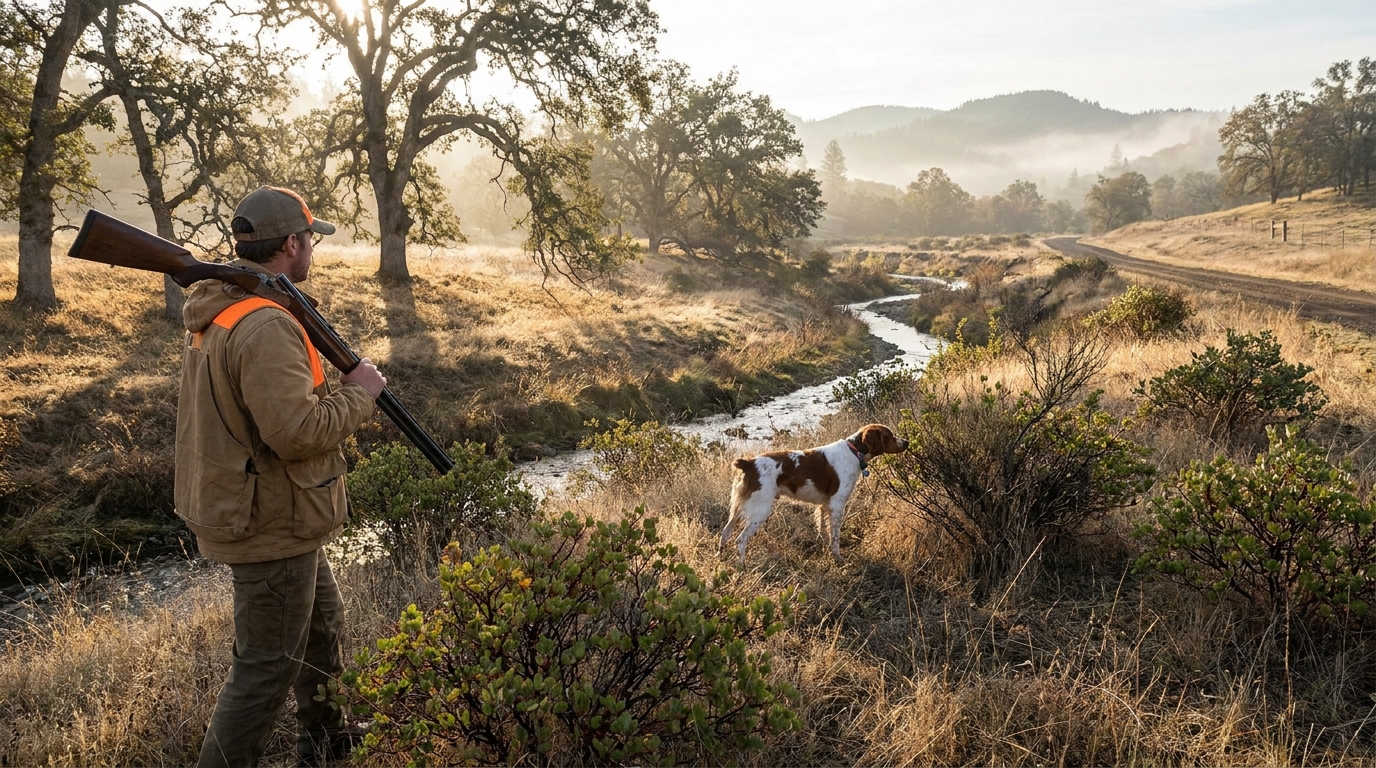
A pointing dog — a Brittany, German Shorthair, or English Setter — is the most effective tool for hunting California quail, but it's not mandatory. These birds hold surprisingly well when a dog is working them, often sitting tight until the pointer is inches away. Flushing dogs work too, but you'll push birds before you're in range more often without the advantage of a solid point.
A dog with good nose and steady manners makes a huge difference in dense blackberry tangles where finding downed birds without a retriever is genuinely difficult. Train your dog in heavy cover before the opener — don't expect a field trial dog to punch through Oregon blackberries without some conditioning.
Shotguns and Loads
California quail are not big birds. A 20-gauge is entirely adequate and significantly more pleasant to carry through thick brush for hours. A 12-gauge works fine. Over points in tight cover, an improved cylinder or skeet choke is right. Birds flushing wild in open country warrant a modified choke.
Shot selection: 7½ or 8 shot in standard or light loads. You're shooting a 6-ounce bird at typically 15–30 yards — you don't need magnums. Lead, steel, or bismuth all work. A 1-ounce load of 7½ shot at 1,200 fps is a classic quail round that won't batter your shoulder on a long day.
September Hunting Tactics
Early season quail are still in family groups — the paired adults and their summer brood together as a covey. In September, finding one bird often means the whole covey is nearby. When a covey flushes, mark where birds land and give them 10–15 minutes to settle before following up. Single birds after a covey break hold tighter than any other upland bird in Oregon.
Hunt the first two hours of daylight and the last 90 minutes before sunset. Birds will be moving between roost cover and feeding areas during those windows. Midday, focus on water sources — quail in warm, dry country need to drink daily, and they'll be found near stock tanks, creeks, and springs during the heat of the day.
Walk slowly. Push through the brush rather than around it. California quail would rather run than fly, and a bird that runs 50 yards ahead of you and crouches in a blackberry clump has beaten you for the day unless a dog pins it.
Cleaning and Cooking
Breast California quail in the field if you're a long way from home — they're small enough that breast-and-thigh is the practical approach. The breast meat is mild, slightly darker than domestic chicken, and excellent pan-fried in butter with garlic or wrapped in bacon and grilled. A limit of 10 birds for two hunters is a genuinely fine table meal, and that makes every bird count.
If you've been sleeping on California quail in Oregon, September is the wake-up call. Low overhead, no draw required, excellent table fare, and bird numbers that reward early-season exploration. Load your 20-gauge, find the brushy creek bottoms, and go introduce yourself to Oregon's most underappreciated upland bird.