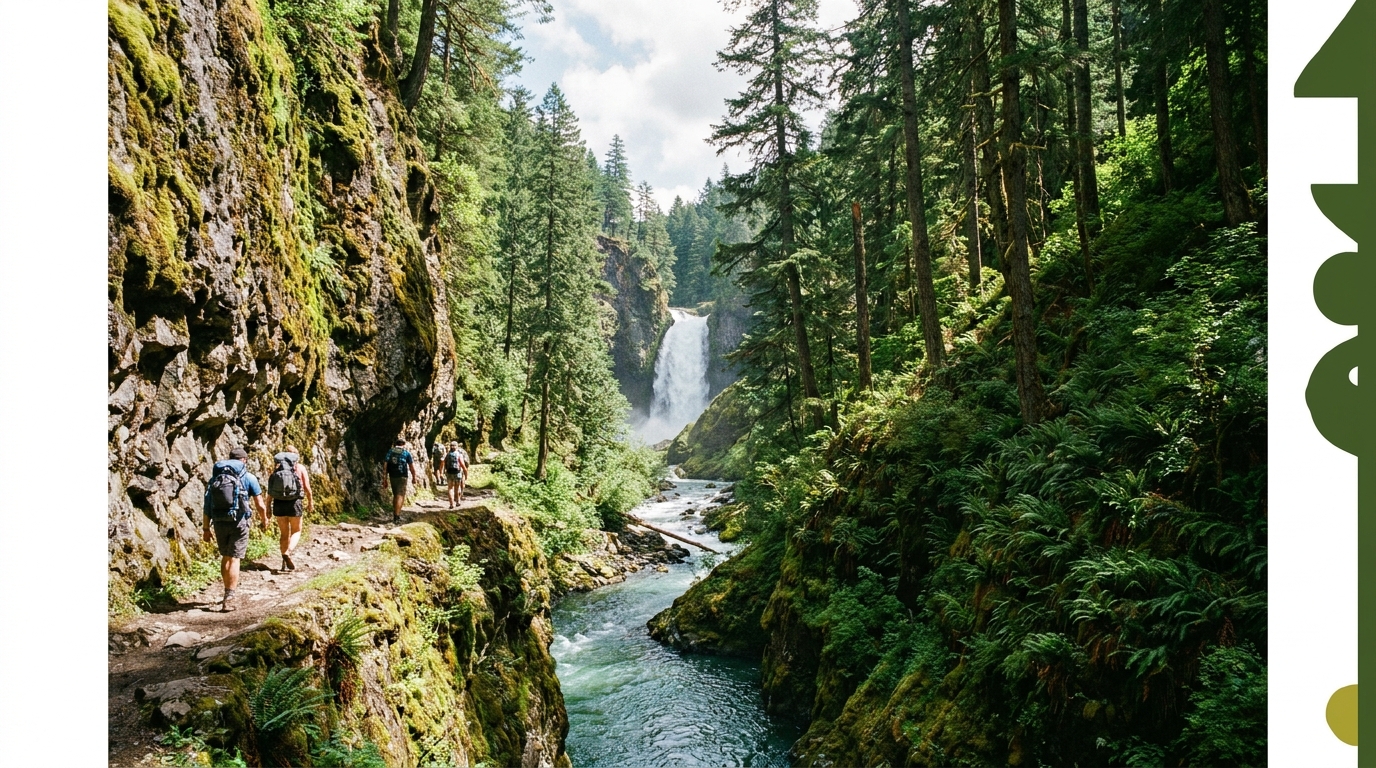
The Eagle Creek Trail is one of the most spectacular hikes in the Pacific Northwest — a narrow path blasted and carved into the basalt walls of a deep Columbia River Gorge canyon, passing seven named waterfalls, threading through tunnels in the rock, and climbing through some of the most dramatic old-growth forest in Oregon. If you only do one backpacking trip in the Columbia Gorge, this is the one. But it deserves more than a day trip — and most of the tourists turn around at Punch Bowl Falls. The real Eagle Creek experience begins where the crowds stop.
The Route: Overview
Total distance: 13.5 miles one way to Wahtum Lake (26+ miles round trip, or shuttle to Wahtum)
Elevation gain: 3,700 feet from trailhead to Wahtum Lake
Trailhead: Eagle Creek Trailhead, off Interstate 84 at Exit 41 near Cascade Locks, Oregon
Permits: A recreation pass is required (Northwest Forest Pass or equivalent). Check for current conditions and permits at fs.usda.gov — sections of trail may have seasonal restrictions following the 2017 Eagle Creek Fire
Season: June through October (higher elevations may hold snow into early July)
Day One: Trailhead to High Camp (7 miles)
Start early — the Eagle Creek parking area fills by 9 AM on summer weekends. The first 4 miles to Punch Bowl Falls and Loowit Falls represent the most trafficked section of trail and are worth hiking through quickly on weekday or early-morning timing. The trail here clings to the canyon wall, sometimes with a cable hand-line bolted into the basalt above a sheer 100-foot drop. It's exposed but not technically difficult — watch your footing and enjoy the views down into the turquoise-green creek.
After Tunnel Falls (mile 6, where the trail passes behind a 150-foot waterfall through a carved tunnel — genuinely one of the most remarkable moments in Oregon hiking), the crowds disappear almost entirely. Camp is available at 7.5 Mile Camp, a flat, established site above the creek with reliable water and room for three or four tents. This is an excellent first-night stop, particularly for parties hiking in on a Saturday afternoon.
Key Waterfalls: Know What You're Passing
- Metlako Falls (mile 1.5): A short side trail leads to a viewpoint above this 100-foot plunge fall. Best photographed in morning light.
- Punch Bowl Falls (mile 2.2): The most photographed feature on the trail — a 30-foot waterfall dropping into a circular basalt bowl with stunning aquamarine water. Crowds here are heavy on weekends.
- Loowit Falls (mile 3.8): A slender, high-volume ribbon fall visible from the trail across the canyon.
- High Bridge (mile 3.3): A single-plank footbridge crossing the gorge 100 feet above the creek. Stop and look down.
- Tunnel Falls (mile 6.0): The showstopper. The trail passes behind a 150-foot falls through a hand-carved tunnel — you walk 20 feet behind the falls with mist pouring over the entrance. Bring a rain jacket.
- Twister Falls (mile 6.2): Just past Tunnel Falls, a 40-foot twisted plunge falls that most day hikers never see.
Day Two: High Camp to Wahtum Lake (6.5 miles)
From 7.5 Mile Camp, the trail continues climbing out of the canyon. The character changes above mile 8 — old-growth Douglas fir and western red cedar give way to younger forest (recovering from the 2017 fire in sections) and eventually to open high-country terrain approaching Wahtum Lake. The final 2 miles gain elevation steadily through a mix of recovery forest and intact old growth that survived at higher elevation.
Wahtum Lake sits at 3,732 feet in a volcanic cirque, surrounded by basalt walls and recovering fire-scarred forest. It's a quiet, moody lake with good campsites along the northeast shore and reliable water. The Pacific Crest Trail crosses here — you're now officially on the PCT, which adds a satisfying continuity to the trip.
Fishing at Wahtum Lake can be productive for stocked rainbow trout. Bring a lightweight ultralight rod if you're so inclined — it's a legitimate reason to linger an extra night.
The Shuttle Option
Eagle Creek to Wahtum Lake makes a superb one-way shuttle with a vehicle left at Wahtum Lake Road (Forest Road 1310, accessible from Hood River Valley). The drive between the two trailheads takes about 50 minutes on paved and gravel forest roads. A one-way trip of 13.5 miles over two days is the classic way to do this trail without repeating terrain on the return.
Gear Notes for Eagle Creek
- Rain gear is non-negotiable: The Columbia Gorge creates its own microclimate — cold, wet, and windy conditions can occur any month. Bring a quality hardshell even in July.
- Trekking poles: The canyon walls and cable-line sections are manageable without them, but poles add confidence on the exposed traverse sections with a loaded pack.
- Bear canister or hang system: Bears are active in the Gorge. Use proper food storage — the established camps have bear hang infrastructure but it's unreliable.
- Water filter: Eagle Creek runs clean but treat all water. A lightweight filter (Sawyer Squeeze or similar) is sufficient.
- Headlamp: The Tunnel Falls section is dim even at midday — you'll want a headlamp for the dark zone behind the falls.
Fire Recovery and Current Conditions
The 2017 Eagle Creek Fire burned a significant portion of the upper canyon and high-country sections of this trail. As of 2026, trail conditions are continuously improving — the Forest Service has worked hard to reopen and rehabilitate the route, but some sections require detours or have reduced infrastructure. Check current conditions at the Columbia River Gorge National Scenic Area website before your trip (fs.usda.gov/crgnsa). Some campsites remain closed while hazard trees are removed.
The recovering forest, while visually different from a mature old-growth canyon, has its own raw beauty — standing silver snags against green recovery brush, wildflowers blooming in the opened canopy, and the canyon itself as dramatic as ever. The falls don't care about fire recovery. Tunnel Falls is still one of the most extraordinary moments in Oregon outdoor recreation.
Eagle Creek delivers experiences that other trails simply can't match: a trail blasted into a vertical basalt wall, a waterfall you walk behind through a carved tunnel, and a canyon so steep and green it feels like it belongs in another country. It earns every step.