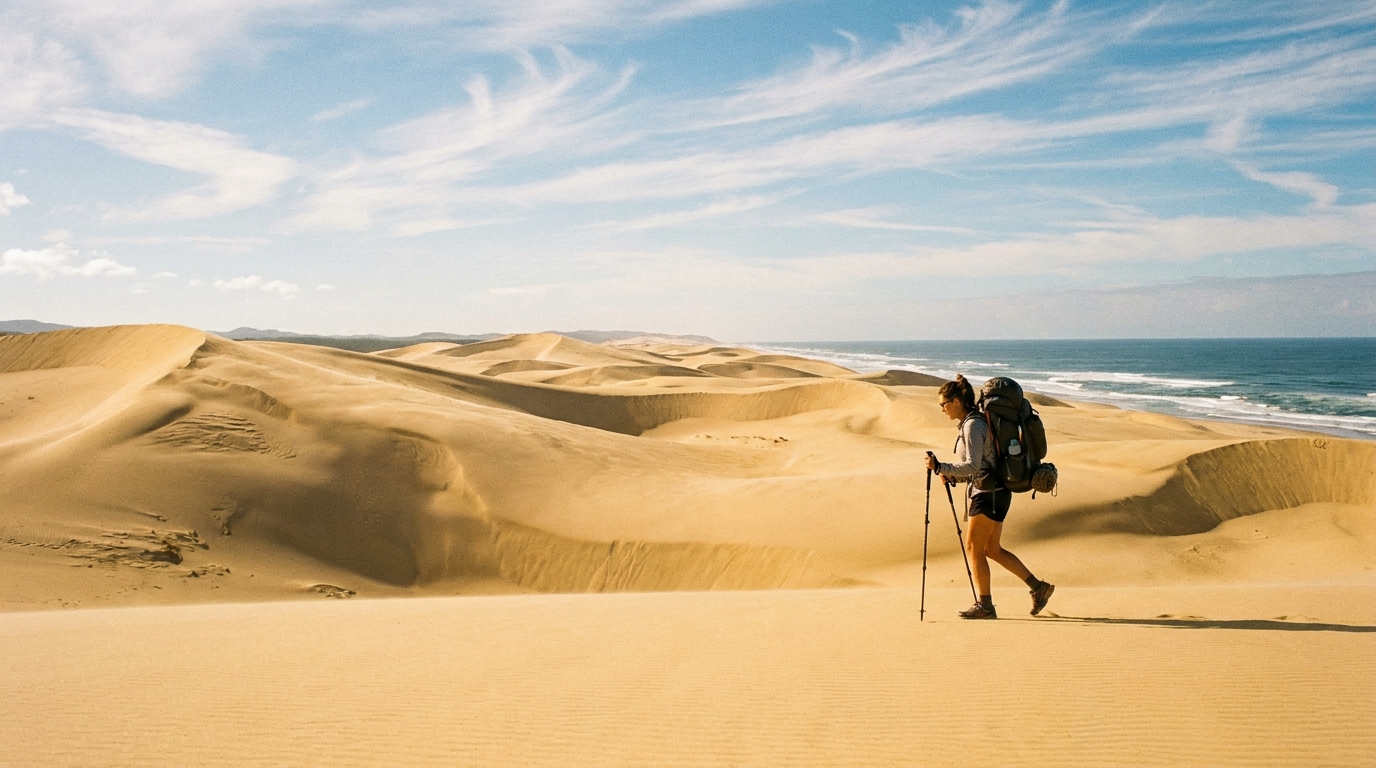
Most Oregon backpackers think in terms of mountains, old-growth forest, and volcanic plateaus. The Oregon Dunes National Recreation Area offers something entirely different: forty miles of active coastal sand dunes running from Florence south to North Bend, with formations reaching 500 feet in height and a landscape that shifts year to year with the wind. Hiking across the open dunes in summer feels closer to the Sahara than to the Cascades — and that disorienting quality is part of what makes it one of the most memorable overnight destinations in the state.
Overview
The Oregon Dunes NRA is managed by the Siuslaw National Forest and encompasses approximately 31,500 acres of dune formations, deflation plains, tree islands, freshwater lakes, and Pacific Ocean beach. The area is divided into motorized (OHV) and non-motorized sections — understanding this boundary is critical before you plan any overnight trip, because you'll want to camp in the designated non-motorized areas away from ATV traffic.
The northern non-motorized section, from the Siuslaw River estuary south to Threemile Lake, offers the best backpacking terrain. This stretch includes the Umpqua Dunes, the Tahkenitch Dune, and access to Threemile Lake — a freshwater lake perched behind the foredunes that offers permitted overnight camping.
Key Trails and Routes
Umpqua Dunes Trail
The premier open-dune hiking experience in the NRA. Starting from the Umpqua Dunes Trailhead on Eel Creek Road (off US-101 north of Reedsport), this route drops you quickly into the biggest open sand formations in the complex — dunes reaching 300 to 400 feet. There are no marked trails across the open sand; navigation is by compass bearing and natural landmarks (tree island clusters, the sound and direction of the ocean, the visible ridgeline of the foredunes). The Umpqua Dunes area is non-motorized. A cross-dune route to the beach and back covers roughly 5 miles round trip with significant elevation gain in the sand — more work than the mileage suggests.
Tahkenitch Dune and Creek Trail
Starting from the Tahkenitch Campground area north of Reedsport, this trail system connects the campground to open dune terrain and Tahkenitch Lake. The Tahkenitch Dune Trail is a 4.5-mile loop that includes a stretch of open dune walking with excellent views. Strong hikers can combine this with a cross-dune push to the beach for a full-day route.
Threemile Lake Route
This is the backpacking destination in the Dunes. Threemile Lake lies immediately behind the foredunes, accessible by a cross-dune route from the Eel Creek Campground area or from the beach. The lake has a handful of dispersed camp sites managed by the Siuslaw NF — check current permit requirements at the Reedsport USFS office or Recreation.gov before your trip, as permit requirements have expanded in recent seasons. The lake itself holds wild cutthroat trout and is worth packing a fishing rod for. Camp back from the water, use a Leave No Trace approach for waste management (pack it out in the dunes — there's no burying in sand), and expect wind.
Navigation in the Open Dunes
This is not the Cascades. The open dune landscape has no maintained trails, no blazes, and the terrain changes between visits. GPS waypoints drift when sand formations shift. The key skills for dune navigation:
- Know your compass bearing to the ocean: The Pacific is always west. When in doubt, head west to the beach, then navigate north or south along the beach to your exit.
- Use tree islands as landmarks: Isolated tree clusters anchor fixed points in the dune landscape. Note their position relative to your route before crossing open sand.
- Mark your trailhead GPS waypoint: Save your vehicle location before you leave the parking area. In overcast conditions the dunes look identical in every direction.
- Travel in pairs minimum: Solo navigation in the open dunes creates unnecessary risk. A turned ankle or disorientation in fog is manageable with a partner; alone it becomes serious.
Water and Wildlife
Water is the critical challenge in dune camping. There is no reliable water source in the open dunes themselves — deflation plain ponds exist but are often brackish or contaminated with animal waste. Carry all water from your trailhead, plan on a minimum 3 liters per person per day in summer heat, and filter any lake water you collect at Threemile or other freshwater lakes.
Wildlife in the Dunes NRA is surprisingly diverse. Roosevelt elk frequently move through the tree islands and deflation plains, especially at dawn and dusk. Blacktail deer browse the edges of the forested margins. The threatened Western Snowy Plover nests on the foredune and beach areas from March through September — honor all posted closure areas, keep dogs leashed, and give nesting birds wide berth. Brown pelicans, bald eagles, and osprey work the lake and river margins.
Weather and Timing
July and August are the optimal months for dune backpacking. The marine layer that blankets the coast from April through June typically burns off by midday in summer, leaving afternoons sunny and warm. Expect morning fog until 10 or 11 AM. Wind is constant in the dunes — afternoon westerlies regularly hit 15 to 25 mph on the open sand, which makes navigation challenging and tent setup critical. Stake everything and carry extra stakes.
Spring and fall visits are possible but the fog can persist all day, temperatures drop significantly, and the psychological challenge of navigating fog-covered identical dunes is real. Winter storms reshape the dune formations dramatically — impressive to see, miserable to camp in.
Getting There and Permits
The Reedsport and Florence Ranger District offices on US-101 are your primary information sources. The main trailhead access roads off US-101 are well-signed. Parking at most trailheads is either free or requires a Northwest Forest Pass ($5/day or $30 annual). For Threemile Lake overnight camping, contact the Reedsport Ranger District at (541) 271-6000 or check Recreation.gov for current permit status and availability.
The Bottom Line
The Oregon Dunes are not a destination you hike to relax in the shade. It's hot, windy, physically demanding sand-slog hiking with no shade and a navigation puzzle every time you leave a marked trail. It's also extraordinary — a coastal wilderness unlike anything else in the Pacific Northwest, where the landscape looks like another planet and the solitude is absolute once you're a mile into the open sand. Pack your compass, carry extra water, and go find it.