Most Mount Hood backpackers go straight to Timberline Lodge and join the crowds grinding the iconic Timberline Trail. There's nothing wrong with that—it's a world-class route—but it's become busy enough in July and August that solitude is hard to find. Cathedral Ridge to Elk Meadows takes a different approach: a steep northeast-side approach through old growth and subalpine forest that earns you one of the finest wildflower meadows in the Oregon Cascades with a fraction of the traffic. This is the Mount Hood overnight that rewards people who don't want to share their campsite with fifteen other tents.
Route Overview
The Cathedral Ridge Trail (Trail #600) begins at the Ramona Falls Trailhead on Lolo Pass Road (Forest Road 1825), roughly 40 miles from Portland. From the trailhead, you have options depending on how you want to configure the route. The most straightforward approach follows the Sandy River Trail (#770) briefly before cutting up the Cathedral Ridge Trail, which climbs aggressively through old-growth Douglas fir and silver fir before emerging into the subalpine zone and eventually reaching the Elk Meadows loop trail system at around 4,750 feet.
Total distance for an out-and-back overnight: approximately 10–11 miles round trip. The elevation gain from the trailhead is roughly 2,700 feet, with the steepest climbing on the Cathedral Ridge Trail itself between 3,500 and 4,500 feet. Plan 4–5 hours on the way in with a loaded pack, and 3–3.5 hours on the return.
A longer option combines Cathedral Ridge with a section of the Timberline Trail for a loop, exiting at the Top Spur trailhead or Ramona Falls—but for a focused two-day overnight focused on Elk Meadows, out-and-back keeps things clean.
Elk Meadows
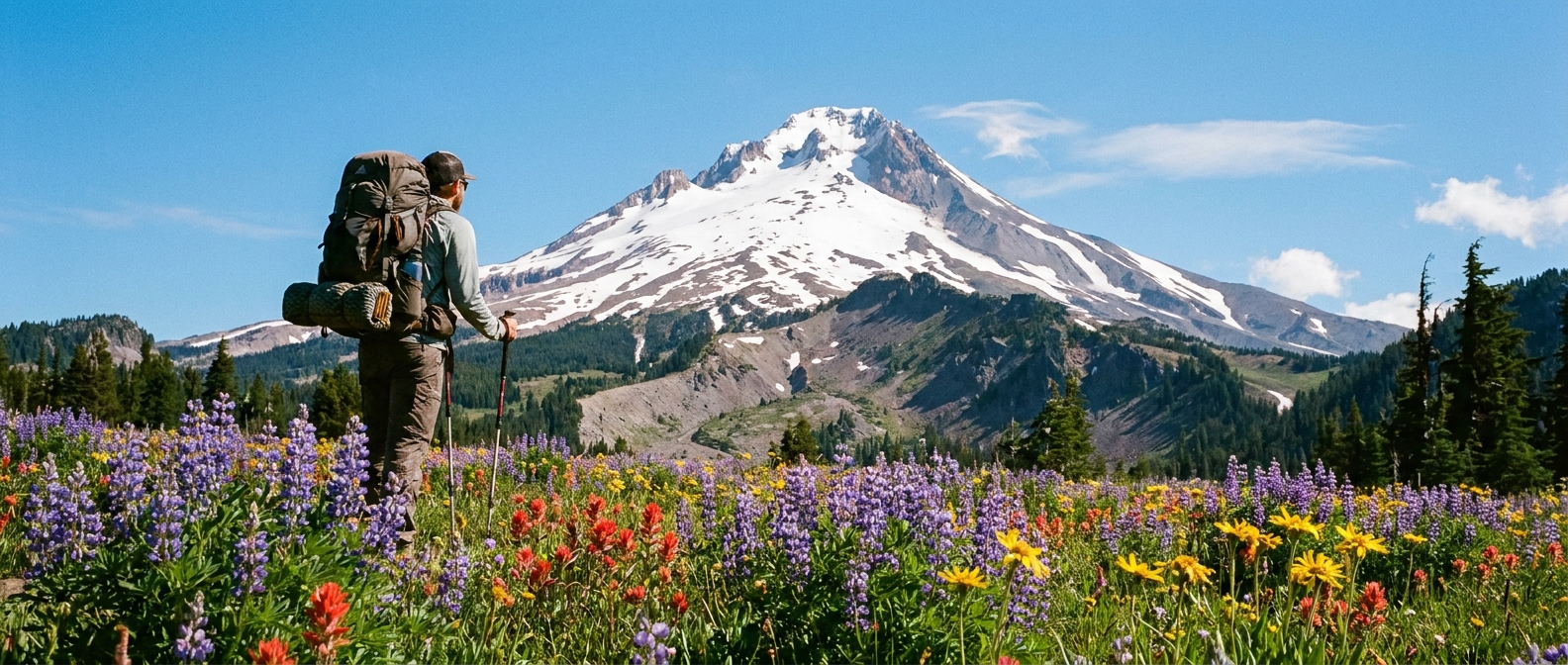
The meadows themselves sit at the northeast flank of Mount Hood, surrounded by a horseshoe of subalpine forest with the mountain's upper ridgelines rising directly above. In July, the wildflower display is exceptional—lupine, paintbrush, bistort, and avalanche lilies typically peak between the second and fourth weeks of the month depending on snowpack year. Mount Hood's summit and the serrated glaciated north face fill the western skyline from every point in the meadow loop, providing one of the best unobstructed mountain views anywhere in the Oregon Cascades at day-hiking altitude.
The Elk Meadows loop trail (about 1.5 miles) circles the perimeter of the meadows and connects to the Timberline Trail junction at the western end. A spur trail leads to Elk Meadows Shelter, a three-sided wooden structure that provides emergency wind and rain protection but is not intended for primary camping use. Designated camping exists in the trees east of the meadow; camp only in established sites or on durable forest surfaces well away from the meadow edge. The meadows themselves are fragile and take years to recover from trampling.
July Conditions
By mid-July in most years, the Cathedral Ridge Trail is fully snow-free below 5,000 feet, though late snowpack years can leave patches on the upper switchbacks through late July. Carry microspikes if you're going in before July 20 and check the Mount Hood National Forest conditions reports at recreation.gov or call the Hood River Ranger District (541-352-6002) for current trail status.
Water is reliable from Ladd Creek near the trailhead and from several small streams on the upper ridge approach. Treat all water—giardia is present throughout the Oregon Cascades. The meadow area itself dries out by late July, so fill up before leaving the last reliable stream at around 4,400 feet elevation.
Expect temperatures at Elk Meadows in July ranging from mid-30s°F at night to upper 60s°F during the day. July is also when afternoon thunderstorms build over Mount Hood with regularity—plan to be in camp or under tree cover by 2:00 p.m. and watch the sky. Lightning is a genuine hazard in an open meadow at 4,700 feet.
Permits and Regulations
The Ramona Falls Trailhead requires a Northwest Forest Pass for day-use parking ($5/day or $30/annual). Overnight camping in the Mount Hood Wilderness requires a free self-issue wilderness permit, available at the trailhead registration box. Campfires are prohibited above 3,500 feet elevation in the Mount Hood Wilderness; a backpacking stove is mandatory for cooking. Hang or canister-store all food and scented items—black bears are present and active in this area throughout the summer.
What to Carry
- Lightweight tent or bivy rated for 25°F minimum (cold nights even in July)
- 30°F sleeping bag or quilt with a liner for shoulder-season conditions
- Rain gear—afternoon storms are common even in peak summer
- Microspikes for pre-July 20 trips or late-snowpack years
- Water filter and 2-liter minimum carrying capacity
- Trekking poles for the steep descent on Cathedral Ridge—your knees will appreciate them
- Bear canister or hang kit (50 feet of paracord and a stuff sack)
- Wildflower identification guide — the Elk Meadows display rewards knowing what you're looking at
Wildlife
The northeast side of Mount Hood is excellent wildlife country. Black bears are regularly seen near the meadow in July and August, feeding on the lush vegetation before berry season starts. Clark's nutcrackers, gray jays, and Steller's jays are constant camp companions. Mountain goats—native residents of Hood's upper ridgelines—are occasionally visible from the meadow with binoculars scanning the rocky slopes above. Elk themselves are present in the area during the summer, though they typically move higher onto the mountain by the time day hikers arrive.
Making the Most of the Trip
Camp the first night at Elk Meadows, set your alarm for 30 minutes before sunrise, and walk to the meadow edge. The pre-dawn alpenglow on Mount Hood's north face—pink to orange to gold with the glaciers reflecting everything—is among the finest mountain light shows in the Pacific Northwest. You'll have the meadows completely to yourself at that hour, the air is cold and still, and the views are as good as anything Oregon has to offer without a helicopter.
Bring a small tripod and a wide-angle lens if you shoot. You'll want the documentation.